
Scope 1 and 2 for a 50–250-Person Company: A One-Afternoon Calculation (Including Leased Buildings)
Short answer
To calculate Scope 1 and 2 emissions:
- Decide which operations you control and fix the reporting year.
- Collect a full year of fuel, refrigerant and purchased-energy quantities (kWh, m³, litres), not euros.
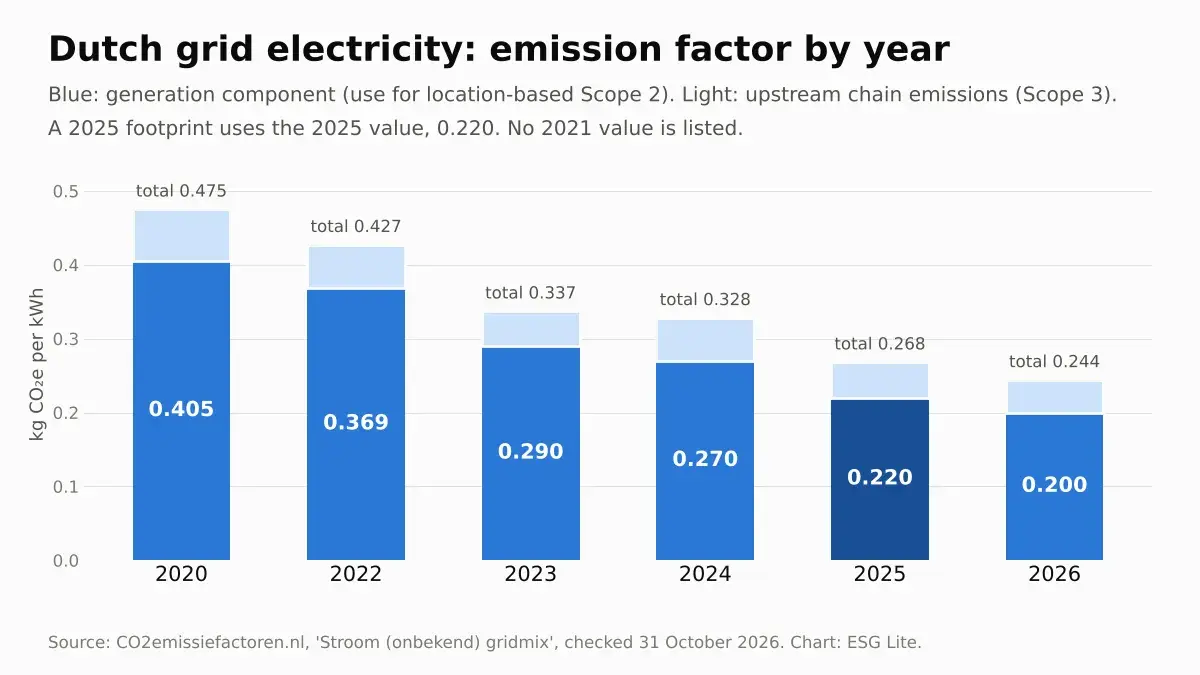
- Multiply each quantity by the right emission factor: the combustion (TTW) factor for Scope 1 fuels and the grid generation factor for location-based Scope 2. For a Dutch 2025 footprint that is 1.779 kg CO₂e per m³ of natural gas, 2.462 per litre of diesel B7 and 0.220 per kWh of grid electricity.
- Divide kg by 1,000 to report tonnes.
If you rent your premises, the energy you use there usually belongs in your Scope 1 and 2 under operational control, even when the landlord pays the bill.
The arithmetic is easy. The judgement calls are what take time: which buildings count, what to do when the rent includes energy, and which column of the Dutch factor table to use. This guide answers each one and ends with the three figures a customer or bank asks for under disclosure B3 of the EU Voluntary Standard (formerly VSME).
Plan one afternoon once the records are in. If the landlord's data or fleet records are missing, use the afternoon to build a documented estimate and a list of what is still outstanding.
What you will have at the end
Output | Unit | Inside the EU value chain cap? |
|---|---|---|
Total energy consumption | MWh | Yes |
Gross Scope 1 emissions | tCO₂e | Yes |
Gross location-based Scope 2 emissions | tCO₂e | Yes |
Renewable / non-renewable split of energy | MWh | No (report it only if you can get the data) |
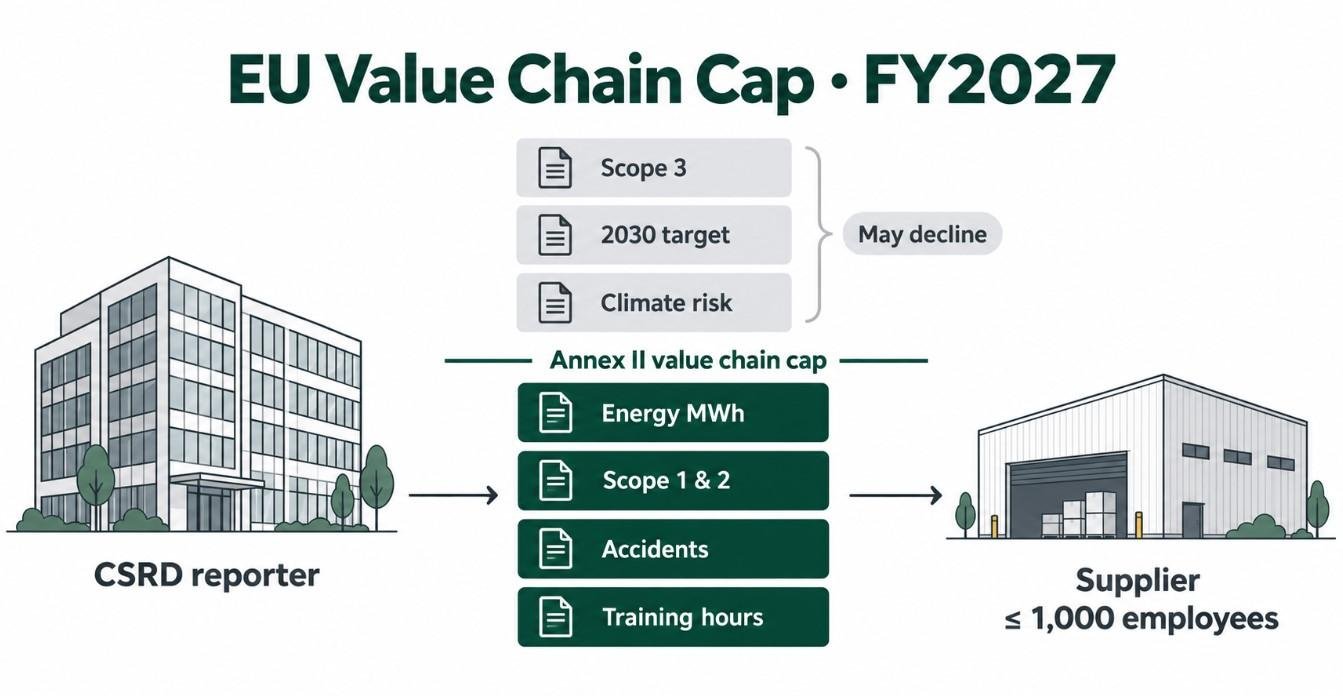
The first three are what a large customer reporting under the CSRD can require from a supplier with up to 1,000 employees from financial year 2027. Annex II of Commission Delegated Regulation (EU) 2026/1560 lists B3 paragraph 32 (first sentence, total energy) and paragraph 33 (gross GHG emissions). The renewable split in paragraph 32 applies only "if it can obtain the necessary information", and B3 is voluntary for companies with 10 or fewer employees. Read our value chain cap explainer for the full list.
VSME or VS? Many questionnaires still say "VSME B3". The 2026 Voluntary Standard keeps total energy, Scope 1 and location-based Scope 2, but drops the emissions-per-turnover intensity metric that the 2025 VSME Recommendation included. Check which version your customer or bank uses before you send numbers.
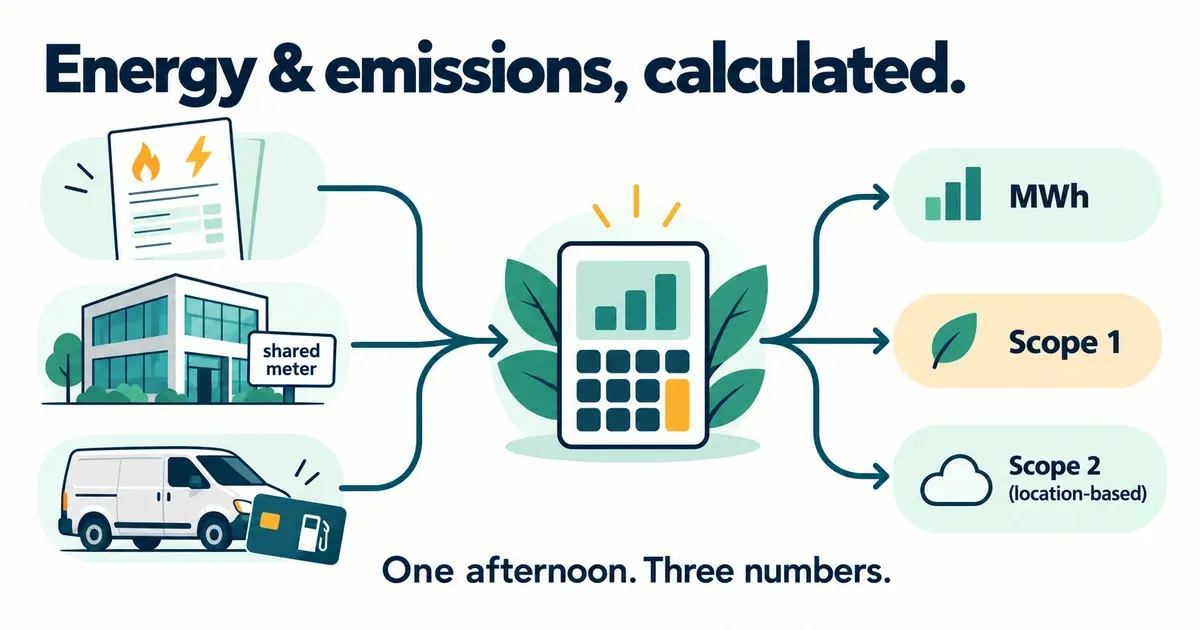
Utility statements, a rented office and a company van feeding into three results: total energy in MWh, Scope 1 and location-based Scope 2 emissions.
Step 1: Know what goes in Scope 1 and Scope 2
Under the GHG Protocol, Scope 1 is direct emissions from sources you own or control. Scope 2 is emissions from generating the electricity, heat, steam or cooling you buy and use.
Activity | Scope (operational control) | Records |
|---|---|---|
Gas burned in a boiler you control | Scope 1 | Gas statement, meter readings |
Fuel in vehicles you control, including leased vans | Scope 1 | Fuel-card exports, vehicle list |
Fuel in generators or site equipment | Scope 1 | Purchases, stock records |
Refrigerant leaking from equipment you control | Scope 1 | Service logs, top-up records |
Electricity you buy and use | Scope 2 | Invoices, meters, landlord allocation |
Heat, steam or cooling you buy | Scope 2 | Supplier or landlord statement |
Commuting, business flights, subcontractors' fuel and the upstream emissions of your fuels sit in Scope 3, not here. A Scope 1 and 2 inventory is not your full carbon footprint, so don't label it as one.
Refrigerants: the Scope 1 source most SMEs miss
Refrigerant is not energy, but leaks count in Scope 1:
tCO₂e = kg of refrigerant released × its global warming potential (GWP) ÷ 1,000
Use the actual refrigerant and note the GWP source. A unit's full charge is not its annual leak. Check service, top-up, installation and disposal records (US EPA method). Missing records are not evidence of zero.
Step 2: Set the boundary before you calculate
Write down four things first:
- The legal entity, and any subsidiaries included.
- The reporting period, for example 1 January to 31 December 2025.
- The consolidation approach. This guide uses operational control: you include an operation if you can introduce and implement its operating policies.
- The sites, vehicles and equipment included, with a reason for any significant exclusion.
Use one approach for everything. Switching approach per asset to get a lower total is the fastest way to lose a customer's trust.
Rented premises are usually in your boundary
Renting does not move a building's emissions into Scope 3. The GHG Protocol's guidance on leased assets says that under operational control "all leases confer operational control to the lessee or tenants, unless otherwise noted", and energy bought from another entity is reported in Scope 2. Under the equity-share or financial-control approaches, a tenant on an operating lease reports it in Scope 3 instead.
In practice, under operational control:
- Electricity you get through the landlord is Scope 2.
- Gas burned in a boiler you control is Scope 1.
- Heat from a central boiler the landlord runs is purchased heat, so Scope 2, not your Scope 1.
Your clients' buildings are not your buildings
This is the most common error in facility services. A cleaning or maintenance contract does not bring the client's building into your inventory.
- Cleaning, routine maintenance: exclude the client's building energy.
- An operation you fully manage and control under contract: assess it, and document the decision.
- Your own vans and tools at the client site: always yours, counted separately.
"Managed by us" and "inside our boundary" are different questions.
Step 3: Collect quantities, not euros
Input | Unit | Where to look first |
|---|---|---|
Electricity, including fleet charging on your meter | kWh | Annual statement, meter export, charge-point report |
Natural gas | m³ | Annual gas statement |
Vehicle and equipment fuel | litres by fuel type | Fuel cards, receipts, tank records |
Purchased heat or cooling | GJ or kWh | Heat supplier or landlord statement |
Refrigerant losses | kg by gas | Service contractor logs |
Use consumption the reporting period. Monthly advance payments, invoice dates and fuel purchases don't always match it; check opening and closing stock where you store fuel.
No own meter? Use this order of evidence
- A tenant meter or submeter reading.
- The landlord's allocation, backed by building meter readings.
- Your own documented estimate.
A service-cost amount in euros is not a kWh figure: it mixes taxes, fixed charges and tariffs. Ask the landlord for:
- the energy carrier, units and exact period;
- building totals and any tenant readings;
- the allocation method and your share;
- how common areas, vacancies and different opening hours are treated;
- whether heat comes from a central plant or from equipment you control.
A green lease clause can make this an annual routine. The Dutch Green Lease 2026 template, written for retail space but easy to adapt, has landlord and tenant exchange total electricity use in kWh, gas, water and waste data every year, and includes a smart-meter authorisation for interval data.
Allocation example. A shared building used 300,000 kWh. Your documented share is 20%: 300,000 × 20% = 60,000 kWh. Floor area is a fair key only when uses are similar; an office and a cold store are not. Label the figure as , keep the basis, and compare it with submeter data when you can.
Step 4: Pick the right Dutch factor: year and column
For Dutch operations, use CO2emissiefactoren.nl, the national list. For sites abroad, use factors for that country. Record the source, factor year, unit, column and download date.
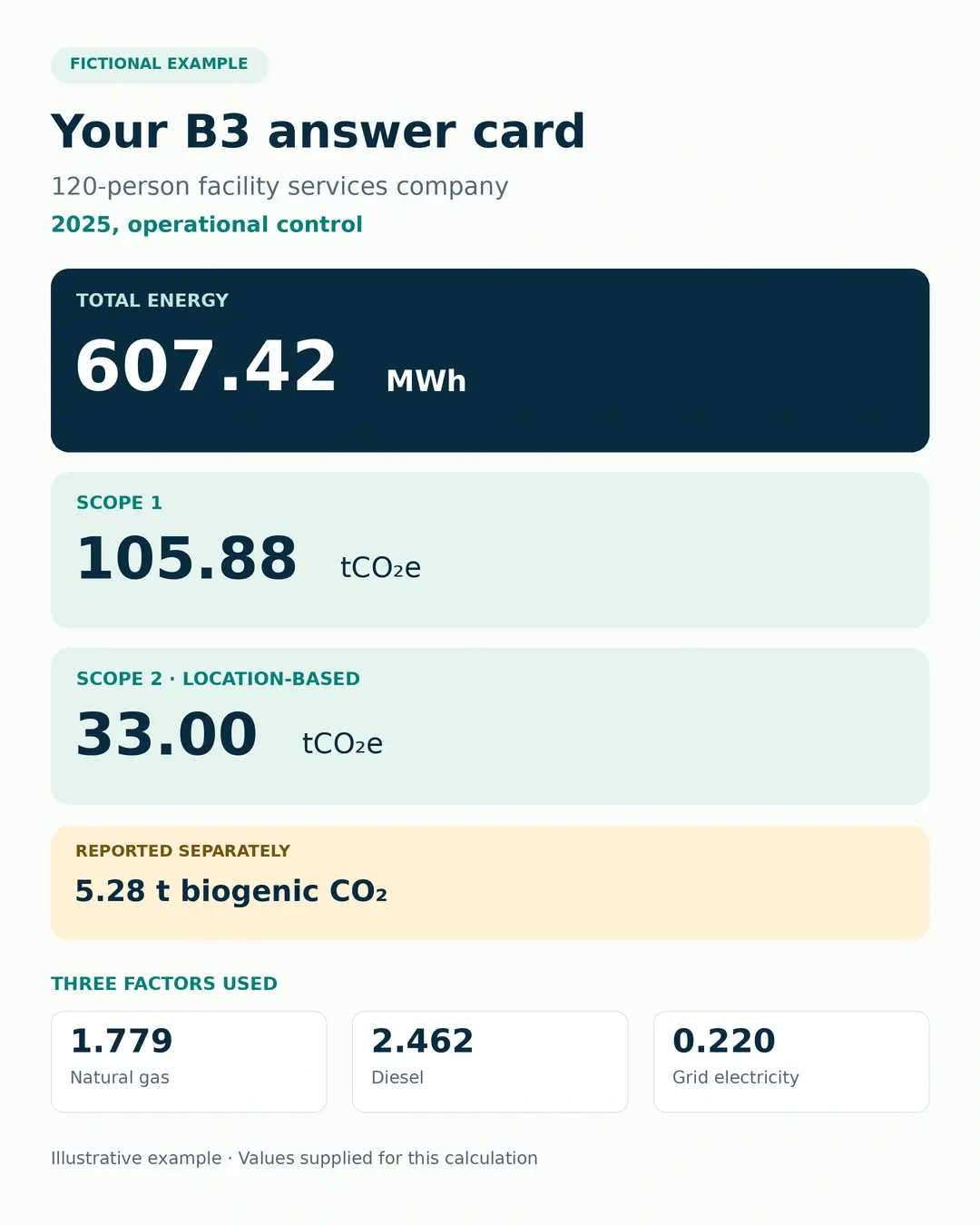
Bar chart of the Dutch grid electricity emission factor from 2020 to 2026. The generation component falls from 0.405 kg CO2e per kWh in 2020 to 0.369 in 2022, 0.290 in 2023, 0.270 in 2024, 0.220 in 2025 and 0.200 in 2026; upstream chain emissions add 0.044 to 0.070 on top.
Use the factor for the footprint year
The list's FAQ is explicit: "Voor de footprint van 2024 wordt met de factor van 2024 gerekend." New factors apply to later emissions, except when new scientific insight justifies a retrospective correction. So a 2025 footprint prepared in 2026 uses the 2025 factors.
Year | Generation (Scope 2) | Upstream chain (Scope 3) | Total |
|---|---|---|---|
2023 | 0.290 | 0.047 | 0.337 |
2024 | 0.270 | 0.058 | 0.328 |
2025 | 0.220 | 0.048 | 0.268 |
2026 | 0.200 | 0.044 | 0.244 |
Two things follow from this table:
- The factor fell by about half since 2020. If your Scope 2 dropped, check whether you saved energy or the grid got cleaner before you claim progress.
- Check footprints made early in 2026. Stimular's Milieubarometer reported that its location-based factors for 2025 footprints "had not yet been adjusted, still using the factors for 2024", so footprints published there before 11 February 2026 contain 2024 electricity factors. For 150,000 kWh that is 40.5 t instead of 33.0 t (0.270 vs 0.220), about 23% too high.
Use the right column
The Dutch list splits each factor into combustion or generation emissions and chain (upstream) emissions.
Calculation | Column to use |
|---|---|
Scope 1, fuel combustion | Combustion emissions (TTW) |
Location-based Scope 2, electricity | Generation emissions at the power plant |
Upstream fuel and energy emissions | Chain emissions (WTT): Scope 3, category 3 |
A full life-cycle footprint | Total (WTW), clearly labelled as such |
Don't put the total (WTW) figure into Scope 1 or 2. The GHG Protocol Scope 2 Guidance separates generation emissions from energy-related value-chain emissions. Using the 2025 electricity total (0.268) instead of generation (0.220) overstates Scope 2 by about 22%.
Location-based vs market-based Scope 2
Method | What it shows | Evidence |
|---|---|---|
Location-based | Average emissions of the grid where you use the power | kWh and a grid-average factor |
Market-based | Emissions of the electricity you contracted | Supplier-specific factors, guarantees of origin, contracts |
B3 asks for location-based. A green electricity contract does not make it zero. If you also report under the GHG Protocol, it requires both figures where contractual instruments exist, labelled separately and never added together.
The Scope 2 Guidance is under revision. The public consultation ran from 20 October 2025 to 31 January 2026, and in July 2026 the board asked for further work; no new effective date has been set. The 2015 guidance applies until then.
Step 5: Worked example for a 120-person facility services company
A fictional Dutch company prepares its 2025 inventory. It rents an office and a warehouse, uses operational control, runs the warehouse gas boiler itself and operates its own service vans. Electricity is 90,000 kWh on its own meter plus the 60,000 kWh landlord allocation above. Its refrigerant records show no releases, and it buys no heat or cooling. A real inventory must check every one of those assumptions.
A. Quantities and factors
Source | Quantity | Factor (2025, combustion or generation) | Energy content |
|---|---|---|---|
Natural gas (G-gas) | 18,000 m³ | 1.779 kg CO₂e/m³ | 31.65 MJ/m³ |
Diesel B7, company vans | 30,000 litres | 2.462 kg CO₂e/litre | 35.9 MJ/litre |
Grid electricity | 150,000 kWh | 0.220 kg CO₂e/kWh | 1,000 kWh = 1 MWh |
B. Scope 1
- Gas: 18,000 × 1.779 ÷ 1,000 = 32.02 tCO₂e
- Diesel B7: 30,000 × 2.462 ÷ 1,000 = 73.86 tCO₂e
- Scope 1 total: 105.88 tCO₂e
Diesel B7 contains a bio blend. The list gives a separate biogenic component of 0.176 kg per litre: 30,000 × 0.176 ÷ 1,000 = 5.28 t biogenic CO₂. Report it next to Scope 1, not inside it (CE Delft on biogenic CO₂).
C. Location-based Scope 2
150,000 × 0.220 ÷ 1,000 = 33.00 tCO₂e. Own-meter and allocated electricity each count once.
D. Energy in MWh
1 MWh = 1,000 kWh = 3,600 MJ.
Source | Calculation | MWh |
|---|---|---|
Gas | 18,000 × 31.65 ÷ 3,600 | 158.25 |
Diesel B7 | 30,000 × 35.9 ÷ 3,600 | 299.17 |
Electricity | 150,000 ÷ 1,000 | 150.00 |
Total | 607.42 |
The gas conversion uses the lower heating value (31.65 MJ/m³). Use one basis throughout, and check how your supplier's kWh figure, if any, was derived. Refrigerant leaks add emissions, not energy.
Step 6: Turn it into a B3 answer
Field | Result |
|---|---|
Reporting period | 1 Jan – 31 Dec 2025 |
Total energy consumption | 607.42 MWh (electricity 150.00, fuels 457.42) |
Gross Scope 1 | 105.88 tCO₂e |
Gross location-based Scope 2 | 33.00 tCO₂e |
Scope 1 + 2 | 138.88 tCO₂e |
Biogenic CO₂ (separate) | 5.28 t |
For the renewable split, use evidence: guarantees of origin or a supplier fuel mix. A low grid factor does not make your electricity renewable, and B7 is not entirely fossil.
Add a short method note:
Dutch operations, calendar year 2025, operational control. Consumption from utility statements, fuel-card data and a documented landlord allocation for 60,000 kWh. Scope 1 uses CO2emissiefactoren.nl 2025 combustion (TTW) factors; location-based Scope 2 uses the 2025 grid generation factor (0.220 kg CO₂e/kWh). Upstream emissions excluded. Refrigerant records reviewed. Not independently assured.
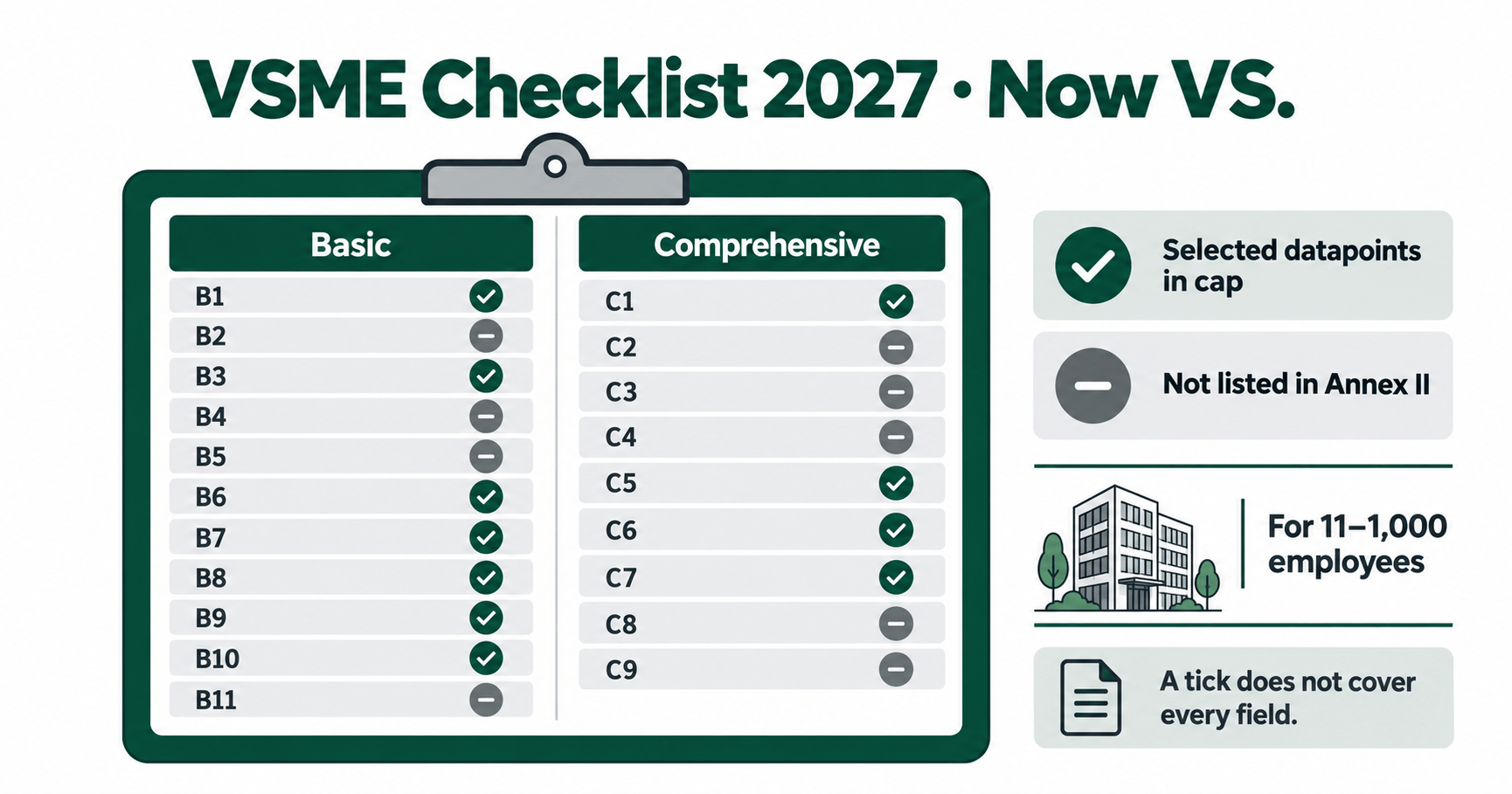
For a real report, name the entity, the share of estimated data, exclusions, factor versions and the reviewer. B3 is one disclosure; it does not make you compliant with the whole standard. For the rest, use our VSME checklist and the guide to where each datapoint sits in Dutch records. If your building has an energy label, read Energy Label C and the Dutch energy-saving obligation: the same meter data feeds the RVO report.
The 12 errors we see most
Error | Do this instead |
|---|---|
Leaving out a rented office because the landlord pays | Include it under operational control; get an allocation |
Counting the whole building your allocation | Count your share once |
Counting a client's building because you maintain it | Check what control the contract gives you |
Using euros as kWh | Get physical quantities or document an estimate |
Using the total (WTW) factor for Scope 1 or 2 | Use combustion (TTW) or generation |
Using 2026 factors for a 2025 footprint | Use the footprint year's factors |
Reporting green power as zero location-based Scope 2 | Use the grid-average factor |
Counting EV charging and the same meter twice | Reconcile charging data with meter coverage |
Using the energy label as consumption | Use bills or meters |
Deducting offsets | Report gross; describe offsets separately |
Treating missing refrigerant records as zero | Investigate or estimate |
Counting gas and the heat made from it | Count the fuel once (EFRAG guidance) |
The four-hour workflow
Time | Task | Output |
|---|---|---|
0:00–0:30 | Confirm entity, year, boundary and sources | Written boundary |
0:30–1:30 | Reconcile bills, fleet, landlord and refrigerant data | Consumption table with evidence |
1:30–2:15 | Pick factors; calculate tCO₂e and MWh | Calculation with factor versions |
2:15–3:00 | Check allocations, gaps and duplicates | Reviewed totals, uncertainty notes |
3:00–4:00 | Write the B3 figures and method note | Reusable answer and evidence folder |
If evidence is missing, mark the result provisional and name who closes each gap. Build your worksheet with these columns so next year takes half the time:
Site or asset | Energy carrier or refrigerant | Period | Quantity | Unit | Scope | Factor | Factor year and column | Energy content | MWh | tCO₂e | Evidence | Measured or estimated
Know your numbers? See how they score. ESG Lite's free readiness assessment shows where your energy and emissions data stands against the VSME structure, and you see your first results before creating an account. Start the free assessment
Sources
- Commission Delegated Regulation (EU) 2026/1560: Voluntary Standard, B3 paragraphs 32–33, Annex II value chain cap.
- EFRAG Knowledge Hub: 2025 VSME Recommendation, B3.
- GHG Protocol: how emissions are categorised.
- GHG Protocol Scope 2 Guidance (2015).
- GHG Protocol: leased assets and landlord-supplied electricity.
- GHG Protocol: dual reporting.
- GHG Protocol: Scope 2 consultation feedback summary (29 July 2026).
- CO2emissiefactoren.nl FAQ: which year to use.
- CO2emissiefactoren.nl: grid electricity.
- CO2emissiefactoren.nl: natural gas (G-gas).
- CO2emissiefactoren.nl: diesel B7.
- Milieubarometer: 2026 factor update and 2025 correction.
- US EPA: fugitive emissions from refrigeration and air conditioning.
- CE Delft: reporting biogenic CO₂.
- EFRAG VSME guidance: energy and double counting.
- KHN: Green Lease 2026.
Make Your Business Online By The Best No—Code & No—Plugin Solution In The Market.
30 Day Money-Back Guarantee
Say goodbye to your low online sales rate!
1. Can a small business calculate Scope 1 and 2 without a consultant?
Yes, if operations are simple and the records are complete. Complex leases, several entities, unusual fuels or large refrigerant losses may need specialist review. Calculating and having the result assured are separate steps.
2. Is electricity in a rented office Scope 2?
Usually yes. Under operational control the GHG Protocol treats leased space as controlled by the tenant, so electricity you get through the landlord is Scope 2. Under the equity-share or financial-control approaches it is Scope 3.
3. What if my landlord only gives me service costs?
Ask for kWh, m³ or GJ and the allocation basis. If you can't get them, make a documented estimate and disclose it. A euro amount is not a measured energy quantity.
4. Which year's emission factors should I use?
The factors for the footprint year. A 2025 footprint uses the 2025 Dutch factors, even if you calculate it in 2026. For grid electricity that is 0.220 kg CO₂e per kWh (generation component).
5. Does green electricity make Scope 2 zero?
Not the location-based figure that B3 asks for. Green contracts can lower a separate market-based figure, if the contractual evidence meets the GHG Protocol's quality criteria.
6. Do I need Scope 3 for B3?
No. B3 asks for total energy, Scope 1 and location-based Scope 2. Scope 3 is outside the value chain cap, though a customer may still ask for it separately.
7. Can I really finish in one afternoon?
Often, if records are complete. Missing landlord data, unclear contracts or refrigerant gaps take longer. End the afternoon with a traceable estimate and a list of open items rather than an unsupported number.