VSME Checklist 2027 (Now “VS”): Every Disclosure to Prepare Before Your First Customer Request
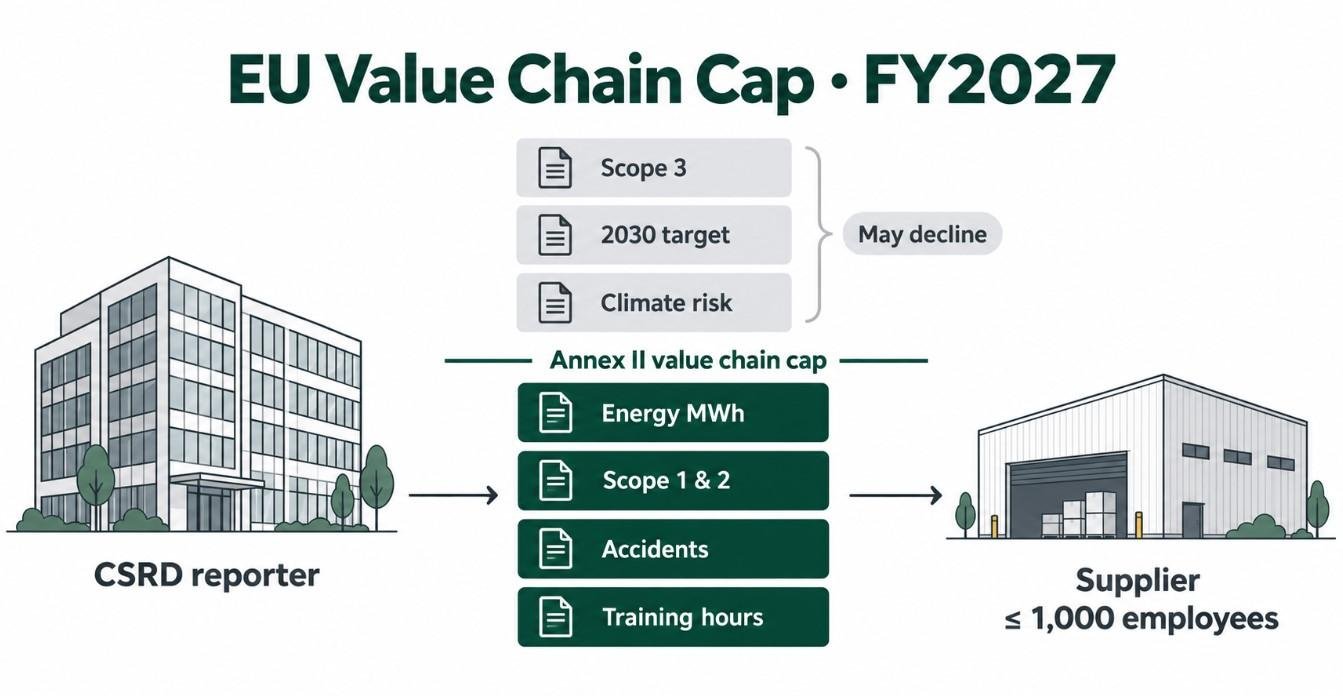
Short answer: A 2027 VSME checklist should follow the EU's new Voluntary Standard (VS) in Delegated Regulation (EU) 2026/1560: 11 Basic Module disclosures (B1–B11) and 9 Comprehensive Module disclosures (C1–C9). For each one, record what to collect, who owns it and where the evidence sits. Then mark which datapoints fall inside the Annex II value chain cap, because CSRD-reporting customers can require only those from suppliers with up to 1,000 employees.
The master checklist at a glance
This table is the whole checklist on one page. “Partial” means only some datapoints in that disclosure are inside the value chain cap; the sections below say which.
Disclosure | What to collect | Typical owner | Evidence | In cap: 1–10 employees | In cap: 11–1,000 employees |
|---|---|---|---|---|---|
B1 Basis for preparation | Module chosen, individual or consolidated basis, legal form, NACE code, balance sheet total, turnover, headcount, countries, site geolocations, certifications | Finance | Annual accounts, company register, site list | Partial | Partial |
B2 Practices and policies | Sustainability practices, policies, future initiatives and targets | Management | Policy register, project records | No | No |
B3 Energy and GHG | Total energy in MWh; energy split if available; Scope 1 and location-based Scope 2 | Finance / Facilities | Utility invoices, fuel cards, refrigerant logs | No | Partial |
B4 Pollution | Pollutant emissions you already report to authorities or under an EMS | HSE | Permits, regulatory filings | No | No |
B5 Biodiversity | Sites in or near biodiversity-sensitive areas, and the area's name | Facilities / Property | Site register, protected-area maps | No | No |
B6 Water | Total withdrawal; consumption and water-stressed sites if relevant | Facilities | Water bills, meters | No | Partial |
B7 Circular economy and waste | Circular principles; total waste (hazardous/non-hazardous); share recycled or reused; material flows if relevant | Operations | Waste contractor reports | No | Partial |
B8 Workforce | Headcount by contract type, gender and (if several) country | HR | HR and payroll system | Partial | Partial |
B9 Health and safety | Recordable accidents (number and rate); fatalities | HSE | Accident register | Partial | Partial |
B10 Pay, bargaining, training | Minimum-wage compliance; gender pay gap if already legally required; collective bargaining %; training hours per employee | HR / Payroll | Payroll, collective agreements, training log | Partial | Partial |
B11 Corruption and bribery | Convictions and fines in the period | Legal / Finance | Legal and compliance records | No | No |
C1 Business model | Products and services, markets, main business relationships, sustainability-related strategy | CEO / Sales | Company profile, key contracts | No | Partial |
C2 Practices described | Short description of B2 items; whether they cover suppliers or clients | Management | Policies, plans | No | No |
C3 GHG targets and transition | Absolute Scope 1 and 2 targets, base year, actions; transition plan status for high-impact sectors | Operations / Management | Targets, emissions files | No | No |
C4 Climate risks | Climate hazards and transition events, exposure, time horizons, adaptation | Operations / Property | Risk register, site assessments | No | No |
C5 Additional workforce | Employee turnover rate; optional management gender ratio and self-employed counts | HR | HR leavers data | No | Partial |
C6 Human rights policies | Code of conduct or policy (yes/no) and topics covered; complaints mechanism | HR / Compliance | Approved policies, grievance procedure | No | Partial |
C7 Human rights incidents | Confirmed incidents in own workforce and value chain; actions taken | HR / Legal | Controlled incident register | No | Partial |
C8 Revenue from certain activities | Revenue from weapons, tobacco, fossil fuels or chemicals, if active there | Finance | Revenue ledger | No | No |
C9 Board gender diversity | Gender diversity ratio of the governance body | Company secretary | Board records | No | No |
Source: Annexes I and II of Delegated Regulation (EU) 2026/1560, as published on the EFRAG Knowledge Hub. Owners and evidence are practical suggestions, not legal requirements.
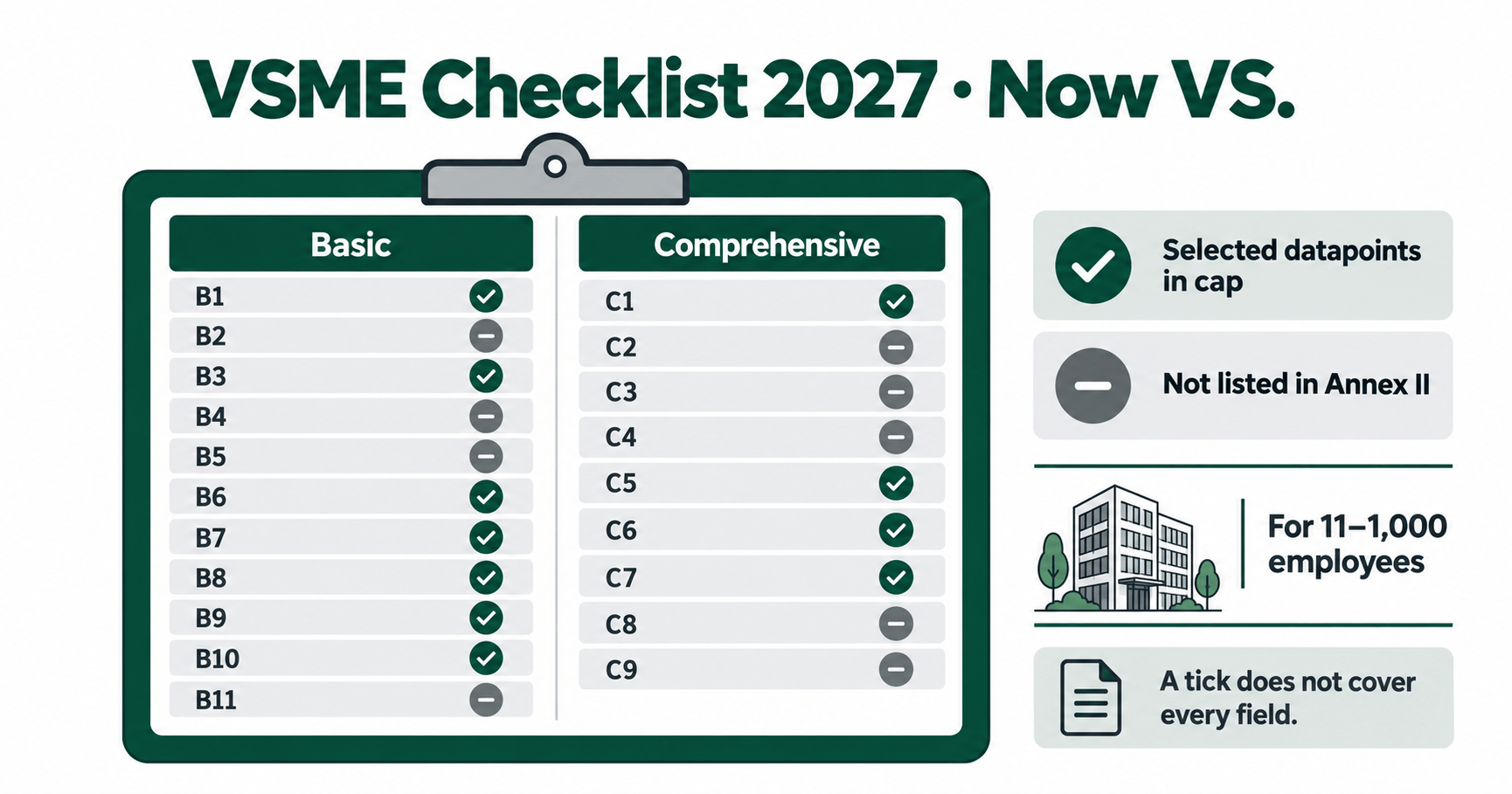
VSME checklist for 2027 showing disclosures B1 to B11 and C1 to C9, with items inside the EU value chain cap marked. |
VSME vs VS: what changed for your checklist
The VSME was published by EFRAG in December 2024 and endorsed by Commission Recommendation (EU) 2025/1710 in July 2025. In 2026 it became law as the Voluntary Standard (VS): Delegated Regulation (EU) 2026/1560 was adopted on 3 July, published on 21 September and entered into force on 24 September 2026. Using it remains voluntary.
The structure is the same: a Basic Module, which is the minimum, and a Comprehensive Module, which requires the Basic Module first. But several datapoints changed, so a checklist built on the 2024 VSME is now out of date.
Area | 2024 VSME | 2026 Voluntary Standard | Checklist impact |
|---|---|---|---|
Scope | Non-listed SMEs (up to 250 employees) | Undertakings averaging up to 1,000 employees | Mid-size firms can now use it too |
B3 GHG intensity | Required (emissions per revenue) | Removed | Drop it |
B5 Biodiversity | Number and hectares of sites; optional land-use metrics | Only which sites are in or near a sensitive area, and its name | Much smaller task |
B8 / C5 Turnover | In B8, for 50+ employees | Moved to C5 (Comprehensive) | Collect only if you report Option B or a customer asks |
B10 Gender pay gap | Required, with an opt-out under 150 employees | Only if another law already requires it | Usually not needed |
B10 Training hours | Broken down by gender | Average per employee | Simpler |
10 or fewer employees | Same rules as others | Many environmental and C datapoints become voluntary | Micro-firms collect much less |
Omissions | Brief exemption | Trade secrets, seriously prejudicial or protected information may be omitted, if disclosed and reassessed yearly | Document every omission |
Value chain cap | Not defined | Annex II lists the capped datapoints | New column in every checklist |
Guidance | Inside the standard | Moved to the EFRAG Knowledge Hub | Use the hub for calculation help |
Source: IBR-IRE comparison of the Delegated Regulation with the EFRAG VSME, checked against the standard's text on the EFRAG Knowledge Hub.
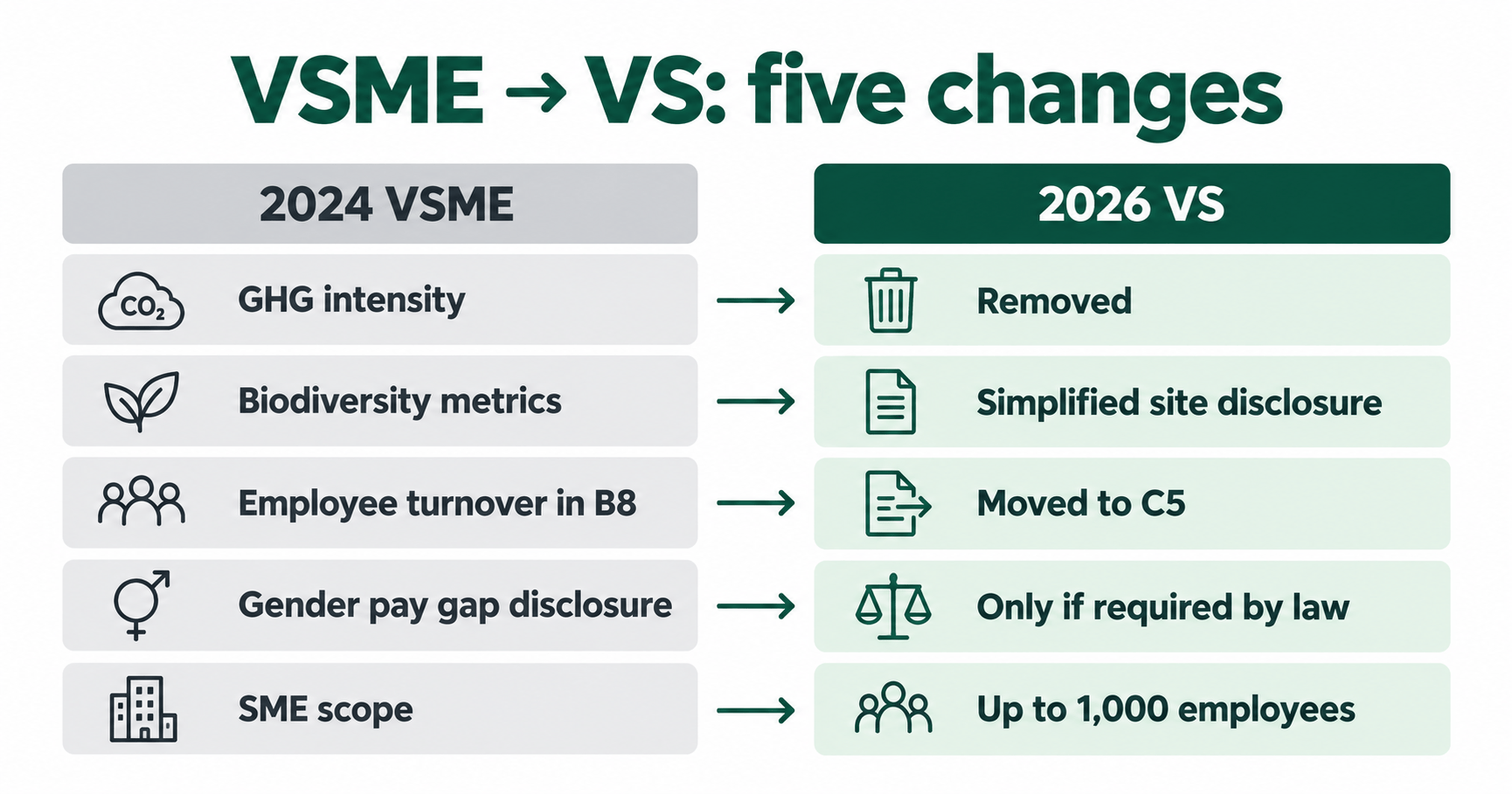
Comparison of the 2024 VSME and the 2026 Voluntary Standard showing five key changes to the reporting checklist.
The Basic Module checklist (B1–B11), disclosure by disclosure
B1 — Basis for preparation
- Collect: the module you are reporting under, with an explicit compliance statement; individual or consolidated basis; subsidiaries if consolidated; legal form; NACE code(s); balance sheet total and turnover in monetary units; headcount or FTE; country of primary operations and significant assets; geolocation of sites owned, leased or managed; any certifications or labels; any omitted disclosures.
- In the cap: module, basis and the company profile items (27(a), (c), (e)) for both size bands. Certifications, subsidiary lists and omissions are outside it.
- Tip: build a proper site register. Logistics and facilities firms often have more operating sites than their registered address suggests.
B2 — Practices, policies and future initiatives
- Collect: whether you have practices, policies, forward-looking initiatives and targets on sustainability issues, and whether the policies are public.
- In the cap: no.
- Tip: report what genuinely exists. A documented energy-saving practice is a valid answer even without a formal ESG strategy.
B3 — Energy and greenhouse gas emissions
- Collect: total energy consumption in MWh; renewable vs non-renewable, electricity vs fuel, if you can obtain the split; estimated Scope 1 and location-based Scope 2 in tCO2e, with reference to the GHG Protocol Corporate Standard.
- In the cap: for 11–1,000 employees, total MWh and the Scope 1 and 2 estimates. The energy split is outside it. For 10 or fewer, B3 is voluntary and outside the cap.
- Example: 185,000 kWh of electricity is 185 MWh. Multiply by your country's location-based grid factor from a published source to estimate Scope 2. Total MWh is not a carbon footprint, and Scope 3 is not part of B3.
B4 — Pollution of air, water and soil
- Collect: pollutant emissions you already report to authorities, or voluntarily under an environmental management system. You may link to a public document instead.
- In the cap: no.
- Tip: B4 does not ask you to commission new testing.
B5 — Biodiversity
- Collect: whether any site is in or near a biodiversity-sensitive area (for example Natura 2000), and its name.
- In the cap: no.
- Tip: a nearby park is not automatically a biodiversity-sensitive area. Check the official protected-area maps.
B6 — Water
- Collect: total water withdrawal. If your production processes consume significant water, also water consumption and the amount used at sites in water-stressed areas.
- In the cap: total withdrawal only, for 11–1,000 employees.
- Tip: withdrawal and consumption are different metrics. In rented premises, ask the landlord for meter data and record any allocation method.
B7 — Resource use, circular economy and waste
- Collect: whether and how you apply circular-economy principles; total waste split into hazardous and non-hazardous; the share sent to recycling or reuse; annual material mass-flow if you are in a high material-flow sector such as construction or manufacturing.
- In the cap: for 11–1,000 employees, the circular-principles statement and the two waste figures. Material mass-flow (39(c)) is outside it.
- Tip: ask your waste contractor for an annual weight report by stream, rather than estimating from invoices.
B8 — Workforce: general characteristics
- Collect: employees by temporary or permanent contract, by gender and, if you operate in several countries, by country of contract.
- In the cap: contract type and gender, for both size bands. The country split is outside it.
- Tip: subcontracted drivers, cleaners or site crews are usually not your employees. Keep the boundary consistent.
B9 — Workforce: health and safety
- Collect: number and rate of recordable work-related accidents; fatalities from work-related accidents and ill health, subject to legal restrictions.
- In the cap: accident number and rate, for both size bands. Fatalities are outside it.
- Tip: a recordable accident means death or more than three days' absence. Do not mix in near misses or first-aid cases.
B10 — Remuneration, collective bargaining and training
- Collect: whether pay meets the applicable minimum wage; the gender pay gap only if another law already requires you to report it; share of employees covered by collective agreements; average annual training hours per employee.
- In the cap: minimum wage, collective bargaining and training hours, for both size bands. The pay gap is outside it.
- Tip: include safety and operational training if it meets the definition. It is often logged by operations, not HR.
B11 — Convictions and fines for corruption and bribery
- Collect: the number of convictions and total fines for anti-corruption or anti-bribery breaches in the period, if any.
- In the cap: no.
- Tip: this is a factual disclosure, not a risk score. Have legal or finance confirm any amount.
The Comprehensive Module checklist (C1–C9)
The Comprehensive Module serves banks, investors and large customers. If you state compliance with Option B, you must follow it in full, subject to the “if applicable” and voluntary provisions. Firms with 10 or fewer employees can use it, but many of its datapoints are voluntary for them, and none are inside their cap.
For companies with 11–1,000 employees, only these Comprehensive datapoints are inside the cap:
- C1: products and services, markets and main business relationships (46(a)–(c)). The sustainability-strategy description (46(d)) is outside it.
- C5: employee turnover rate. The optional management gender ratio and self-employed counts are outside it.
- C6: whether you have a code of conduct or human rights policy, and a complaints mechanism. Which topics the policy covers is outside it.
- C7: confirmed human-rights incidents in your workforce and the value chain. The description of actions taken is outside it.
C3 and C4 are outside the cap but still matter. Banks increasingly ask about emissions targets (C3) and climate risks such as flood or heat exposure (C4), and these map to bank Pillar 3 disclosures. If you operate in a high climate-impact sector (NACE sections A–H and M) and have no transition plan, C3 asks you to say whether and when you will adopt one.
Scope 3 sits in the Standard's guidance for sectors where it is significant, such as manufacturing, construction, real estate and packaging. It is not a general essential datapoint and is not in Annex II. For the full cap rules, see The EU Value Chain Cap Explained.
Turn the checklist into a data system: five fields per datapoint
A checklist says what to collect. A data system says who has it, where it is and whether it is right. Record five fields for every datapoint:
- Reporting period: for example 1 January–31 December 2026.
- Named owner: a person, not just “Finance.”
- Source: the invoice, payroll extract, register or policy behind the figure.
- Method: how any figure was calculated or estimated, with assumptions.
- Status: Ready, Partial, Missing, Not applicable (with reason) or Needs review.
A blank cell never means zero, and a document in a shared folder is not a checked figure.
Worked example: a 160-person facilities-management company
Westbridge Property Services is a fictional facilities-management firm with 160 employees, a service-van fleet and maintenance contracts across client buildings.
Disclosure | What it already has | Gap to close |
|---|---|---|
B1 | Accounts, staff records, office list | Geolocate every operating site |
B3 | Electricity invoices, fuel-card data | Calculate Scope 1 and location-based Scope 2 |
B6 | Water bills for its own offices | Agree the boundary for client sites |
B7 | Waste contractor invoices | Get annual weights and recycling share |
B9 | Accident register | Calculate the accident rate |
B10 | Payroll, training records | Consolidate training hours across teams |
C5 | HR leavers list | Calculate the turnover rate |
C6 | Employee code of conduct | Confirm a complaints mechanism exists |
The boundary trap. Westbridge can see the electricity bills of the client buildings it manages. That does not put that electricity in its own Scope 2. Under the GHG Protocol, only energy within its organisational boundary counts: its own offices, depots and the vehicles and equipment it owns or controls. Adding every bill it can access would overstate its footprint and contradict its clients' own reporting.
The result: one controlled dataset that answers recurring requests consistently, with the capped items clearly marked for CSRD customers.
EFRAG's free Excel template: when is it enough?
EFRAG publishes a free VSME Digital Template in Excel, an XBRL taxonomy and a converter that turns the completed template into a tagged digital report.
Check the version first. As of 27 October 2026 the current release is version 1.3.0, published 11 June 2026. It was built for the 2025 VSME Recommendation, not the final Voluntary Standard. EFRAG says it is updating the template, taxonomy and converter, including a migration tool, for release in Q4 2026; its September announcement names November. Until then, check v1.3.0 against the changes table above.
What it does: conditional checkboxes that show which disclosures apply, automatic totals, validation checks, drop-downs for narrative items, links to the standard at paragraph level, colour-coded tooltips and a fuel-to-MWh converter. It was developed and tested in Microsoft Excel 365.
Licence: the converter's source code is open source under the MIT licence. That statement covers the converter, not every EFRAG document.
One caution: EFRAG says the current template ecosystem was designed for companies with fewer than 250 employees and not tested on larger, more complex ones.
Need | EFRAG Excel template | Structured workflow or software |
|---|---|---|
One entity, few sites, first report | Usually enough | Optional |
XBRL digital report | Yes, via EFRAG's converter | Depends on the tool |
Several data owners and approvals | Manual coordination | Assigned tasks and sign-off |
Evidence linked to each figure | Separate folder | Linked per datapoint |
Many customer questionnaires | Manual reuse | Reusable answers and history |
Several entities or reporting periods | Hard to keep apart | Built in |
Do not pay for software only to replace a spreadsheet that already works. Pay when it removes real coordination work.
A 30-day collection plan for finance or operations
This is an illustrative plan, not a legal deadline.
Days | Focus | Deliverable |
|---|---|---|
1–5 | Scope: entity, period, Option A or B, applicable disclosures, cap items for CSRD customers, owners | Company checklist and owner matrix |
6–10 | Finance and environment: accounts, energy and fuel, water, waste, site register, environmental filings | Evidence folder |
11–15 | HR and governance: headcount, payroll, bargaining, training, accidents, policies, incidents | HR and governance dataset with gaps |
16–20 | Calculate and check: MWh, Scope 1 and 2, rates, turnover, boundaries | Calculation file with sources and methods |
21–25 | Review gaps: status per datapoint, omissions, confidentiality | Approved gap register |
26–30 | Package: profile, metrics, policy register, evidence index, response template, update calendar | Reusable response pack, version 1 |
By day 30 you may still have gaps. That is fine: the milestone is knowing what you have, what is missing and what is worth fixing.
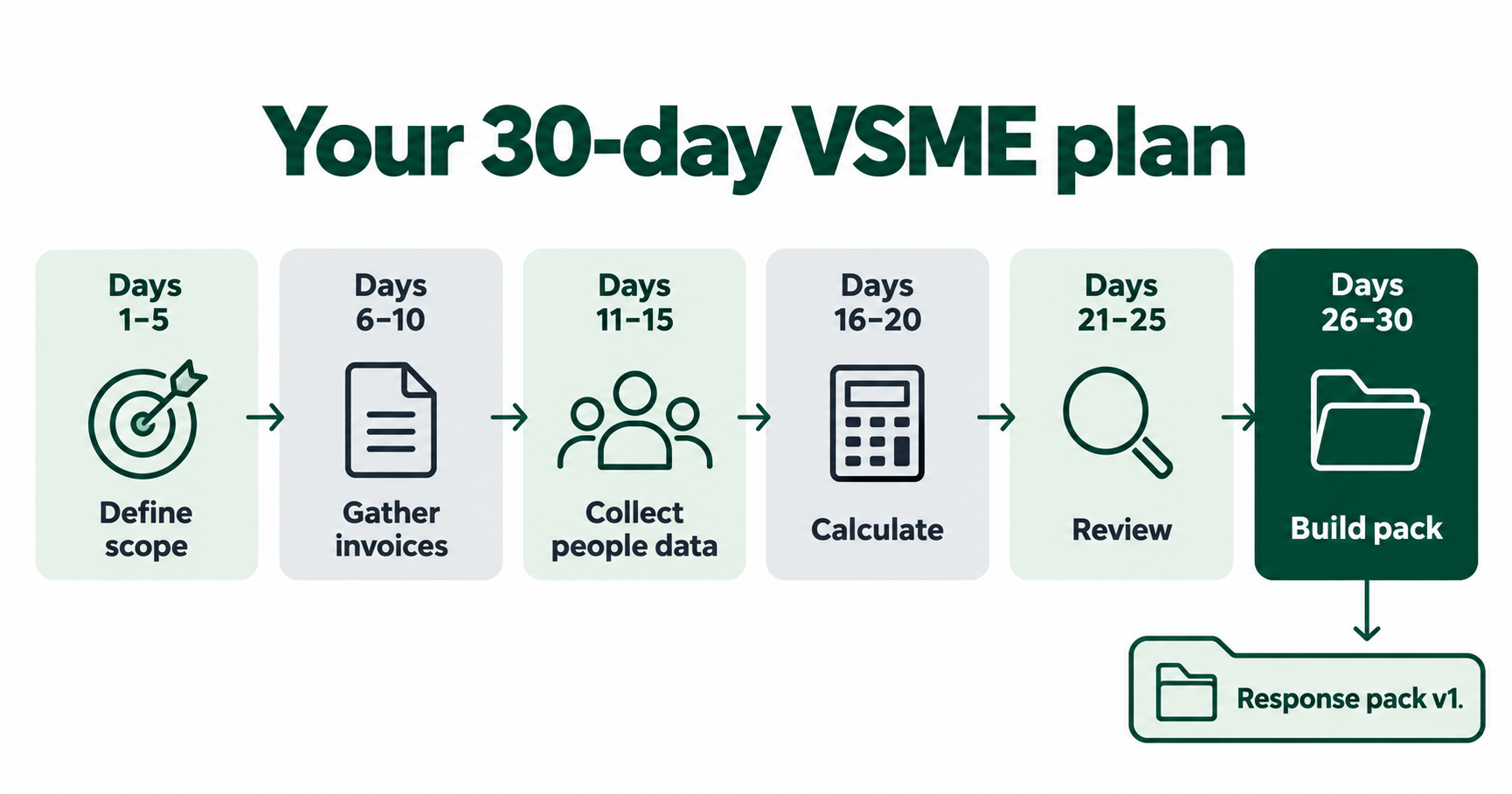
Thirty-day VSME data collection plan in six stages, from defining scope to building a reusable response pack.
Keeping the checklist current
- Monthly: file new utility invoices, fuel data and incident records.
- Quarterly: review gaps, operational changes and whether owners are keeping records.
- Annually: reconcile full-year figures, recalculate emissions, update workforce data and approve the dataset.
From your second report, the standard requires prior-year comparatives (except for new metrics), and you can refer back to unchanged datapoints. Consistent records make both easy.
If your financial year is the calendar year, full 2027 figures will not exist until early 2028. A questionnaire in mid-2027 will usually want 2026 figures, current policies or baselines. Always confirm the period.
Seven checklist mistakes to avoid
Mistake | Better approach |
|---|---|
Using a 2024 VSME checklist | Work from Regulation 2026/1560 and the changes table above |
Treating B1–B11 as the value chain cap | Check each paragraph and point against Annex II |
Ignoring C1, C5, C6 and C7 | Add them: they are inside the cap above 10 employees |
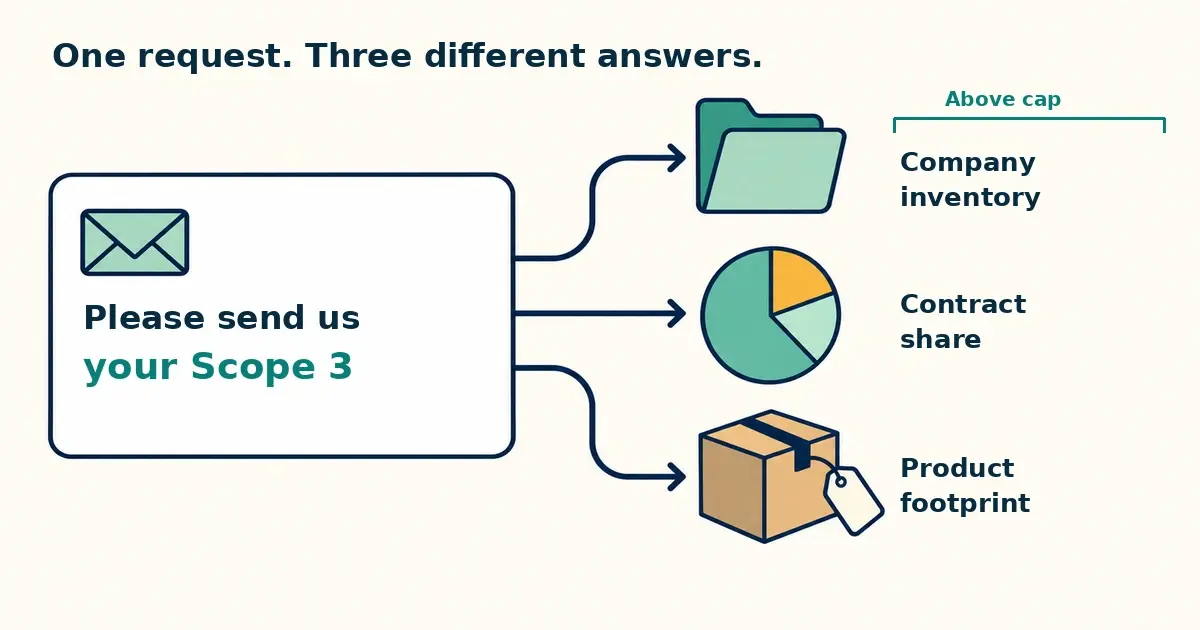
Starting a Scope 3 project before clarifying the request | Confirm whether the customer needs Scope 1 and 2, a product figure or something else |
Unsupported estimates | Keep the source and method for every figure |
Writing “0” for unknown | Use Missing or Not applicable with a reason |
No named owner | Give every datapoint an owner, source, deadline and status |
Start with the evidence you already have
The best checklist is not the longest one; it is the one your team keeps up to date. Start with the Basic Module, mark the Annex II items, give every datapoint an owner and a source, and record gaps honestly.
Get your checklist with your gaps already marked. ESG Lite's free readiness assessment takes a few minutes and needs no documents. You get a readiness score and a preview of your VSME-aligned checklist; the full roadmap and PDF report are available as a paid upgrade. Start your free assessment
Sources
- Commission Delegated Regulation (EU) 2026/1560: the Voluntary Standard, Annex I and Annex II (EUR-Lex)
- EFRAG Knowledge Hub: 2026 Voluntary Standard: interactive text and Annex II
- EFRAG: VSME Digital Template and XBRL Taxonomy: template versions, features and converter licence
- EFRAG: adoption of the revised ESRS and Voluntary Standard: guidance update and template timing
- IBR-IRE: Delegated Regulation vs EFRAG VSME comparison
- Directive (EU) 2026/470: Omnibus I and the value chain protections (EUR-Lex)
- GHG Protocol: corporate emissions accounting
Make Your Business Online By The Best No—Code & No—Plugin Solution In The Market.
30 Day Money-Back Guarantee
Say goodbye to your low online sales rate!
Is VSME still valid in 2027?
The VSME has been replaced in law by the Voluntary Standard (VS) in Delegated Regulation (EU) 2026/1560, in force since 24 September 2026. “VSME” is still widely used, including in EFRAG's tools, but a 2027 checklist should follow the 2026 legal text, which changed several datapoints.
Where can I download the official VSME Excel template?
From EFRAG's VSME Digital Template and XBRL Taxonomy page. As of 27 October 2026 the current version is 1.3.0, published 11 June 2026, with a Voluntary Standard update scheduled for Q4 2026. The template and the XBRL converter are free.
How many datapoints does the VSME have?
Counts such as 143 or 147 come from the 2024 VSME and depend on how nested and conditional fields are counted. The 2026 Voluntary Standard has 11 Basic and 9 Comprehensive disclosures. Annex II lists 23 entries for the value chain cap, which are table rows, not 23 single fields.
Is the VSME Basic Module mandatory?
No. Applying the Voluntary Standard is voluntary for companies outside mandatory CSRD reporting. The Basic Module is mandatory only if you choose to report under the standard, and it is a prerequisite for the Comprehensive Module.
Which VSME datapoints can a CSRD customer require?
Only the Annex II datapoints, from financial years starting 1 January 2027, and only from suppliers averaging up to 1,000 employees. For 11–1,000 employees that means selected items from B1, B3, B6–B10, C1 and C5–C7. For 10 or fewer, only selected B1, B8, B9 and B10 items.
Do I need ESG software to complete a VSME report?
No. EFRAG's Excel template and converter are free and work for a single entity with a few data owners. Software earns its cost when you manage several sites or entities, many owners and approvals, or repeated customer questionnaires.
What is the difference between a VSME checklist and a VSME report?
A checklist identifies what to collect and where the gaps are. A report presents the disclosures under the module you chose, with a compliance statement. Completing a readiness checklist does not mean a report complies with the standard.