VSME Checklist for Dutch Companies: Where to Find Every Datapoint in Your Own Records (2027)
Short answer: Most VSME datapoints a customer can request are already in your records. Energy use comes from your energy bills, CO₂ is calculated with the factors from CO2emissiefactoren.nl, workforce data comes from payroll, accidents from your statutory Arbo accident register, and waste figures from the waste register Dutch law already requires. From financial year 2027, a CSRD-reporting customer may require only the Annex II datapoints from a supplier with up to 1,000 employees.
The source map: every capped datapoint and where it lives
This table is the core of the article. For each datapoint inside the EU value chain cap (companies with 11–1,000 employees), it shows the Dutch source, the logical owner and the trap we see most often.
Datapoint (VS ref.) | What you report | Dutch source | Owner | Common trap |
|---|---|---|---|---|
B1 27(a), (c) | Module chosen; individual or consolidated basis | Management decision, documented | Finance | Claiming a “VSME report” without completing the module |
B1 27(e) | Legal form, SBI/NACE code, balance sheet total, turnover, employees, country, site geolocation | KvK (Chamber of Commerce) extract, annual accounts, site list, BAG IDs via EP-Online | Finance | Listing only the head office when you rent or manage more sites |
B3 32 | Total energy consumption in MWh | Annual electricity and gas statements, fuel-card data, district heating, landlord data | Finance / Facilities | Counting energy used in client buildings |
B3 33 | Scope 1 and location-based Scope 2 (tCO₂e) | Consumption data × factors from CO2emissiefactoren.nl | Finance / Facilities | Treating a green-power contract as zero location-based emissions |
B6 36 | Total water withdrawal | Water company bills, water meters, service-charge statements | Facilities | Assuming “no own contract” means “no consumption” |
B7 38 | Whether and how you apply circular-economy principles | Existing practices, purchasing and reuse arrangements | Operations | Claiming a policy that does not exist |
B7 39(a) | Total waste, hazardous and non-hazardous | Waste register (afvalstoffenregistratie), waybills, processor invoices | Operations | Estimating weights from invoice amounts |
B7 39(b) | Share sent to recycling or reuse | Processing report from the waste company | Operations | Equating separate collection with recycling |
B8 40(a), (b) | Employees by contract type and gender | Payroll, HR system | HR | Counting agency workers as employees |
B9 41(a) | Number and rate of recordable work-related accidents | Arbo accident register (Article 9, Dutch Working Conditions Act) | HSE / HR | Counting only notifications to the Labour Inspectorate |
B10 42(a) | Pay at or above the minimum wage | Payroll records per pay period | Payroll | Checking December only |
B10 42(c) | Share of employees covered by a cao (collective labour agreement) | Employment contracts, cao application | HR | Confusing cao coverage with union membership |
B10 42(d) | Average training hours per employee | Training records, VCA and other safety courses | HR | Forgetting operational training |
C1 46(a)–(c) | Services, markets, main business relationships | Company profile, contract register | Management | Sharing a full customer list |
C5 58 | Employee turnover rate | HR leavers report and average headcount | HR | Changing the calculation method each year |
C6 61(a), (c) | Code of conduct or human-rights policy; complaints procedure | Staff handbook, grievance procedure | HR / Compliance | Answering “yes” for a draft policy |
C7 62(a), (c) | Confirmed human-rights incidents | Compliance and HR register | HR / Legal | Counting unconfirmed reports as incidents |
Source: Annex II of Delegated Regulation (EU) 2026/1560, as presented on the EFRAG Knowledge Hub. Owners and sources are practical suggestions, not legal requirements.
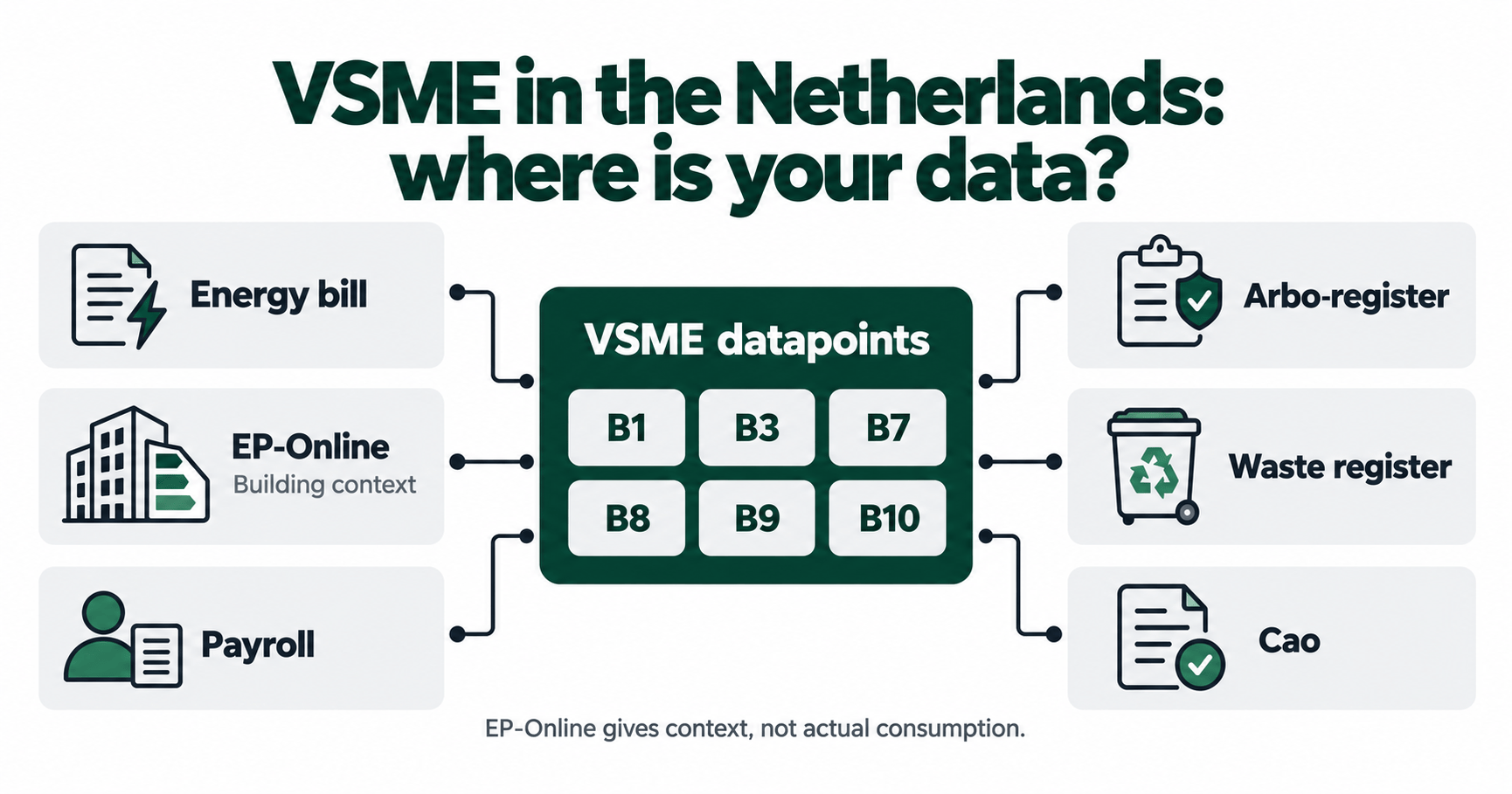
Source map linking VSME datapoints to Dutch records such as energy bills, payroll and the Arbo accident register.
First: what can a CSRD customer actually require?
Since 24 September 2026, the European VSME standard has officially been called the Voluntary Standard (VS), set out in Delegated Regulation (EU) 2026/1560. The name VSME is still widely used, including in EFRAG's tools. Using the standard remains voluntary.
The regulation also sets the value chain cap. A company subject to mandatory CSRD reporting may, for that reporting, require only the Annex II datapoints from a supplier averaging no more than 1,000 employees. This applies to financial years starting on or after 1 January 2027, and also covers suppliers outside the EU.
Three points matter:
- It is a ceiling, not a duty. A datapoint being in Annex II does not automatically oblige you to provide it.
- It applies only to CSRD requests. Questions for a tender, bank financing or another law fall outside it.
- The cap works per datapoint. Within B3, B6, B7, B8, B9, B10, C1, C6 and C7, only part of each disclosure sits under the ceiling. The table above shows exactly which part.
For the legal detail, read The EU Value Chain Cap Explained.
Energy (B3): start with your bills, not a new measurement
You rarely need to measure anything new to report total energy consumption in MWh. Collect, per site:
- annual electricity and gas statements;
- fuel-card and fleet fuel data;
- district heating statements, if you have them;
- consumption data from the landlord if they buy the energy.
Convert everything to the same unit. Electricity is simple: 312,000 kWh is 312 MWh. Gas (m³) and diesel (litres) need a fixed conversion factor; EFRAG's free Excel template has a built-in fuel-to-MWh converter. Do not report your electricity bill as total energy use.
Cross-check with RVO. If a site uses 50,000 kWh of electricity or 25,000 m³ of natural gas (equivalent) or more per year, the Dutch energy-saving obligation (energiebesparingsplicht) applies there. You report on it once every four years through the information obligation (informatieplicht); the previous round closed on 1 December 2023. That filing is a handy check on your own per-site consumption figures.
The biggest trap for facility-services firms. If you manage the installations of ten office buildings, you can see their energy bills in your building-management system. That energy does not automatically belong in your B3 figure. Under the GHG Protocol, only sources within your own organisational boundary count: your own office, workshops, and the vehicles and equipment you own or control. Record that boundary and keep client sites separate.
EP-Online: useful evidence, but not energy consumption
EP-Online is the official Dutch national database of building energy labels and energy-performance indicators, run by RVO (the Netherlands Enterprise Agency). You search by registration number, postcode and house number, or BAG ID (the national building and address register). Commercial building owners download the label certificate with eHerkenning (the Dutch business login); for non-residential buildings, this applies to labels registered from 2021.
Where EP-Online helps:
- B1 geolocation. The BAG IDs and addresses of your buildings make a reliable site register.
- Conversations with banks and customers. The label shows a building's energy performance, which matters for climate risk (C4) and financing. Offices over 100 m² must also meet the Dutch energy label C requirement.
Where EP-Online does not help: actual energy consumption. A label is a calculated performance under the NTA 8800 method; B3 asks what you actually used in the reporting period. A label-A building can still use a lot of energy if it is used intensively. Use EP-Online for building performance and your bills for consumption.
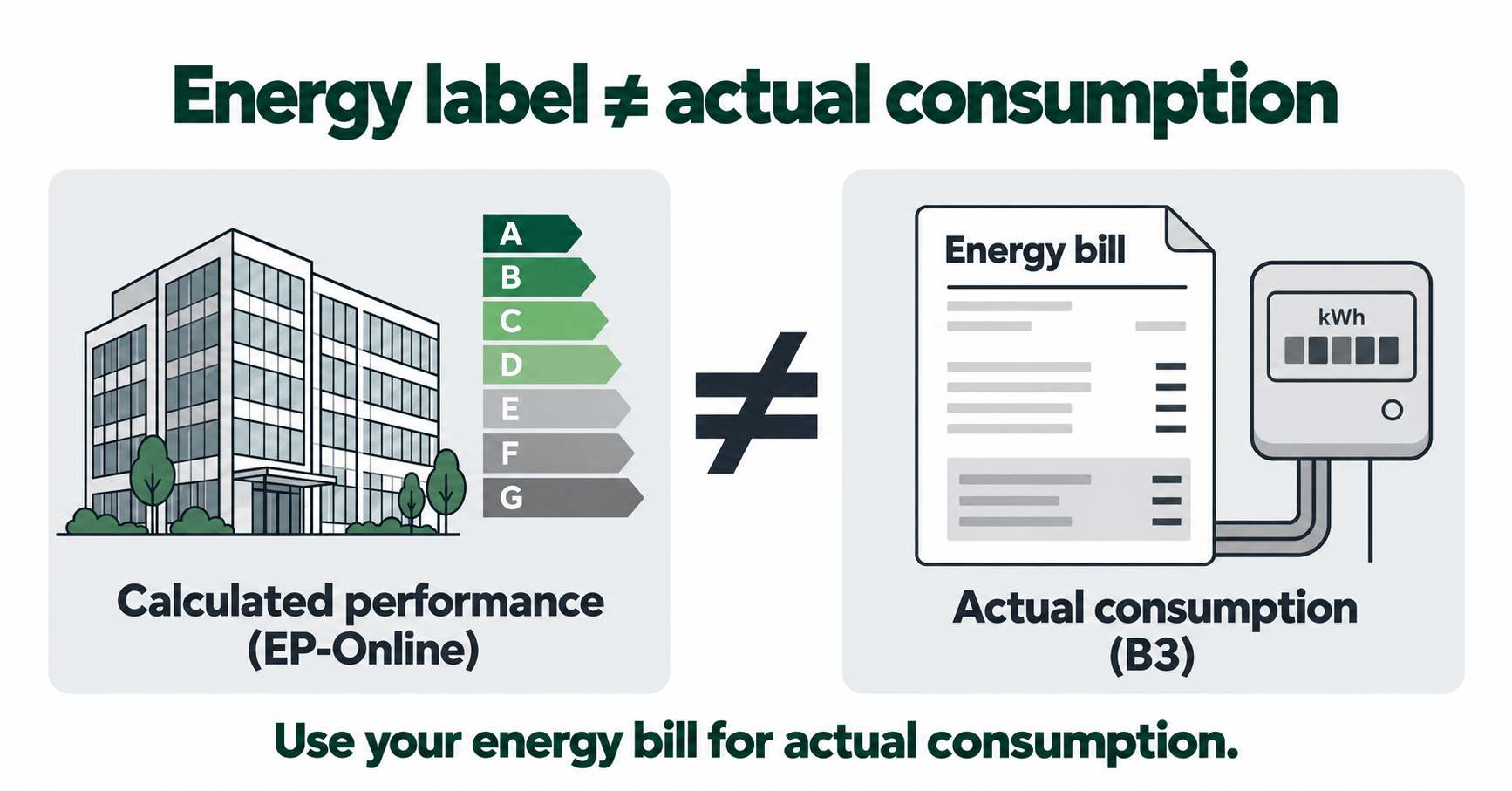
An EP-Online energy label next to an energy bill: calculated building performance is not the same as actual use.
Calculating CO₂: Scope 1 and Scope 2 with Dutch factors
The VS asks for estimated Scope 1 and location-based Scope 2 emissions in tonnes of CO₂ equivalent, with the GHG Protocol as the reference.
- Scope 1: direct emissions from sources you own or control: diesel and petrol in your vehicles, natural gas in your boilers, machine fuel and refrigerant leaks. Evidence: fuel cards, gas bills, fleet reports and maintenance logs for cooling equipment.
- Scope 2: indirect emissions from purchased electricity, heat or cooling.
Which factors? In the Netherlands the standard list is CO2emissiefactoren.nl, managed by Rijkswaterstaat (the national public works agency) and Stichting Stimular. You download the factors per year, including 2026. Use the factor for the same year as your consumption.
Location-based versus market-based. Location-based uses the average Dutch electricity mix, whatever your contract. Market-based uses your own supplier's fuel mix or guarantees of origin. A green-power contract lowers your market-based emissions, but not your location-based Scope 2 to zero.
Check your 2025 figures. According to Stimular, the location-based factors for 2025 were still the 2024 values until 11 February 2026. If you calculated a 2025 footprint before that date, download the factors again and recalculate electricity (Milieubarometer, 2026 update).
For every calculation, keep the consumption data, the factor used with its year and source, the organisational boundary, the method and any assumptions. A CO₂ figure without a traceable calculation is not a usable datapoint.
Water (B6) and waste (B7): the figures are with your suppliers
Water. Only total water withdrawal is inside the cap. Start with the water company's bills and meter readings. If you rent premises and pay for water through service charges, ask the landlord for the meter readings or allocation key, and record how you allocated.
Waste. Here you have an advantage many companies miss: if you dispose of commercial waste, Dutch law already requires you to keep a waste register (afvalstoffenregistratie). It records the date, type and quantity of each disposal, plus the contract, waybills where applicable and invoices, and you must keep it for five years. That is exactly the source for B7 39(a).
For the recycling share (B7 39(b)) you need the processing route. Ask your waste company for an annual report per waste stream with the confirmed destination.
Waste stream (fictional distribution centre, 2026) | Quantity | Confirmed processing |
|---|---|---|
Cardboard | 18 tonnes | Recycling |
Plastic film | 6 tonnes | Recycling |
Mixed commercial waste | 12 tonnes | Incineration |
Hazardous waste | 1 tonne | Specialist treatment |
Total | 37 tonnes | 24 tonnes (65%) to recycling |
Report the 65% only if the waste company confirms the recycling. Collected separately does not automatically mean recycled.
Workforce (B8 and C5): payroll is your starting point
For B8 you report employees by temporary or permanent contract and by gender, in headcount or FTE. Both are in your payroll or HR system. The split by country is outside the cap.
Agency workers do not count in B8. The VS defines an employee as someone in an employment relationship with your company under national law. Agency workers (uitzendkrachten) are employed by the staffing agency. You may report them separately and voluntarily under C5 (paragraph 60). In logistics and facility services, with heavy use of agency staff, this makes a real difference to the figures.
For C5, calculate employee turnover: leavers divided by average headcount. Choose one method and keep it every year.
Work accidents (B9): your Arbo register is almost an exact match
This is good news few articles mention. The VS defines a recordable work-related accident as one that results in death or more than three days' absence. The Dutch Working Conditions Act (Arbowet) already requires employers to record every work accident causing more than 3 working days' absence (Article 9 Arbowet, Arboportaal). Your existing register is therefore the right source.
Dutch record | What it contains | Usable for B9? |
|---|---|---|
Notification to the Labour Inspectorate | Only accidents causing hospital admission, permanent injury or death | No, too narrow: a subset |
Arbo accident register | All accidents with more than 3 working days' absence | Yes, the best source |
Sickness absence records | All absence, including non-work-related | Only as a cross-check |
Do not count near misses or first-aid cases. For the accident rate you also need total hours worked; follow the method in EFRAG's guidance and keep it the same every year.
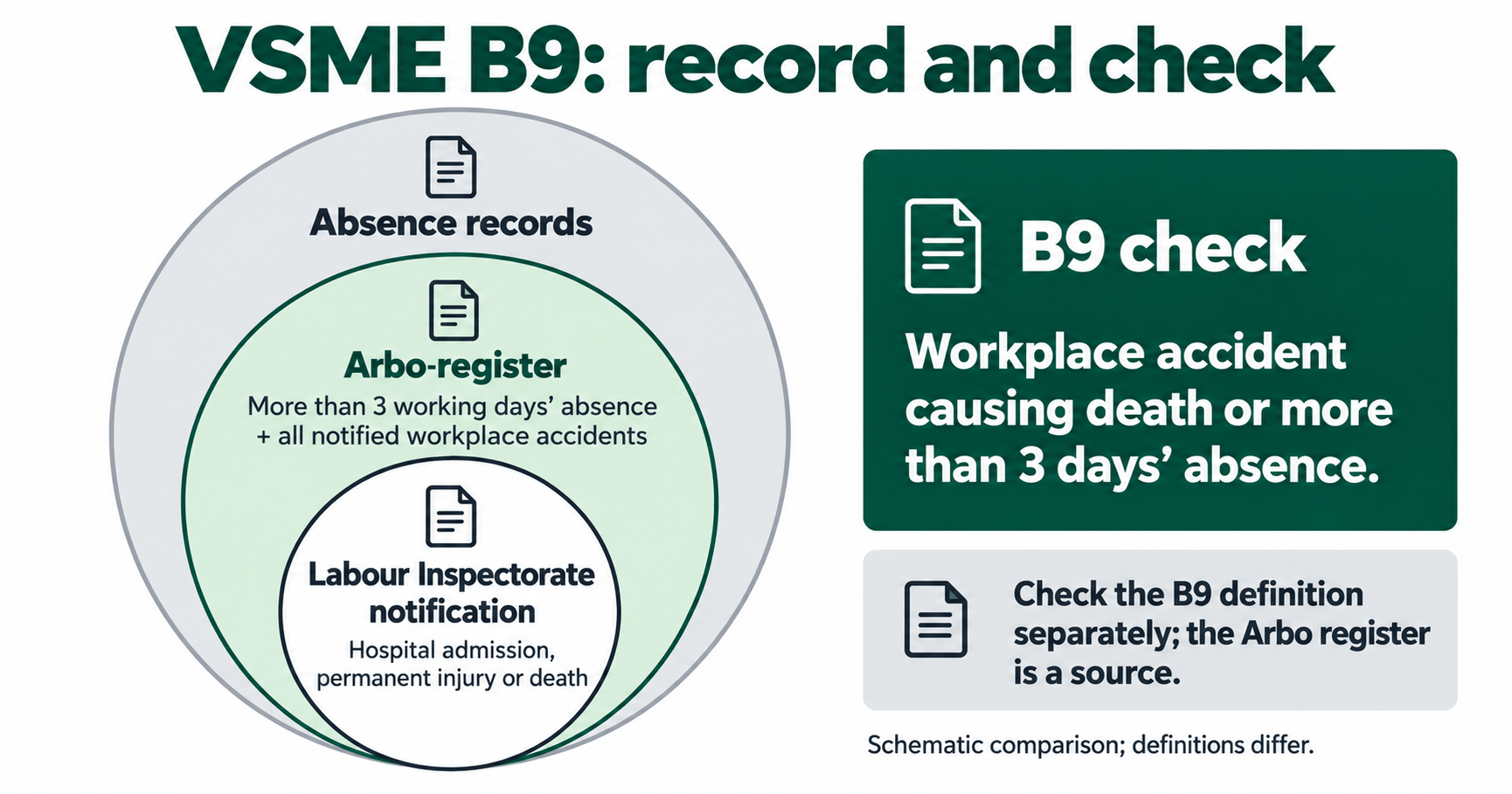
Comparison of Dutch absence records, the Arbo accident register and Labour Inspectorate notifications for VSME B9.
Minimum wage, cao and training (B10): three figures from HR
Minimum wage. Since 1 January 2024 the Netherlands has had a statutory hourly minimum wage (minimumuurloon), indexed on 1 January and 1 July. Check both halves of your reporting period, not just the last payslip. If your staff fall under a cao, the cao wage applies where it is higher.
Cao coverage. B10 asks what percentage of your employees are covered by a collective labour agreement, not how many are union members. In the Netherlands a cao can apply in four ways: a company-level cao, membership of an employers' association that signed the cao, a sector cao declared generally binding (AVV), or a reference in the employment contract (Rijksoverheid).
Training hours. Divide total recorded training hours by average headcount: 1,200 hours across 100 employees is 12 hours per employee. Include VCA (Dutch safety certification), forklift and other safety training if it meets the definition. These are often recorded by Operations, not HR.
Governance (C1, C6, C7): short answers, careful evidence
- C1: describe your main services, markets and business relationships. A full customer list is not needed.
- C6: do you have a code of conduct or human-rights policy for your own workforce, and a complaints procedure? Answer “yes” only if the document has been formally adopted. Which topics the policy covers is outside the cap.
- C7: confirmed incidents involving child labour, forced labour, human trafficking or discrimination, in your own organisation and in the value chain. An unconfirmed report is not a confirmed incident. Do not share confidential case files.
B11 (convictions and fines for corruption) is part of the Basic Module but not in Annex II. A CSRD customer cannot require it under the cap.
Outside the cap, but often asked by banks: C3 and C4
Emissions-reduction targets (C3) and climate risks (C4) are outside Annex II. Banks still ask about them more and more, because they need this information for their own ESG risk management. For property, warehousing and logistics, C4 covers issues such as flooding at warehouses, heat stress in distribution centres and stricter building-performance rules. Existing risk assessments, insurance reports and your EP-Online labels are a good starting point, but a label alone is not a climate-risk assessment.
Whether you share this information is a commercial choice. If a customer asks for it for its CSRD reporting, you may decline.
10 employees or fewer? A shorter list applies
VS disclosure | Inside the cap for 1–10 employees |
|---|---|
B1 | Module, reporting basis, general company information |
B8 | Employees by contract type and gender |
B9 | Number and rate of recordable accidents |
B10 | Minimum wage, cao coverage, training hours |
Energy, CO₂, water, waste and all C datapoints are outside the cap for this group. You may still report them voluntarily.
Worked example: a 145-employee facility-services company
Delta Facility Services BV (fictional) provides maintenance and technical management for offices and logistics buildings. It has its own office, six service vans and several large property clients. One client asks for VSME data for its CSRD reporting.
Disclosure | Existing source | Status |
|---|---|---|
B1 Company data | KvK extract, annual accounts, BAG IDs via EP-Online | Available |
B3 Energy | Annual statements for own office, fuel cards | Available; client buildings excluded |
B3 Scope 1 and 2 | Consumption × 2026 factors | Calculation needed |
B6 Water | Landlord service charges | Request allocation key |
B7 Waste | Waste register | Request recycling report |
B8 Workforce | Payroll | Available; agency workers separate |
B9 Accidents | Arbo accident register | Add hours worked |
B10 Cao and training | Cao application, training register | Add VCA hours |
C5 Turnover | HR leavers report | Calculation needed |
C6 Code of conduct | Staff handbook | Confirm complaints procedure |
The conclusion: almost all source information already exists. The work is in collecting, calculating, setting the organisational boundary and storing everything traceably, not in an expensive external ESG project.
From scattered records to one annual dataset
Record for each datapoint:
Field | Example |
|---|---|
VS reference | B3, paragraph 32 |
Reporting year | 2026 |
Owner | A named person, not just “Finance” |
Source document | Energy supplier's annual statement |
Method | Conversion to MWh, 2026 factor year |
Status | Ready / Partial / Missing / Not applicable / Needs review |
Approved by | Reviewer and date |
Annual rhythm: monthly, archive bills, fuel data, waste receipts and incidents; quarterly, check what is missing; after year-end, consolidate everything, calculate CO₂ and have the dataset approved. From your second reporting year, the VS also asks for prior-year comparatives, so keep definitions stable.
EFRAG's free Excel template
EFRAG offers a free VSME Digital Template in Excel, with a converter to a digital XBRL report. As of 27 October 2026 the current version is 1.3.0, dated 11 June 2026. It was built for the 2025 VSME Recommendation, not the final VS; EFRAG expects the updated version in Q4 2026. The template was developed for Excel 365 and is intended for companies with fewer than 250 employees.
For one company with a few sites, Excel is often enough. A structured process or software becomes worthwhile only with many sites, several data owners and recurring customer questionnaires.
Start with what you have
For Dutch companies in facility services, property management, logistics and warehousing, the first VSME step is practical. Energy data sits with Finance, building data in EP-Online, workforce data in payroll, accidents in the Arbo register and waste in your waste register. What is usually missing is the overview.
See which datapoints you already have. Take ESG Lite's free readiness check: in a few minutes and without uploading documents, you get a readiness score and a preview of your VSME checklist. If you want to go further, a full roadmap with a PDF report is available as a paid upgrade. Start the free VSME check
Sources
- Delegated Regulation (EU) 2026/1560: Voluntary Standard, Annexes I and II (EUR-Lex)
- EFRAG Knowledge Hub: Voluntary Standard and Annex II
- EFRAG: VSME Digital Template
- EP-Online: official Dutch energy label database (RVO)
- RVO: Energy-saving obligation (Dutch; English page)
- CO2emissiefactoren.nl: downloads
- Milieubarometer: 2026 CO₂ factor update
- Arboportaal: what the law says about work accidents (Dutch)
- Rijksoverheid: statutory hourly minimum wage (Dutch)
- Rijksoverheid: which cao must an employer apply? (Dutch)
- Ondernemersplein: registering commercial waste (Dutch; English version)
Machen Sie Ihr Geschäft online mit der besten nicht-technischen Lösung auf dem Markt.
30 Tage Geld-zurück-Garantie
Verabschieden Sie sich von Ihrer niedrigen Online-Verkaufsrate!
Which VSME datapoints can a CSRD customer require from my company?
Only the Annex II datapoints of Regulation (EU) 2026/1560, from financial year 2027, and only if you average no more than 1,000 employees. With 11–1,000 employees, that means selected items from B1, B3, B6–B10, C1 and C5–C7. With 10 or fewer, only from B1, B8, B9 and B10.
Where do I find my energy consumption for VSME B3 in the Netherlands?
In your annual electricity and gas statements, fuel-card data and any district-heating or landlord statements. Convert everything to MWh. If a site falls under the Dutch energy-saving obligation, your RVO filing is a useful cross-check.
Can I use my EP-Online energy label as my energy consumption?
No. An energy label is a calculated building performance, not measured consumption. B3 asks for actual consumption in the reporting period. EP-Online is useful for your site register (B1) and for conversations about climate risk and financing.
Which emission factors should Dutch companies use for Scope 2?
The factors from CO2emissiefactoren.nl, managed by Rijkswaterstaat and Stichting Stimular, for the same year as your consumption. For the VS, use location-based Scope 2, based on the average Dutch electricity mix. A green-power contract does not make that figure zero.
Is my Dutch Arbo accident register the same as VSME B9?
Almost. The Arbowet requires recording accidents with more than 3 working days' absence; the VS counts accidents causing death or more than three days' absence. Use the register, not just your notifications to the Labour Inspectorate, and add hours worked for the rate.
Do agency workers count in B8?
No. B8 counts employees in an employment relationship with your company. Agency workers are employed by the staffing agency. You may report them separately and voluntarily under C5.
Is cao coverage the same as union membership?
No. B10 asks what percentage of your employees are covered by a collective labour agreement, whether through a company cao, your employers' association, a generally binding sector cao or a reference in the employment contract. Union membership plays no role.