The EU Value Chain Cap Explained: What Your CSRD Customers Can (and Can't) Require From You From 2027
Short answer: The EU value chain cap limits the sustainability information that companies reporting under the CSRD can require from businesses in their value chain that average no more than 1,000 employees. For financial years starting on or after 1 January 2027, the ceiling is the list of datapoints in Annex II of Commission Delegated Regulation (EU) 2026/1560: 9 entries for companies with 10 or fewer employees and 23 entries for companies with 11 to 1,000. A protected supplier may decline anything beyond that list when it is requested for the customer's CSRD reporting.
Key facts at a glance
Question | Answer | Legal source |
|---|---|---|
What sets the cap? | Article 3 and Annex II of the Voluntary Standard regulation | |
Who is protected? | Value-chain businesses averaging no more than 1,000 employees in the preceding financial year | |
From when? | Financial years beginning on or after 1 January 2027 | Regulation 2026/1560, Article 4 |
Which requests does it cover? | Only information gathered for mandatory CSRD sustainability reporting | |
Does it cover non-EU suppliers? | Yes, the revised ESRS extend the limitation to non-EU value-chain businesses | |
Can a supplier share more? | Yes, voluntarily | Explanatory memorandum, C(2026) 5011 |
What is the EU value chain cap?
The value chain cap is a legal ceiling on what CSRD-reporting companies may require from smaller companies in their value chain. Article 3 of Regulation 2026/1560 states that the cap “shall only comprise the datapoints specified in Annex II.”
Three EU acts work together:
- Directive (EU) 2026/470 (Omnibus I) created “protected undertakings,” their right to decline, and the duties of the companies asking.
- Delegated Regulation (EU) 2026/1560 created the Voluntary Standard (VS), the successor to the VSME standard, and lists the capped datapoints in Annex II.
- Delegated Regulation (EU) 2026/1563 replaced the ESRS and tells reporting companies how to handle value-chain information, including estimates.
Every question in a supplier questionnaire falls into one of three groups:
Group | What it means for a protected supplier |
|---|---|
Inside the cap | An Annex II datapoint for your size band. The customer may require it for CSRD reporting. |
Beyond the cap | Requested for CSRD reporting but not in Annex II for your band. You may decline. |
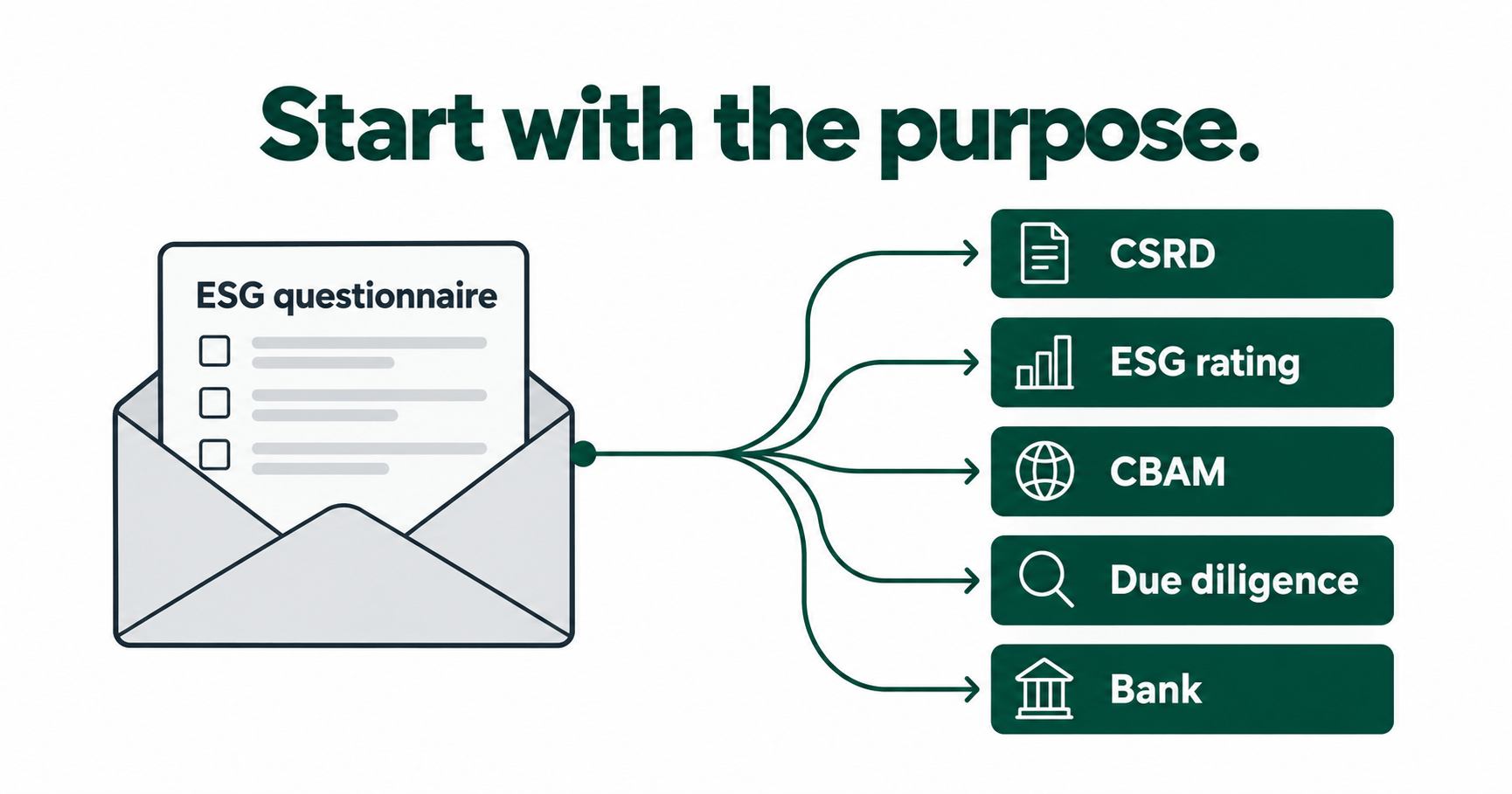
Outside the cap's purpose | Requested under another law, or for lending, investment, procurement or ratings. Different rules apply. |
Two points are easy to miss. First, the cap is a ceiling, not a duty: being in Annex II does not oblige you to answer. Second, the regulation expects reporting companies to request only what they need, and less than the standard where they do not need it. Annex II is a maximum, not a default questionnaire.
What changed on 24 September 2026?
On 24 September 2026 the Voluntary Standard entered into force, turning the EU's voluntary SME reporting framework into a legally defined ceiling on value-chain data requests.
Date | Milestone |
|---|---|
26 February 2026 | Directive (EU) 2026/470 (Omnibus I) published in the Official Journal |
18 March 2026 | Omnibus I enters into force |
3 July 2026 | Commission adopts the Voluntary Standard, C(2026) 5011 |
21 September 2026 | Regulations 2026/1560 (Voluntary Standard) and 2026/1563 (revised ESRS) published |
24 September 2026 | Voluntary Standard enters into force; it replaces the 2025 VSME Recommendation |
10 November 2026 | Revised ESRS enter into force |
November 2026 | EFRAG releases its updated Digital Template and guidance translations |
1 January 2027 | The cap applies to financial years starting on or after this date |
19 March 2027 | Deadline for Member States to transpose Omnibus I |
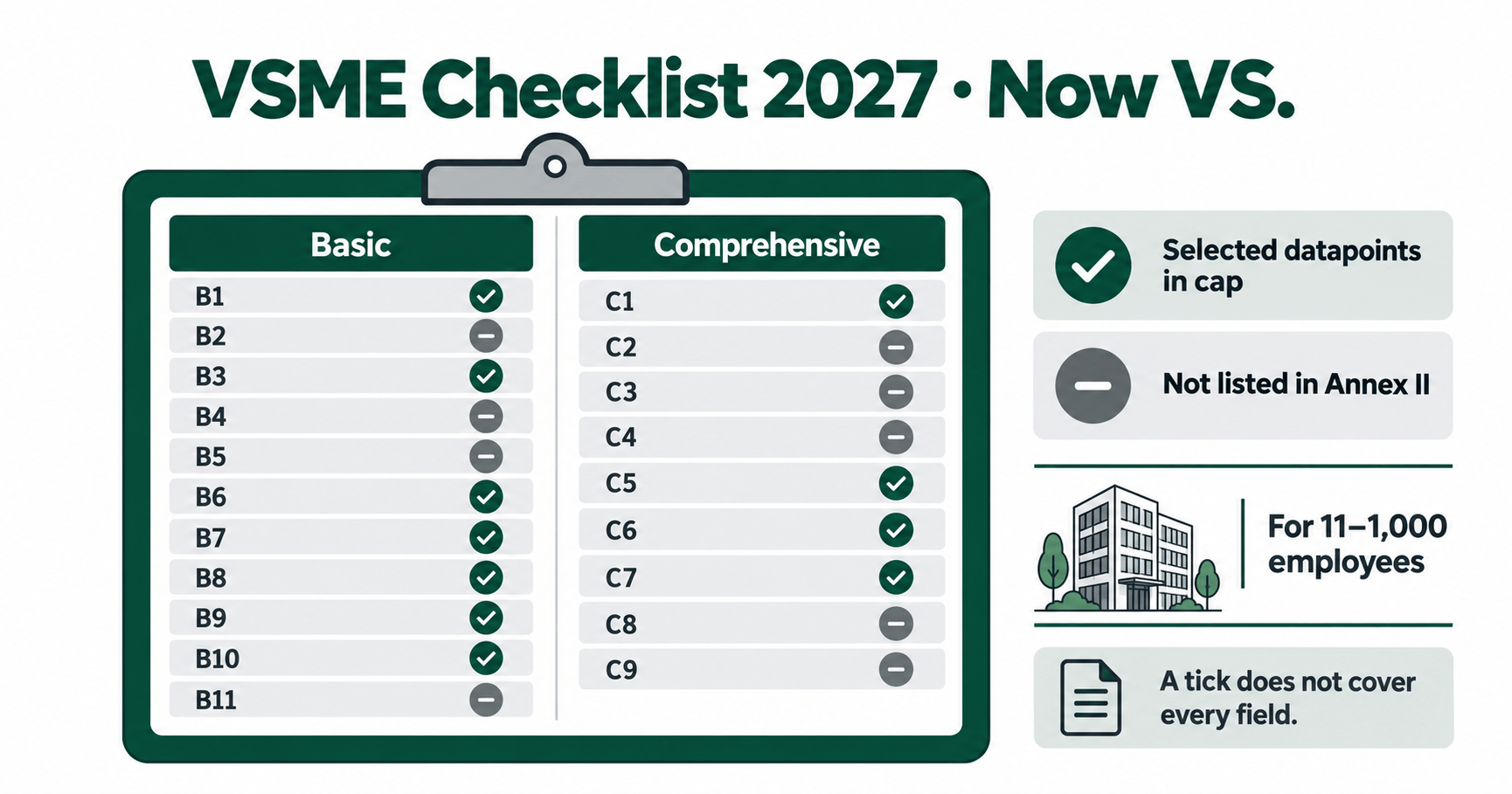
The Voluntary Standard has two modules. The Basic Module (B1–B11) covers general, environmental, social and governance metrics. The Comprehensive Module (C1–C9) adds information that customers, banks and investors often ask for. Many people still call it “VSME,” and EFRAG's tools still use that label.
Are you a protected undertaking?
You are protected if both conditions are met:
- Size: your average number of employees during the preceding financial year, assessed on your balance sheet date, does not exceed 1,000. “Does not exceed” means a company with exactly 1,000 employees qualifies. Summaries that say “fewer than 1,000” are wrong.
- Relationship: you are in the value chain of a company subject to mandatory CSRD reporting.
Turnover is not part of the test. You also do not need to publish a Voluntary Standard report to be protected.
Your headcount | How the cap applies |
|---|---|
1–10 employees | Reduced Annex II list (9 entries) |
11–1,000 employees | Full Annex II list (23 entries) |
More than 1,000 employees | Not a protected undertaking |
Proving it is simple. Omnibus I lets the reporting company rely on your self-declaration of size. It does not need to verify it unless the declaration is manifestly incorrect. Keep a record of your average headcount and the financial year it relates to.
Non-EU suppliers are covered too. The revised ESRS 1, adopted in Regulation 2026/1563, extends the value-chain limitation to non-EU businesses in a reporting company's value chain. A supplier in the UK, Turkey, India or the US selling to an EU reporter is therefore inside the same ceiling. Enforcing that right under a contract governed by non-EU law can be harder in practice.
Which datapoints are inside the cap? (Annex II)
Annex II lists 23 entries for companies with more than 10 employees and 9 for companies with 10 or fewer. It works at paragraph-and-point level, not at disclosure level.
Ref. | Datapoint inside the cap | 1–10 employees | 11–1,000 employees |
|---|---|---|---|
B1 27(a) | Module chosen (Basic only, or Basic and Comprehensive) | Yes | Yes |
B1 27(c) | Individual or consolidated reporting basis | Yes | Yes |
B1 27(e) | Company profile: legal form, NACE code, balance sheet total, turnover, employees, country, geolocation of sites | Yes | Yes |
B3 32 | Total energy consumption in MWh | No | Yes |
B3 33 | Estimated gross GHG emissions: Scope 1 and location-based Scope 2 | No | Yes |
B6 36 | Total water withdrawal | No | Yes |
B7 38 | Whether and how you apply circular-economy principles | No | Yes |
B7 39(a) | Total waste, split hazardous and non-hazardous | No | Yes |
B7 39(b) | Share of waste diverted to recycling or reuse | No | Yes |
B8 40(a) | Employees by contract type (temporary or permanent) | Yes | Yes |
B8 40(b) | Employees by gender | Yes | Yes |
B9 41(a) | Number and rate of recordable work-related accidents | Yes | Yes |
B10 42(a) | Pay at or above the applicable minimum wage | Yes | Yes |
B10 42(c) | Share of employees covered by collective bargaining | Yes | Yes |
B10 42(d) | Average annual training hours per employee | Yes | Yes |
C1 46(a) | Main products and services | No | Yes |
C1 46(b) | Main markets | No | Yes |
C1 46(c) | Main business relationships | No | Yes |
C5 58 | Employee turnover rate | No | Yes |
C6 61(a) | Code of conduct or human rights policy (yes/no) | No | Yes |
C6 61(c) | Complaints-handling mechanism (yes/no) | No | Yes |
C7 62(a) | Confirmed human-rights incidents in your own workforce | No | Yes |
C7 62(c) | Awareness of confirmed incidents in the value chain, communities or among consumers | No | Yes |
Source: EFRAG Knowledge Hub, Voluntary Standard Annex II. Descriptions are simplified; the legal text in Regulation 2026/1560 prevails.
The fine print: parts of capped disclosures that sit outside the cap
A question labelled “B3” or “B10” is not automatically inside the cap. Several points within otherwise capped disclosures are excluded:
Disclosure | Inside the cap | Outside the cap |
|---|---|---|
B1 | Module, reporting basis, company profile | List of omitted disclosures (27(b)), list of subsidiaries (27(d)), certifications and labels (28) |
B3 | Total MWh; Scope 1 and location-based Scope 2 | Renewable vs non-renewable energy breakdown (32, second sentence) |
B6 | Total water withdrawal | Water consumption and use in water-stressed areas (37) |
B7 | Circular principles, waste totals, recycling share | Annual mass-flow of materials (39(c)) |
B8 | Headcount by contract type and gender | Headcount by country (40(c)) |
B9 | Number and rate of accidents | Fatalities (41(b)) |
B10 | Minimum wage, collective bargaining, training hours | Gender pay gap (42(b)) |
C1 | Products, markets, business relationships | Sustainability-related strategy elements (46(d)) |
C6 | Policy exists; complaints mechanism exists | Which topics the policy covers (61(b)) |
C7 | Confirmed incidents | Description of actions taken (62(b)) |
Some of these are cheap to answer, such as fatalities when there were none. Others, such as a material mass-flow, can take real work. Either way, the decision to answer is yours.
Disclosures that are not in Annex II at all
These Voluntary Standard disclosures sit entirely above the cap: B2 (sustainability practices and policies), B4 (pollution), B5 (biodiversity), B11 (corruption convictions and fines), C2 (policy descriptions), C3 (GHG reduction targets and transition plans), C4 (climate risks), C8 (revenues from certain sectors) and C9 (board gender diversity). The Standard's guidance on Scope 3 emissions (paragraphs 49–52) is also outside Annex II.
What can a CSRD customer still ask for beyond the cap?
The cap limits what a reporting company can require for CSRD reporting. It does not ban broader questions. Five areas come up most often.
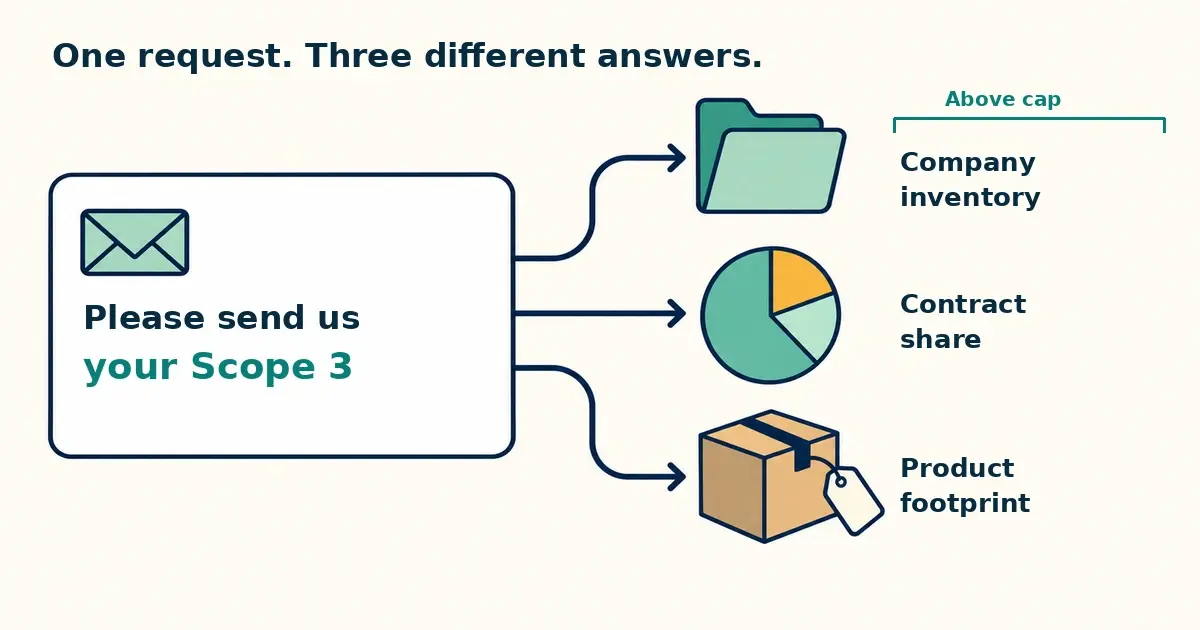
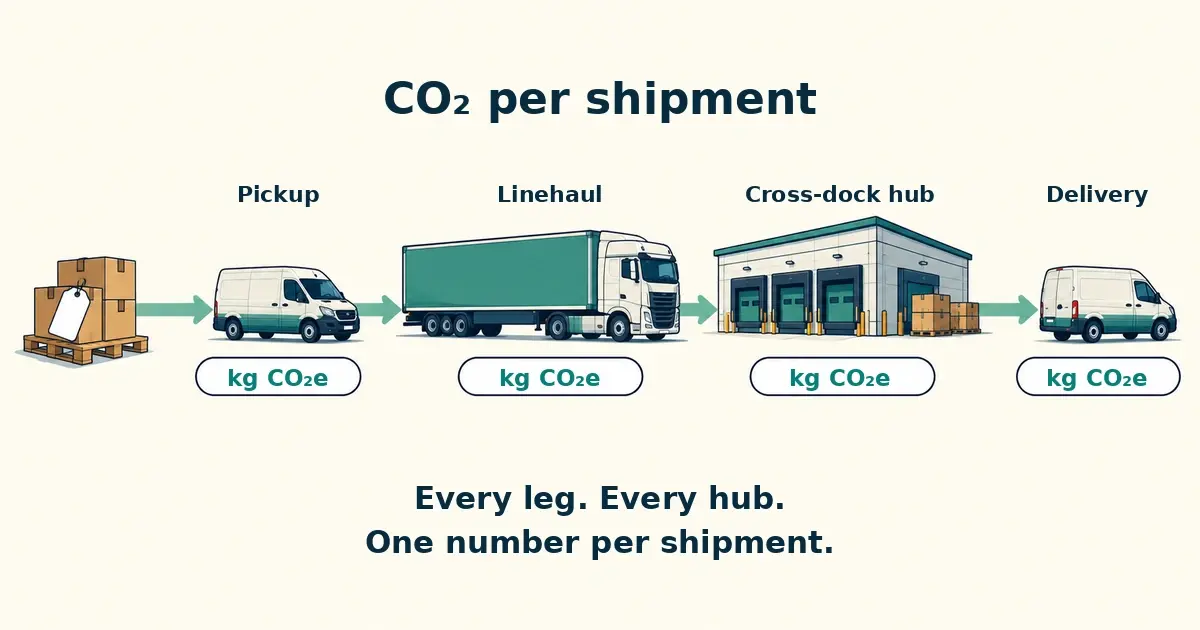
Scope 3 and customer-specific emissions. Annex II covers your own Scope 1 and location-based Scope 2. It does not cover your Scope 3 inventory or emissions allocated to the services you deliver for one customer. The Standard itself notes that Scope 3 may be relevant for manufacturing, construction, real estate and packaging businesses, so expect these questions anyway.
Targets and transition plans (C3). A request for a 2030 reduction target or a climate transition plan is above the cap. You may still choose to share it.
Climate risk assessments (C4). Questions about flood, heat or transition risk across your sites are above the cap for CSRD purposes.
Other EU and national laws. The cap applies only to information gathered for sustainability reporting under the Accounting Directive. It does not affect requests needed under other EU or national legislation, such as the EU Deforestation Regulation or due-diligence rules.
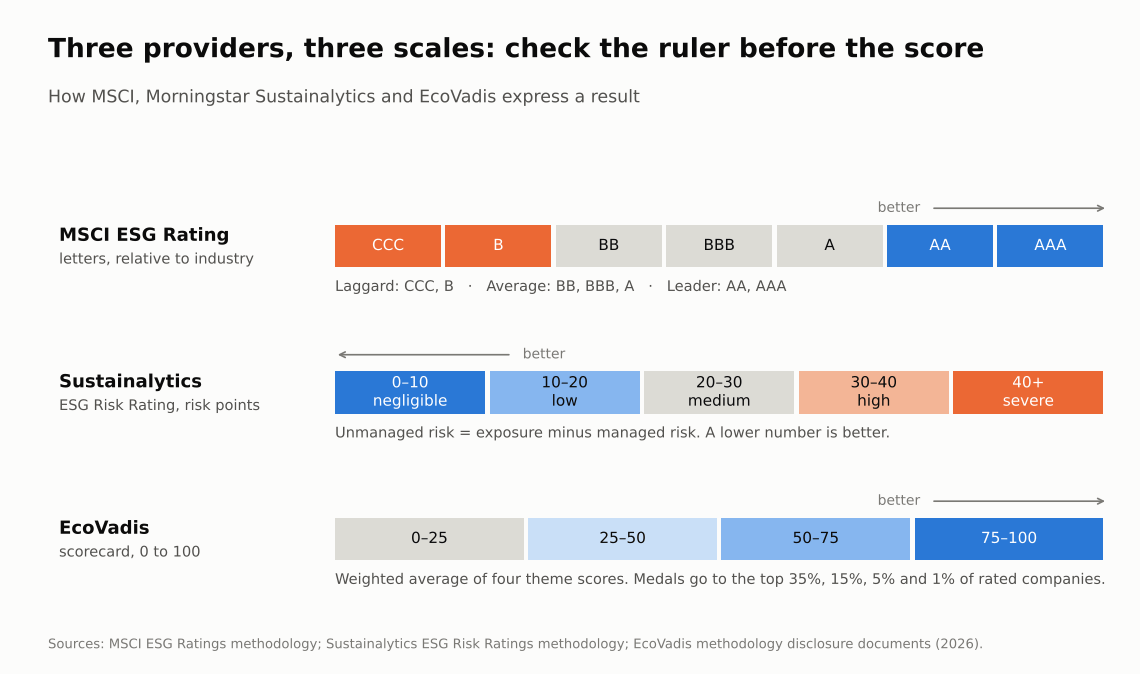
Banks, investors and ratings. Lenders, investors and rating platforms such as EcoVadis or CDP ask for their own purposes, which the cap does not govern. However, Omnibus I covers requests made “directly or indirectly” for CSRD reporting. A reporting company cannot escape the cap by routing its CSRD data collection through a third-party platform. What matters is why the data is requested, not which tool sends the form.
The Commission also notes that the cap does not stop businesses from voluntarily sharing information that is commonly shared in their sector.
“Can't require” does not mean “can't ask”
When a reporting company asks a protected supplier for more than the cap allows, Omnibus I requires it to tell the supplier which information exceeds the limit and that the supplier has a statutory right to decline. Contractual arrangements cannot be used to impose above-cap requests for CSRD purposes.
That does not end the conversation. Under the revised ESRS, reporting companies may use estimates, such as sector averages or other indirect data, when supplier data is unavailable. If you decline, your customer may estimate your footprint, and that estimate may not reflect your actual performance.
Your legal right to decline and your commercial interest in sharing better data are separate decisions. Weigh both.
Worked example: a 160-person logistics company
Northway Logistics is a fictional third-party logistics firm with two warehouses, a mixed delivery fleet and 160 employees. In early 2027 its largest customer, a CSRD reporter, sends a sustainability questionnaire for its CSRD report.
Customer's question | Classification | Suggested approach |
|---|---|---|
Total energy consumption in MWh | Inside the cap (B3 32) | Prepare from utility and fuel invoices |
Renewable vs non-renewable split | Beyond the cap (B3 breakdown) | Often easy from invoices; share if available |
Scope 1 and location-based Scope 2 | Inside the cap (B3 33) | Provide with the method used |
Number and rate of recordable accidents | Inside the cap (B9 41(a)) | Use the safety log |
Workplace fatalities | Beyond the cap (B9 41(b)) | Low effort; answering is usually sensible |
Gender pay gap | Beyond the cap (B10 42(b)) | Share only if already calculated |
Employee turnover rate | Inside the cap (C5) | Get the figure from HR |
Emissions per delivery for this customer | Beyond the cap (Scope 3 for the customer) | Weigh cost against commercial value |
Science-based 2030 target | Beyond the cap (C3) | Answer voluntarily if you have one |
Full climate risk assessment | Beyond the cap (C4) | Ask about the purpose first |
This classification is illustrative and assumes every question is asked for the customer's CSRD reporting. It is not a determination about any real contract.
Estimate versus actual data
Without Northway's data, the customer's generic model attributes 310 tCO2e to the contracted transport service. Northway's fuel and delivery records support 245 tCO2e for the same service and period. Both figures are hypothetical.
Approach | Illustrative emissions |
|---|---|
Customer's generic estimate | 310 tCO2e |
Supplier-supported calculation | 245 tCO2e |
Difference | 65 tCO2e (about 21% lower) |
Northway is not required to produce this calculation under the cap. Sharing a well-documented figure may still help it look better than the generic estimate. The customer must assess the data's quality and is not obliged to accept the lower number. If producing the figure needed expensive consultancy for little commercial value, declining would be equally reasonable.
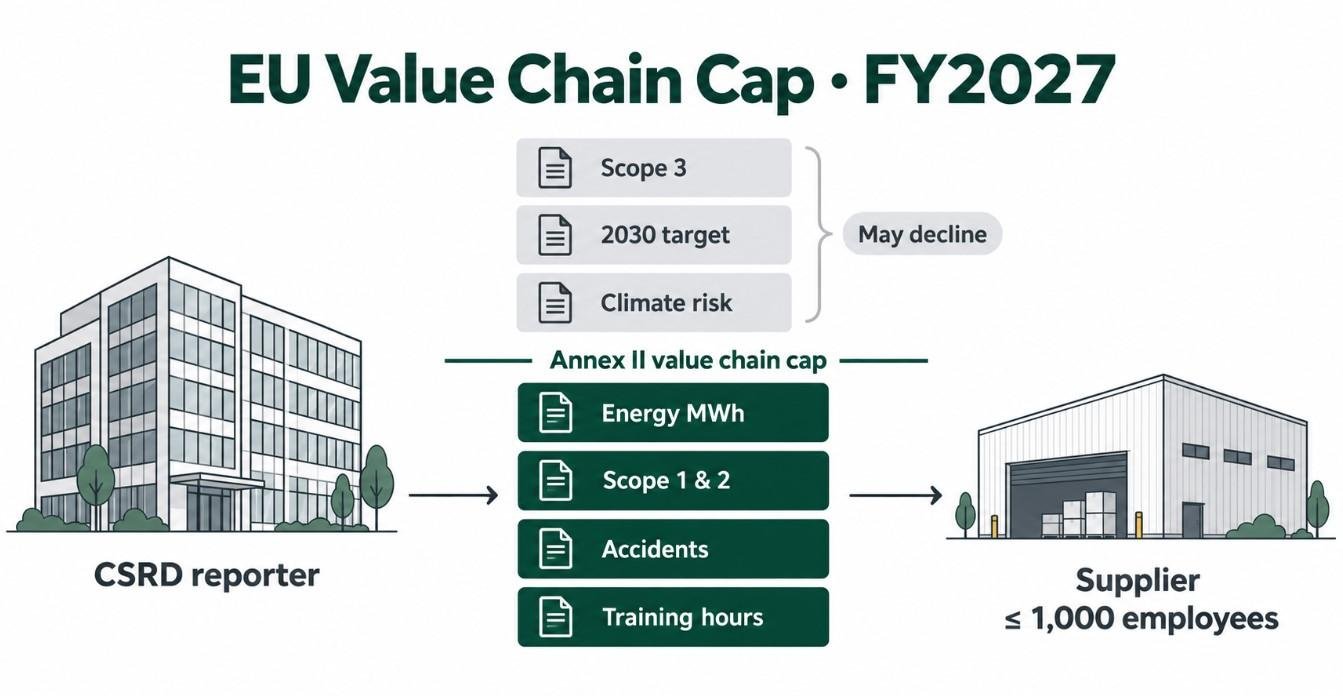
Diagram of the EU value chain cap: Annex II datapoints a CSRD customer can require from a supplier, and requests above the cap.
A five-step decision framework for finance and operations teams
- Check the purpose. Is the question for the customer's mandatory CSRD reporting? If not, find the other legal or commercial basis before relying on the cap.
- Check your status. Confirm your average headcount for the preceding financial year and that the requester is a CSRD reporter.
- Check the exact datapoint. Match each question to an Annex II paragraph and point for your size band, not just the B or C code.
- Weigh the commercial value. Consider the customer's importance, your data quality, the cost of preparing an answer and the risk of an unfavourable estimate.
- Answer defensibly. Never invent figures. Document methods, estimates and assumptions.
How to reply to an above-cap request
You do not need a legal objection. Ask the customer to separate mandatory CSRD questions from voluntary ones. Adapt this template:
Subject: Sustainability questionnaire: clarifying the reporting scope
Dear [Name],
Thank you for your sustainability questionnaire. We have reviewed it against the Voluntary Standard in Commission Delegated Regulation (EU) 2026/1560, including the value chain cap that applies from the 2027 financial year.
With an average of no more than 1,000 employees, we fall within the protected-undertaking threshold. Several questions appear to go beyond the datapoints in Annex II.
Could you confirm which questions you need for your mandatory CSRD reporting and which are additional or commercial requests? We are glad to share relevant information we hold and to discuss further disclosures that support our partnership.
Kind regards, [Name, role, company]
Before relying on specific statutory rights in a dispute, check the national law that transposes Omnibus I and your contract terms.
What is still changing before 2027
- National transposition. Member States must transpose Omnibus I by 19 March 2027. The delegated regulations apply directly, but the protected-undertaking rights sit in the Directive, so national wording matters.
- EFRAG tools. EFRAG published updated English guidance in September 2026. It plans translations and an updated Digital Template in November 2026. The template makes data collection easier but does not change the cap.
- Revised ESRS. They enter into force on 10 November 2026 and apply to financial years from 2027.
- Questionnaire timing. Full 2027 data will only exist after the year ends. Requests in early 2027 are more likely to ask about methods, baselines and policies than final figures.
Frequently asked questions
What is the EU value chain cap?
It is the maximum sustainability information a CSRD-reporting company can require from value-chain businesses averaging no more than 1,000 employees. It consists only of the datapoints in Annex II of Delegated Regulation (EU) 2026/1560 and applies from financial years starting on or after 1 January 2027.
Can a CSRD customer require my Scope 3 emissions?
No, not for its CSRD reporting if you are a protected undertaking. Annex II covers only your Scope 1 and location-based Scope 2 emissions, and only if you have more than 10 employees. You may still share Scope 3 data voluntarily.
Does the cap protect a company with exactly 1,000 employees?
Yes. The test is an average of no more than 1,000 employees during the preceding financial year, so exactly 1,000 qualifies. The company must also be in the value chain of a CSRD reporter.
Is the whole VSME Basic Module inside the cap?
No. B2, B4, B5 and B11 are entirely outside Annex II. Some points within capped disclosures are also excluded, including fatalities under B9, the gender pay gap under B10 and the energy breakdown under B3.
Does the cap apply to EcoVadis, CDP or bank questionnaires?
Not as such. The cap covers information requested, directly or indirectly, for CSRD reporting. Banks, investors and rating platforms ask for their own purposes. If a CSRD reporter uses a platform to collect its CSRD data, the cap still applies to that collection.
Does the value chain cap apply to suppliers outside the EU?
Yes. The revised ESRS 1 in Delegated Regulation (EU) 2026/1563 extends the value-chain limitation to non-EU businesses in a reporting company's value chain. Enforcing it under non-EU contract law may be harder in practice.
Do companies with 10 or fewer employees have to give energy and emissions data?
Not under the cap. For this size band, Annex II excludes B3 energy and emissions, B6 water, B7 waste and all Comprehensive Module datapoints. The capped list covers only company profile and basic workforce data.
What suppliers should do now
- Map your Annex II datapoints. Most 50–250-person companies already hold much of this data in accounting, payroll, utility bills, safety logs and waste-contractor reports.
- Separate legal limits from commercial needs. Know which questions you can decline before deciding which ones are worth answering anyway.
- Build one reusable, evidenced dataset. Stop rebuilding the same energy, workforce and policy answers for every customer questionnaire.
See how ready your data is. Take ESG Lite's free readiness assessment. In a few minutes you get a readiness score and a preview of a VSME-aligned checklist, so you can see which datapoints you can already evidence before the next questionnaire arrives. Start your free assessment
Sources
- Commission Delegated Regulation (EU) 2026/1560: Voluntary Standard, Articles 3–4 and Annex II (EUR-Lex)
- Directive (EU) 2026/470: Omnibus I, protected undertakings and right to decline (EUR-Lex)
- Commission Delegated Regulation (EU) 2026/1563: revised ESRS, including ESRS 1 on value-chain information (EUR-Lex)
- Explanatory memorandum to C(2026) 5011 (EUR-Lex)
- EFRAG Knowledge Hub: Voluntary Standard and Annex II
- EFRAG: updated Voluntary Standard guidance and Digital Template plans
- IBR-IRE: comparison of the final revised ESRS with EFRAG's draft (on the non-EU extension)
Make Your Business Online By The Best No—Code & No—Plugin Solution In The Market.
30 Day Money-Back Guarantee
Say goodbye to your low online sales rate!
What is the EU value chain cap?
It is the maximum sustainability information a CSRD-reporting company can require from value-chain businesses averaging no more than 1,000 employees. It consists only of the datapoints in Annex II of Delegated Regulation (EU) 2026/1560 and applies from financial years starting on or after 1 January 2027.
Can a CSRD customer require my Scope 3 emissions?
No, not for its CSRD reporting if you are a protected undertaking. Annex II covers only your Scope 1 and location-based Scope 2 emissions, and only if you have more than 10 employees. You may still share Scope 3 data voluntarily.
Does the cap protect a company with exactly 1,000 employees?
Yes. The test is an average of no more than 1,000 employees during the preceding financial year, so exactly 1,000 qualifies. The company must also be in the value chain of a CSRD reporter.
Is the whole VSME Basic Module inside the cap?
No. B2, B4, B5 and B11 are entirely outside Annex II. Some points within capped disclosures are also excluded, including fatalities under B9, the gender pay gap under B10 and the energy breakdown under B3.
Does the cap apply to EcoVadis, CDP or bank questionnaires?
Not as such. The cap covers information requested, directly or indirectly, for CSRD reporting. Banks, investors and rating platforms ask for their own purposes. If a CSRD reporter uses a platform to collect its CSRD data, the cap still applies to that collection.
Does the value chain cap apply to suppliers outside the EU?
Yes. The revised ESRS 1 in Delegated Regulation (EU) 2026/1563 extends the value-chain limitation to non-EU businesses in a reporting company's value chain. Enforcing it under non-EU contract law may be harder in practice.
Do companies with 10 or fewer employees have to give energy and emissions data?
Not under the cap. For this size band, Annex II excludes B3 energy and emissions, B6 water, B7 waste and all Comprehensive Module datapoints. The capped list covers only company profile and basic workforce data.