Energy Label C and the Dutch Energy-Saving Obligation: One Building Dataset for Regulators, Banks and Customers (2027)
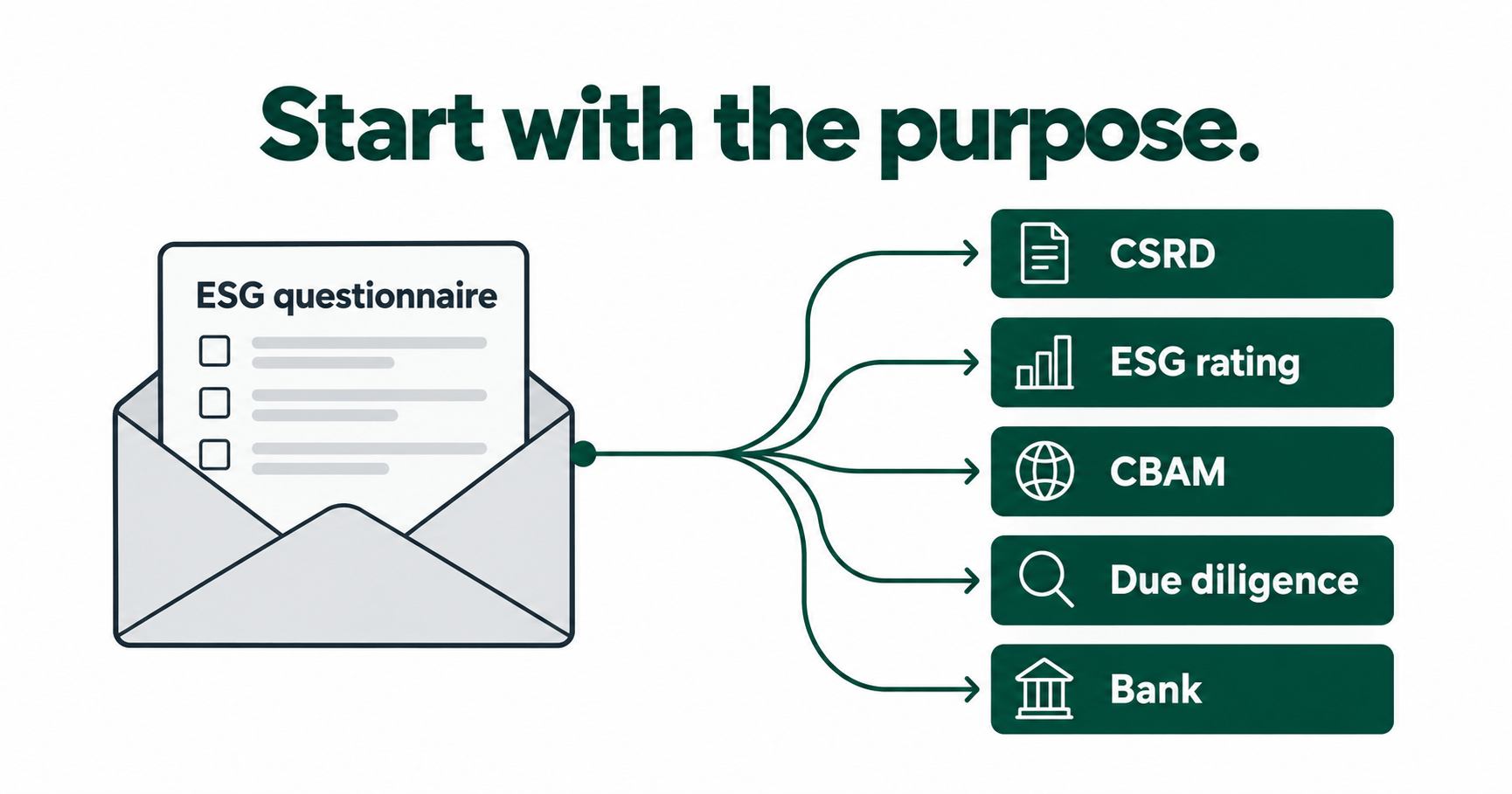
If you own or run a commercial building in the Netherlands, three parties now want facts about it. Your omgevingsdienst (environmental service) wants proof of energy-saving measures by 1 December 2027. Your bank wants to know how energy-efficient the collateral is. Your largest customer wants your energy use and Scope 1 and 2 emissions for its CSRD report. Most of the answers come from the same records: the energy label, meter readings, invoices and a list of completed measures. Collect them once, keep them in one place, and produce three different outputs from them.
Short answer
- Energy label C has been mandatory since 1 January 2023 for buildings where office use covers at least 50% of the floor area and at least 100 m², unless an exemption applies. An office without label C or better may not be used as an office.
- The energy-saving obligation (energiebesparingsplicht) applies per location using 50,000 kWh of electricity or 25,000 m³ of natural gas equivalent a year. You must take all measures with a payback period of 5 years or less. The next report under the information duty is due 1 December 2027.
- A move to a 7-year payback period is proposed for 2027, but it is not law yet. Until it is, the 5-year rule applies.
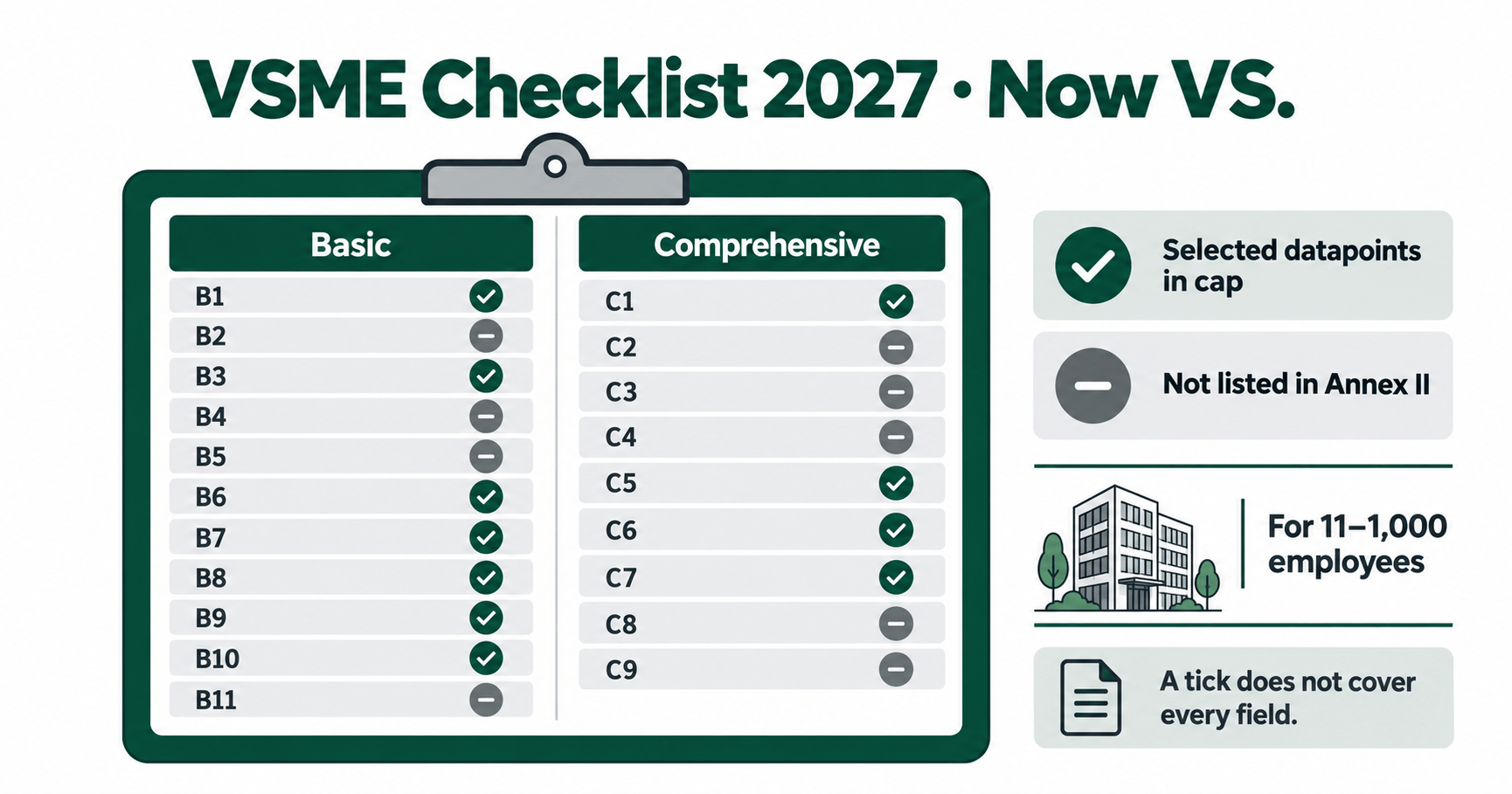
- Banks look at building energy performance under EBA guidelines. Customers can ask for energy consumption and Scope 1 and 2 under disclosure B3 of the EU Voluntary Standard (VS, formerly VSME), which is inside the value chain cap.
- One building dataset can feed all three. It does not replace the official label, the RVO report or a proper emissions calculation.
The three obligations at a glance
These rules sit at different levels. That is why a company with two buildings can be in scope for one rule and out of scope for another.
Rule | Level | Who is in scope | What you must do | Official source |
|---|---|---|---|---|
Energy label C for offices | Building | Office use at least 50% of floor area and at least 100 m² | Hold a registered label C or better (max. 225 kWh primary fossil energy per m² per year) | RVO, Energielabel C kantoren |
Energy-saving obligation and information duty | Location (buildings plus activities) | 50,000 kWh electricity or 25,000 m³ natural gas equivalent per year | Take all measures with a payback period of 5 years or less; report every four years | RVO, Energiebesparingsplicht |
EED energy audit | Enterprise or group | Today: large enterprises. After the revised rules: energy-use thresholds (10 TJ, 85 TJ) | Energy audit every four years; energy management system for the largest users | RVO, EED-auditplicht |
Keep the two payback periods apart. The office label C rule has an exemption when the measures needed to reach label C would take more than 10 years to pay back. The energy-saving obligation requires measures that pay back in 5 years or less. They are different tests in different rules.
Office building and warehouse in a Dutch business park, linked to a regulator, a bank and a customer to show one building dataset serving three requests.
When is energy label C mandatory for an office?
Check four things for each building:
- Does the building have an office function (kantoorfunctie)?
- Does office use cover at least 50% of the total usable floor area?
- Is the office area, including its ancillary space, at least 100 m²?
- Does an exemption apply? RVO lists, among others, listed monuments, buildings that will be expropriated or demolished, temporary buildings, and cases where the measures to reach label C have a payback period of more than 10 years.
If the rule applies and the office has label D or worse, or no registered label, the building may not be used as an office. Municipalities and environmental services enforce this.
Example 1: a 750 m² office with label D. The rule applies and no exemption is available, so the building does not comply. An energy advisor (EP-adviseur) can calculate which measures get it to label C. RVO suggests asking the advisor to include the EML measures in the same advice, so one site visit serves both rules.
Example 2: a 3,000 m² warehouse with a 200 m² office. Office use is about 6.7% of the floor area, well below 50%, so the label C rule does not apply. That says nothing about the energy-saving obligation. A warehouse with cooling, lighting and electric forklifts can easily pass 50,000 kWh.
Where to check the label: search EP-Online by postcode and house number, BAG ID or registration number. Save the label class, registration date, validity date (labels are valid for 10 years) and the address it covers.
How many offices comply? RVO's July 2026 figures
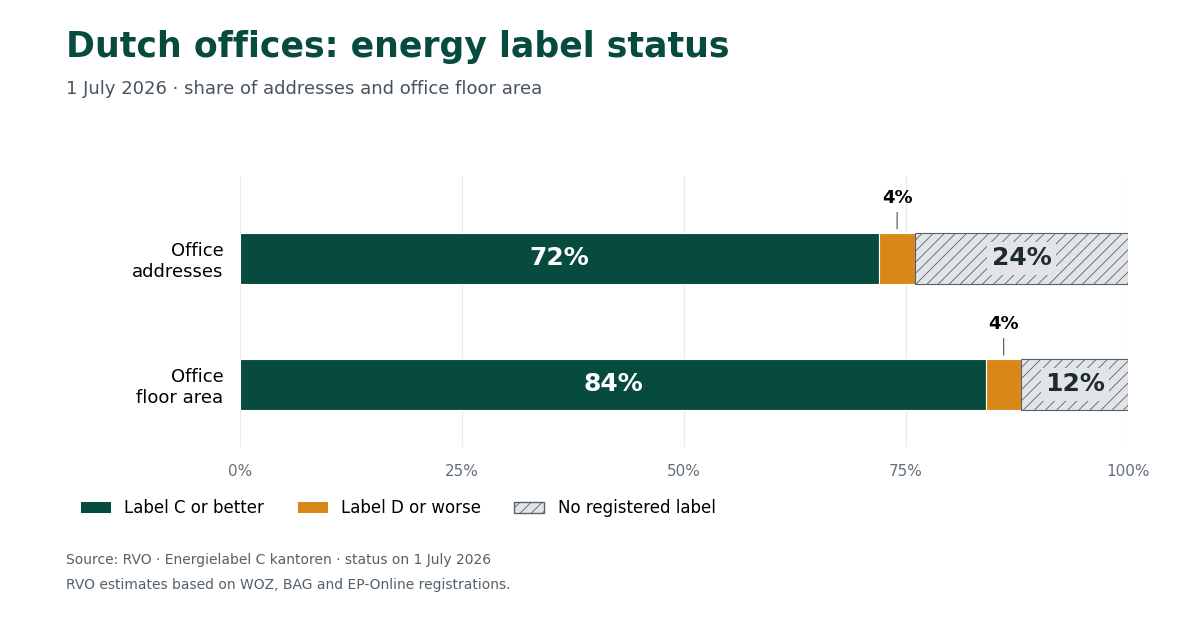
RVO estimates compliance twice a year using the WOZ, BAG and EP-Online registers. The latest status, at 1 July 2026:
Label status | Share of office addresses | Share of office floor area |
|---|---|---|
Label C or better | 72% | 84% |
Label D or worse | 4% | 4% |
No registered label | 24% | 12% |
The gap between the two columns tells you where the problem is. A quarter of office addresses have no registered label, but they hold only 12% of the floor area, so most unlabelled offices are small. Not all of them break the rule: some are exempt, and some are registered as offices but used differently. If you own small offices, check them before a buyer, tenant or bank does.
Does the energy-saving obligation apply to your location?
The obligation applies per location, based on the combined annual energy use of the buildings and the activities there. The threshold is met if you use either:
- 50,000 kWh of electricity or more, or
- 25,000 m³ of natural gas equivalent or more.
RVO's counting rules matter for logistics and facility companies:
- Use the most recent representative year. Skip a year with a production stop.
- Include energy you generate and use yourself, such as solar power. Energy you sell on does not count.
- Electric forklifts count, because they stay on the location. Charging for vehicles that drive off-site does not count.
- Energy used as a raw material does not count, and neither does a dwelling on the site.
Locations with very high use (10 million kWh or 170,000 m³ for certain sector activities under the Bal) have an energy-saving investigation duty (onderzoeksplicht) instead of the EML route.
What you must do
Take all energy-saving measures with a payback period of 5 years or less. Measures that cut CO₂ without saving energy, such as generating renewable power, can also count. The practical route is the Erkende Maatregelenlijst (EML), a list of recognised measures by sector. For each applicable measure you report one of three statuses:
- implemented,
- not implemented, or
- an alternative measure implemented that saves at least as much energy.
If you do not use the EML, you must show through your own study that you took all measures with a payback period of 5 years or less.
Who submits the report: owner or tenant?
Until the 1 December 2027 deadline, transitional rules from the Omgevingswet still apply to locations that had an information duty on 1 December 2023. For those locations, the drijver van de inrichting (the operator of the establishment) is formally responsible for the report. In general, the owner is responsible for building measures such as insulation and lighting, and the organisation running the activities is responsible for activity measures such as product cooling or electric motors. For offices and shops with few activity measures, the owner often reports for the tenant. RVO publishes a guide on who reports in rental situations. Agree it in writing per location.
Why banks ask about your building's energy performance
Two sets of EBA guidelines explain why the question appears in credit reviews:
- EBA/GL/2020/06 on loan origination and monitoring tells banks to take ESG factors that affect collateral value into account, and names the energy efficiency of buildings as an example.
- EBA/GL/2025/01 on the management of ESG risks applies from 11 January 2026 for most banks and from 11 January 2027 for small and non-complex institutions. Banks must assess the ESG risks of their counterparties, including transition risk.
A good label does not guarantee a lower rate, and a poor label does not mean automatic rejection. Credit decisions still rest on cash flow, loan-to-value and the bank's own policy. What a complete building file does is shorten the conversation and show that you know your renovation costs.
Bring to the bank meeting:
Information | Evidence |
|---|---|
Property and ownership | Address, BAG ID, land registry or lease |
Energy performance | Registered label from EP-Online |
Actual use | Annual meter readings or supplier statements |
Energy costs | Contracts and invoices |
Measures taken | EML status and invoices |
Planned work and cost | Advisor report, quotes, timeline |
Physical climate risk | Any flood or heat assessment you have |
Reusing the same data for VSME B3 and customer questionnaires
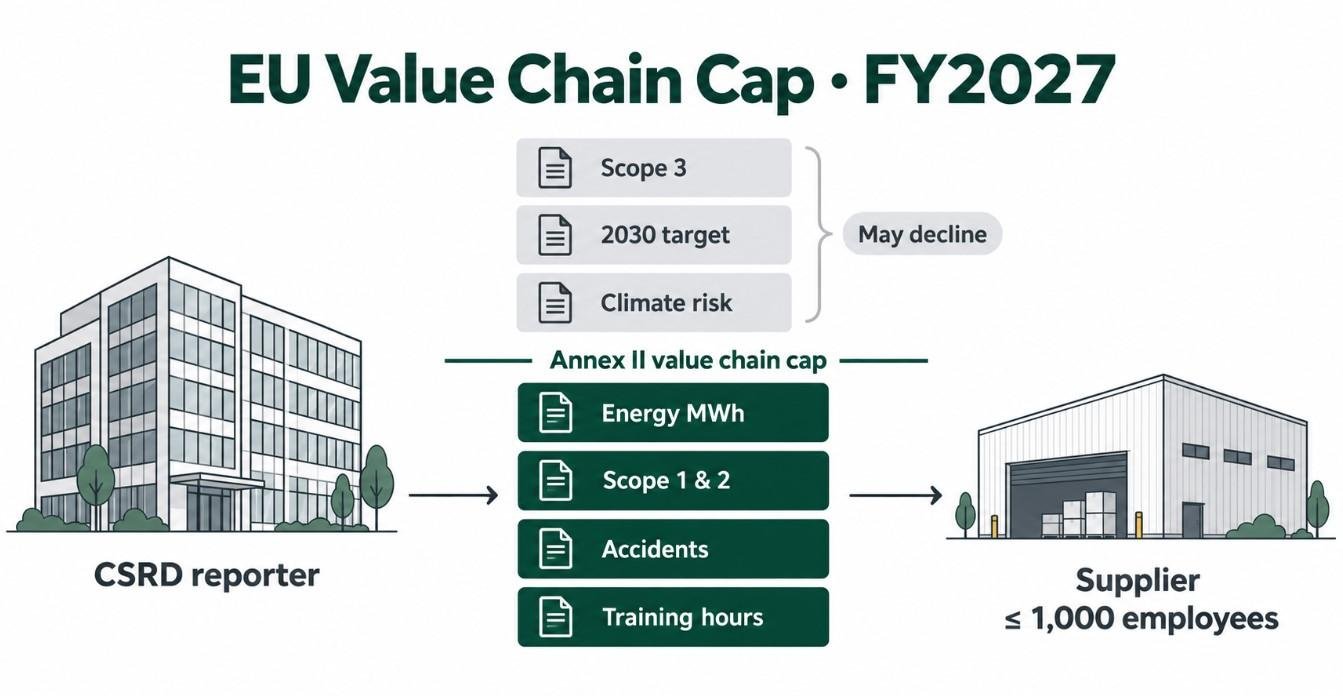
Your customer's request comes from a different direction. A company reporting under the CSRD asks suppliers for data, and since 2027 the value chain cap limits what it may ask a protected supplier (up to 1,000 employees on average) for that purpose. The cap is set out in Annex II of Commission Delegated Regulation (EU) 2026/1560, the Voluntary Standard. Disclosure B3 covers energy and greenhouse gas emissions, and its capped datapoints include total energy consumption in MWh, gross Scope 1 and location-based Scope 2 emissions.
Record you already keep | Original purpose | Reuse for B3 or the customer |
|---|---|---|
Electricity invoices and meter data | Costs, energy-saving obligation | Energy consumption, Scope 2 |
Gas invoices | Costs, energy-saving obligation | Energy consumption, Scope 1 |
Fuel cards (vans, trucks, diesel forklifts) | Fleet costs | Energy consumption, Scope 1 |
EML status per location | RVO report | Evidence of reduction measures |
Energy label | Label C rule, bank | Context only, not a B3 datapoint |
Renovation plan | Bank, management | Transition plan narrative (optional) |
An energy label is not an energy figure. The label is a calculated performance under the NTA 8800 method. B3 asks what you actually used. A label A office with long opening hours can use more energy than a label C office of the same size. Always report measured use.
Watch the boundary. Facility service companies often see their clients' energy data in the building management system. That energy belongs to the client, not to you. Under the GHG Protocol you count only sources within your own organisational boundary.
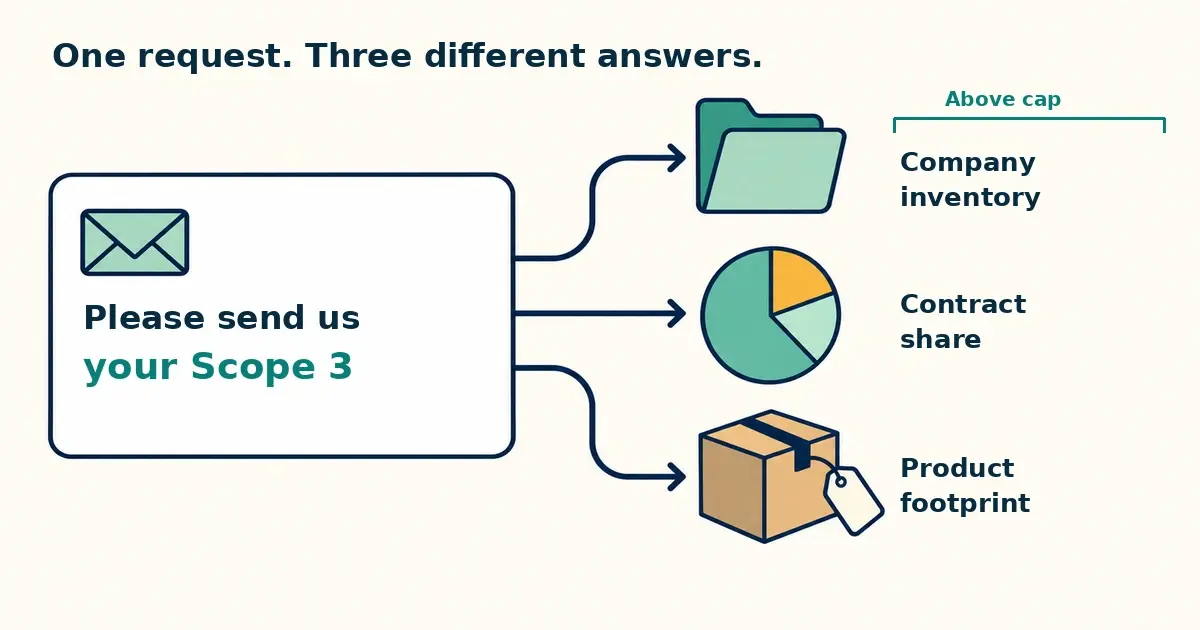
Scope 3 is outside the cap. If a customer asks for a full Scope 3 inventory solely for its CSRD report, you may decline that part. Requests for other reasons, such as a contract or a bank covenant, are not limited by the cap.
Worked example: one company, two buildings, three outputs
Delta Logistics BV (fictional, 125 employees) runs two locations:
Office | Warehouse | |
|---|---|---|
Floor area | 750 m² office | 3,000 m², of which 200 m² office |
Energy label | D | Not relevant for the label C rule |
Electricity per year | 82,000 kWh | 340,000 kWh (incl. electric forklifts) |
Natural gas per year | 9,000 m³ | 18,000 m³ |
Label C rule | Applies, does not comply | Does not apply (office use 6.7%) |
Energy-saving obligation | Applies (82,000 kWh is above 50,000) | Applies (340,000 kWh) |
Note the office row. It is easy to think only the warehouse is in scope for the energy-saving obligation, but the office also passes the electricity threshold, so Delta needs an EML report for both locations.
Total energy for B3. Electricity: 82,000 + 340,000 = 422,000 kWh = 422 MWh. Natural gas: 27,000 m³ × 8.79 kWh/m³ (lower heating value of 31.65 MJ/m³) ≈ 237 MWh. Total from buildings ≈ 659 MWh. Diesel for any vans or trucks comes on top.
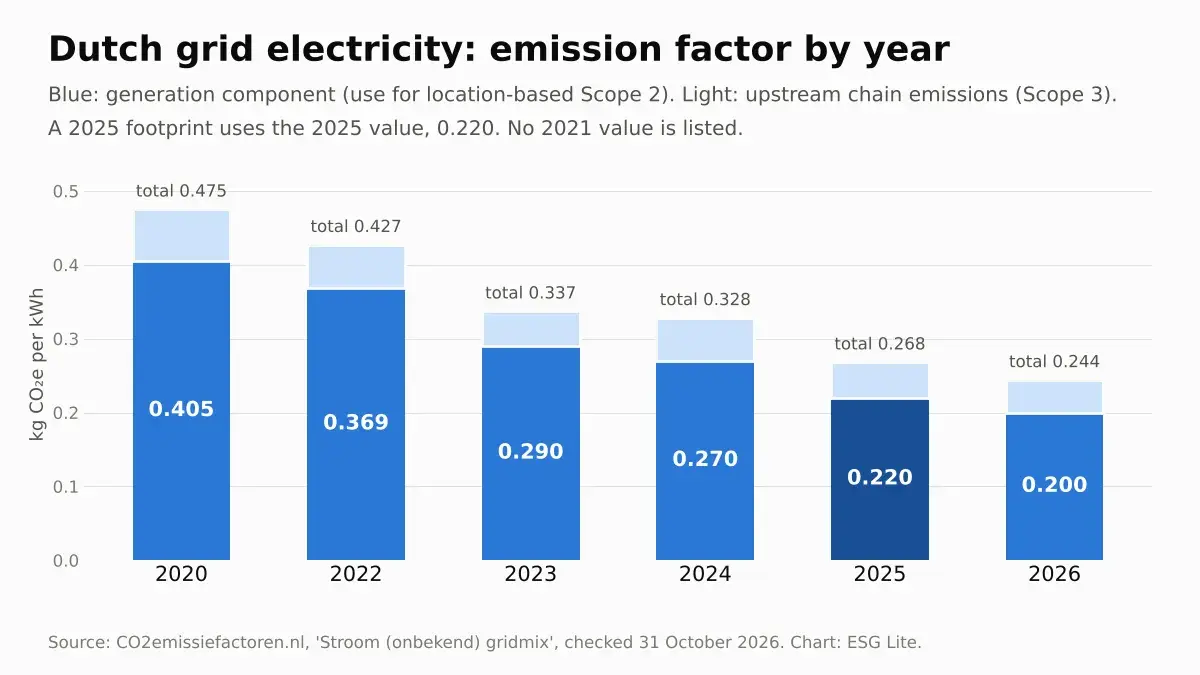
Emissions. Scope 1 = 27,000 m³ gas × the natural gas factor, plus vehicle fuel × the diesel factor. Scope 2 (location-based) = 422,000 kWh × the Dutch grid factor. Take the factors for your reporting year from CO2emissiefactoren.nl and note which ones you used.
Three outputs from one dataset:
- Omgevingsdienst: EML status per location with invoices as evidence, submitted via the RVO eLoket before 1 December 2027.
- Bank: label, actual use, energy costs, the advisor's plan to get the office to label C, and the investment needed.
- Customer: 659 MWh plus vehicle fuel, Scope 1 and Scope 2 for the financial year, with the boundary stated.
What to collect: the building data checklist
A spreadsheet is enough to start. One row per building, these columns:
Field | Source | Used for |
|---|---|---|
Address and BAG ID | BAG, land registry | Everything |
Owner, tenant, drijver | Deed, lease | Who reports |
Use and floor area per function | BAG, drawings | Label C rule |
Registered label, date, validity | EP-Online | Label C rule, bank |
Electricity kWh per year | Meter data, invoices | Threshold, B3 |
Gas m³ and other fuels per year | Invoices, fuel cards | Threshold, B3 |
EML status per measure | Advisor, own check | RVO report |
Evidence of measures | Invoices, completion records | Inspection |
Planned measures and cost | Quotes | Bank, management |
Scope 1 and 2 with factors used | Your calculation | B3, customer |
Add three control fields to every figure: reporting period, organisational boundary and evidence status (measured, estimated or missing). They stop the two most common errors: counting a client's energy as your own, and presenting an estimate as a measured value.
What changes in 2027 and after
Separate what is law today from what is proposed.
Change | Status on 27 October 2026 | What to do |
|---|---|---|
Information duty report due 1 December 2027 | In force | Start collecting evidence now |
Payback period from 5 to 7 years | Proposed (consultation 2026); updated obligation expected in 2027 | Keep using 5 years; screen which measures fall between 5 and 7 years |
Thresholds of 50,000 kWh / 25,000 m³ | Unchanged in the consultation | No change expected |
EPBD IV, third tranche (1 July 2027): worst-performing non-residential buildings at least label D by 1 January 2030 | Planned national implementation | Check older warehouses, workshops and halls now |
Revised EED: audit from 10 TJ (about 2.8 GWh), energy management system from 85 TJ (about 23.6 GWh) | Dutch law expected after Q1 2027; current EED audit duty applies until then | Add up group-wide energy use |
Energy label scale from 2030: A+ to A++++ dropped, scale G to A | Planned | Existing labels stay valid for 10 years |
One useful signal from RVO on EPBD IV: buildings that have label C by December 2029 will already meet the European requirements that apply from 2033. For owners of warehouses and halls that are not covered by the office rule, label C is a sensible target to plan towards.
A 30-day plan
Week 1. List buildings and roles. One row per building. Add use, floor area, label from EP-Online, owner, tenant and who reports.
Week 2. Collect consumption and measures. Twelve months of electricity and gas per location, fuel cards, and the EML for your sector. Mark each measure implemented, not implemented or alternative.
Week 3. Calculate. Check each location against the 50,000 kWh and 25,000 m³ thresholds. Calculate total MWh and Scope 1 and 2 with the factors written down.
Week 4. Review and package. Have Finance or Operations check the numbers. Then prepare three packs: the RVO report, the bank file and the B3 answers for customers.
Frequently asked questions
Is energy label C mandatory for every office in the Netherlands?
No. It applies when office use covers at least 50% of the building's usable floor area and at least 100 m², and no exemption applies. Exemptions include listed monuments, buildings due for expropriation or demolition, temporary buildings, and cases where reaching label C takes more than 10 years to pay back.
What happens if my office has label D?
If the rule applies and you have no exemption, the building may not be used as an office until it has a registered label C or better. The municipality or environmental service can enforce this.
What is the next deadline for the energy-saving information duty?
1 December 2027. You report the status of each applicable EML measure for each location in scope through RVO's eLoket.
Has the payback period already changed to 7 years?
No. On 27 October 2026 the rule is still 5 years or less. The 7-year period was proposed in a 2026 consultation and is expected in the updated obligation in 2027. Check the final text before you rely on it.
Do electric forklifts count towards the 50,000 kWh threshold?
Yes. Energy for vehicles that stay on the location, such as forklifts, counts. Charging for vehicles that drive off-site does not.
Can I use my energy label as my carbon footprint?
No. A label is a calculated building performance. VSME B3 asks for actual energy use in MWh and Scope 1 and 2 emissions calculated from that use.
Is VSME B3 mandatory for Dutch SMEs?
No. The Voluntary Standard is voluntary. But a customer that reports under the CSRD may ask for B3 data, and energy use and Scope 1 and 2 are inside the value chain cap, so expect the question.
Final takeaway
The energy label, the energy bills and the EML list are usually filed by three different people for three different reasons. Put them in one register per building, add the period, boundary and evidence status, and you can answer the omgevingsdienst, the bank and your customers from the same numbers. Start with the 1 December 2027 report: it forces you to collect most of the data anyway.
How ready is your company for customer and bank ESG requests? ESG Lite's free readiness assessment gives you a readiness score, the gaps that matter for VSME and a preview of your VSME-aligned checklist, in minutes and before you create an account. The full action plan and PDF report are available as a paid upgrade. Start the free assessment
Sources
- RVO, Energielabel C kantoren: scope, exemptions and status at 1 July 2026.
- EP-Online: official register of energy labels.
- RVO, Energiebesparingsplicht: thresholds, counting rules and the 5-year payback rule.
- RVO, Informatieplicht energiebesparing: 1 December 2027 deadline, EML statuses and the drijver van de inrichting.
- IPLO, Wijzigingen energiebesparingsplicht 2027 bekend: proposed 7-year payback period, unchanged thresholds.
- RVO, EPBD IV: implementation timeline and the label D 2030 requirement.
- RVO, Herziene EED-auditplicht: 10 TJ and 85 TJ thresholds and expected timing.
- EBA, Guidelines on the management of ESG risks (EBA/GL/2025/01).
- EBA, Guidelines on loan origination and monitoring (EBA/GL/2020/06): ESG factors and collateral valuation.
- Commission Delegated Regulation (EU) 2026/1560: Voluntary Standard and Annex II value chain cap.
- CO2emissiefactoren.nl: Dutch emission factors.
Make Your Business Online By The Best No—Code & No—Plugin Solution In The Market.
30 Day Money-Back Guarantee
Say goodbye to your low online sales rate!
1. Is energy label C mandatory for every office in the Netherlands?
No. It applies when office use covers at least 50% of the building's usable floor area and at least 100 m², and no exemption applies. Exemptions include listed monuments, buildings due for expropriation or demolition, temporary buildings, and cases where reaching label C takes more than 10 years to pay back.
2. What happens if my office has label D?
If the rule applies and you have no exemption, the building may not be used as an office until it has a registered label C or better. The municipality or environmental service can enforce this.
3. What is the next deadline for the energy-saving information duty?
1 December 2027. You report the status of each applicable EML measure for each location in scope through RVO's eLoket.
4. Has the payback period already changed to 7 years?
No. On 27 October 2026 the rule is still 5 years or less. The 7-year period was proposed in a 2026 consultation and is expected in the updated obligation in 2027. Check the final text before you rely on it.
5. Do electric forklifts count towards the 50,000 kWh threshold?
Yes. Energy for vehicles that stay on the location, such as forklifts, counts. Charging for vehicles that drive off-site does not.
6. Can I use my energy label as my carbon footprint?
No. A label is a calculated building performance. VSME B3 asks for actual energy use in MWh and Scope 1 and 2 emissions calculated from that use.
7. Is VSME B3 mandatory for Dutch SMEs?
No. The Voluntary Standard is voluntary. But a customer that reports under the CSRD may ask for B3 data, and energy use and Scope 1 and 2 are inside the value chain cap, so expect the question.