
"Can You Send Us Your Scope 3?" What an SME Supplier Should Answer When the Request Goes Beyond the Cap
Short answer
- Clarify first. "Your Scope 3" can mean your company-wide value-chain inventory, a footprint for the service you sell, or data the customer needs for Scope 3. Most customers mean the last one.
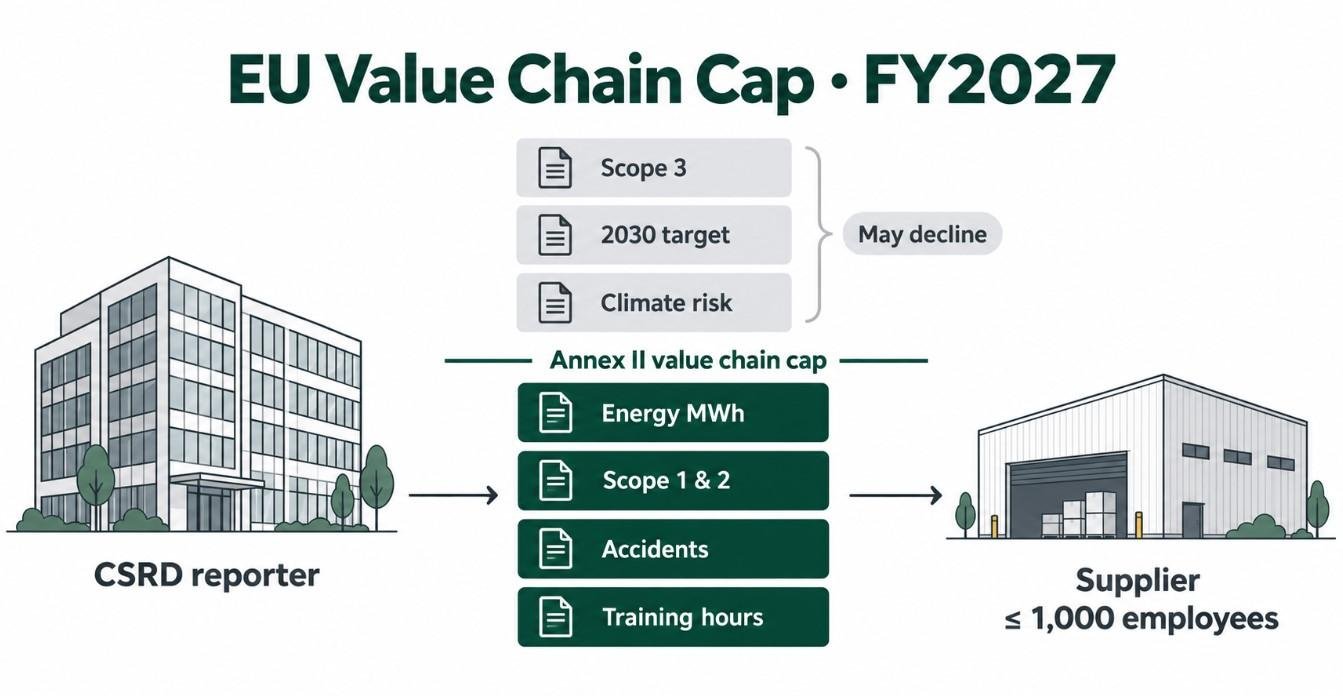
- Check the cap. From financial year 2027, a company reporting under the CSRD cannot your Scope 3 if you have up to 1,000 employees on average. It is not in the EU value chain cap. It may still ask, but must say the item is above the cap and that you may decline.
- Choose: answer, partial answer or decline. Often your Scope 1 and 2 allocated to their contract, clearly labelled, is the most useful reply. If you estimate, say so. If you decline, offer what you have.
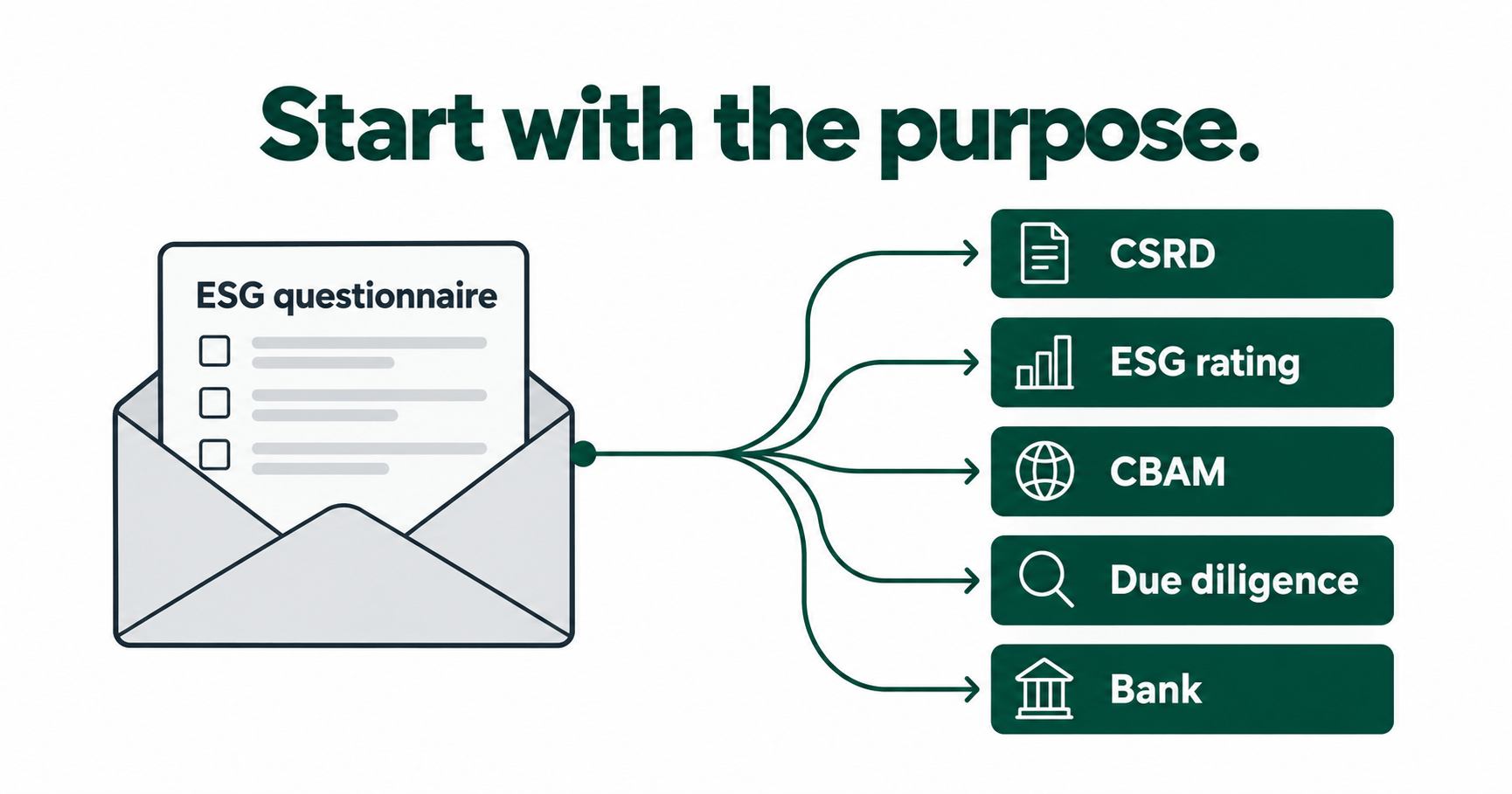
A customer emails: "Please send us your Scope 3 emissions by Friday." Taken literally, that can mean weeks of work. Often it hides a simpler question: This guide helps CFOs and commercial directors at facility services, logistics and installation companies decide what to send, with a contract-allocation example, a spend-based screening example and three reply templates.
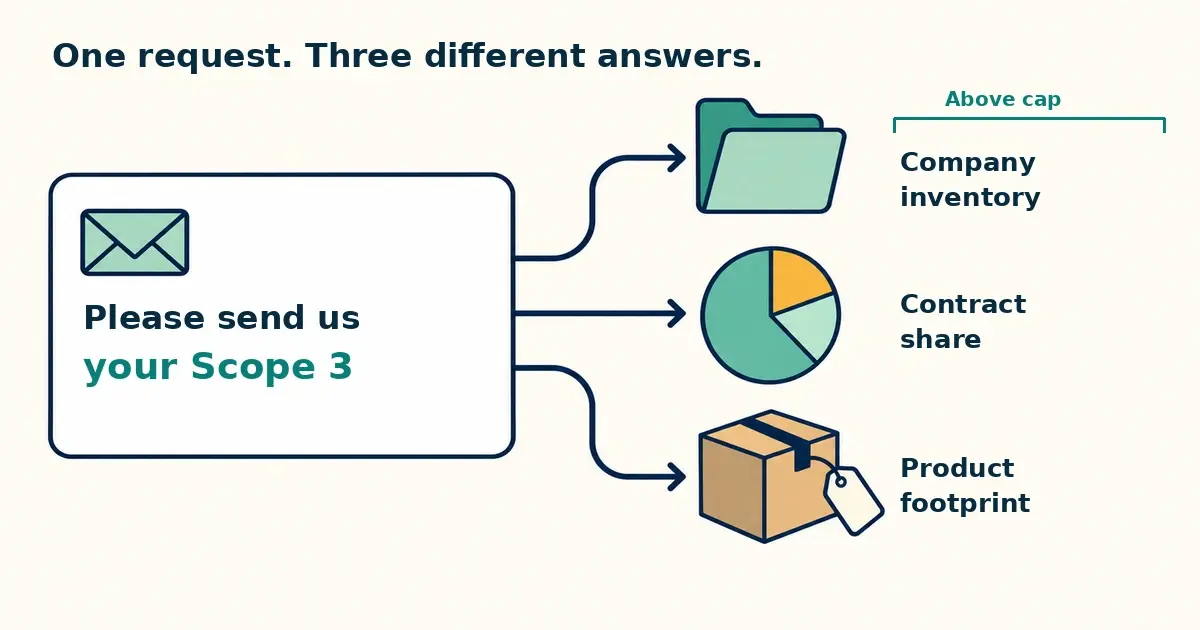
1. Your customer's Scope 3 is not your Scope 3
Scopes depend on whose inventory you look at. Diesel burned in a van you control is your Scope 1. The emissions linked to the service a customer buys from you sit in the customer's Scope 3. Your Scope 3 is something else: your purchases, subcontractors, travel, commuting and other value-chain sources.
The customer asks for | What it means | What you may need to send |
|---|---|---|
"Your Scope 3" (company-wide) | Indirect emissions across your own value chain | A category-level inventory with boundary and methods |
"Your Scope 1 and 2" | Your operations and purchased energy | Annual totals, period, boundary, Scope 2 method |
"Emissions for our contract" | The share of emissions linked to their service | Contract activity data and an allocation |
"A product carbon footprint" | One product or service over a defined life cycle | A product-level calculation with a declared unit |
"Data for our Scope 3" | Inputs to the buyer's own calculation | Quantities, activity data or a footprint, not your whole Scope 3 |
The GHG Protocol Scope 3 Standard separates corporate value-chain inventories from product footprints. A corporate total does not answer a contract question.
Example: a cleaning company. It buys chemicals and outsourced laundry, runs vans and uses electricity. A customer's footprint for that cleaning service could include a share of the supplier's operational emissions, upstream emissions of the chemicals used, and relevant subcontracted work, but not emissions from the supplier's other contracts. Allocated Scope 1 and 2 alone are only of that footprint. The GHG Protocol's Category 1 guidance calls this the hybrid method: "a combination of supplier-specific activity data (where available) and secondary data to fill the gaps."
2. What the value chain cap means for a Scope 3 request
Under Article 3 of Delegated Regulation (EU) 2026/1560, a company reporting under the CSRD cannot require information beyond the cap from value-chain companies with an average of 1,000 employees or fewer. The cap lists only the Annex II datapoints, and Scope 3 is not among them. It applies to financial years beginning on or after 1 January 2027. Being above the cap doesn't remove your protection; it means the customer can't make that item compulsory for its CSRD report. Full detail: our value chain cap explainer.
The flag-and-decline rule
The European Commission's 6 May 2026 Q&A explains that a CSRD reporter may still for more than the cap, but must identify the above-cap items and tell the supplier it has a statutory right to decline. The Q&A also stresses proportionality: request only what you need.
The cap covers CSRD reporting. Requests for a tender, a loan or another law have their own basis, so ask what the request is for. Calling a questionnaire "procurement" does not by itself settle which rules apply.
Situation | First response |
|---|---|
A CSRD questionnaire marks your Scope 3 as mandatory | Ask the buyer to flag the above-cap item and its basis |
A buyer asks for better data for its inventory | Decide whether a useful, proportionate answer exists |
The request supports a tender, financing or another legal duty | Ask for the criteria, purpose and consequences |
One questionnaire mixes several purposes | Ask for them to be separated |
For sorting a mixed questionnaire, use our questionnaire triage guide.
If you do report Scope 3 voluntarily, the standard still has rules
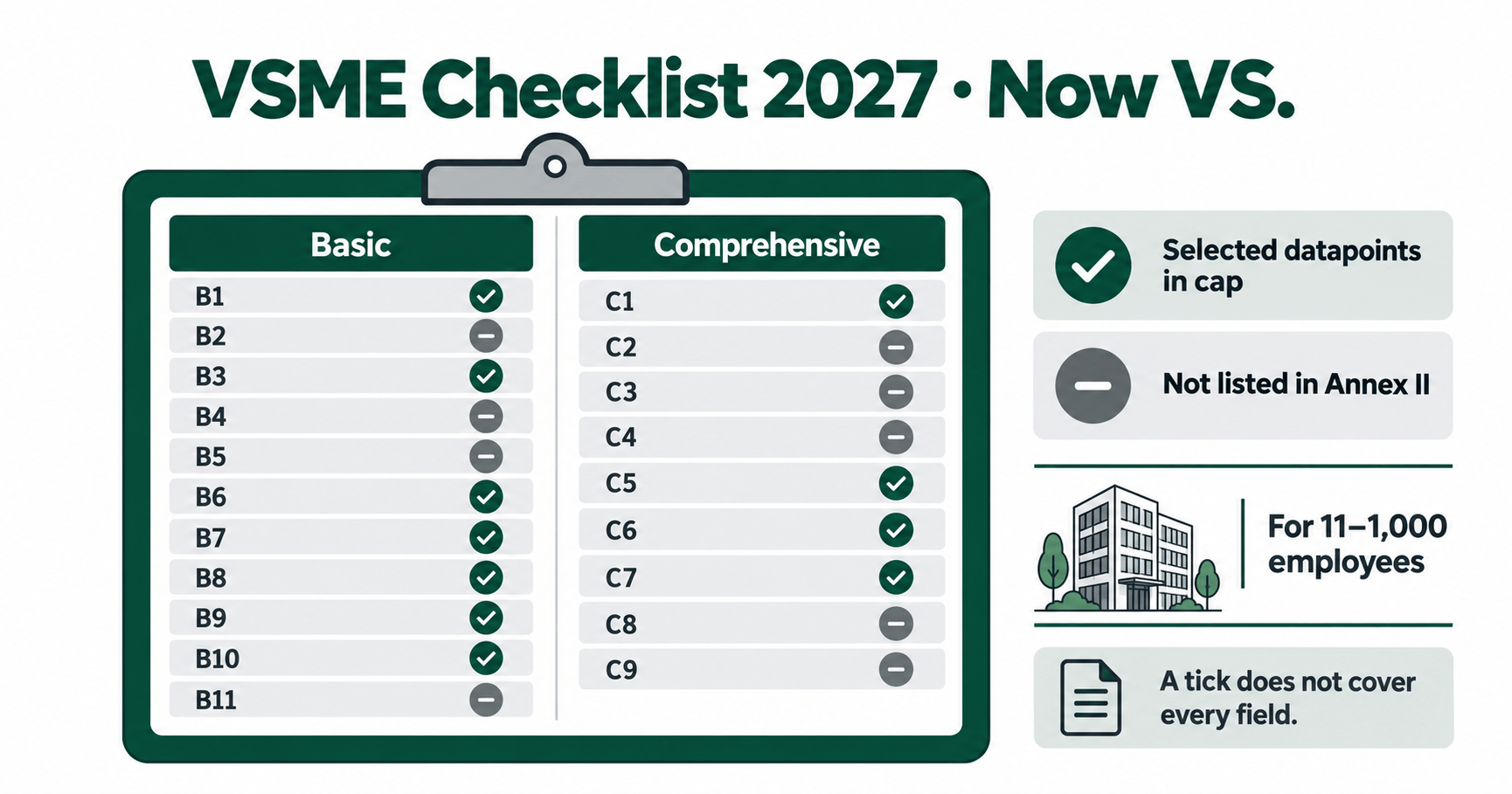
The Voluntary Standard's guidance on B3 (paragraphs 49–52) says that if you report Scope 3, you should refer to the GHG Protocol's 15 categories and include the categories that are significant by your own assessment, and present them next to your Scope 1 and 2. It also notes that manufacturing, agrifood, real estate construction and packaging businesses are "likely to have significant Scope 3 categories". So a four-category screen is a , not a Scope 3 inventory.
3. What happens if you decline: the sector-average trade-off
Without supplier data, the buyer uses secondary data: an industry-average factor or a spend-based estimate. The GHG Protocol allows both, next to supplier-specific and hybrid methods.
The fallback is not automatically worse than your real number. It may be higher or lower, depending on the sector mapping, country, price basis and boundary. The real cost of declining is that the buyer can't see what is specific to you: your efficient vans, your electric equipment, your lower-emission delivery. An incomplete supplier number doesn't fix that either.
Before doing new work, ask the buyer:
- Which fallback method will you use for us?
- Would activity data (litres, kWh, hours) be enough instead of a full inventory?
- Does this affect your reporting only, a supplier score or a tender criterion?
- What boundary and evidence must supplier-specific data meet?
- Can you reuse a report we already have?
Don't pay to replace one unexplained number with another.
4. First check whether Scope 1 and 2 plus contract data answers it
Send this clarification first:
Then check what you already hold:
Service | Useful contract data | Watch out for |
|---|---|---|
Facility services | Service hours, materials, site visits, dedicated energy or fuel | Hours may not track vehicle or heating emissions |
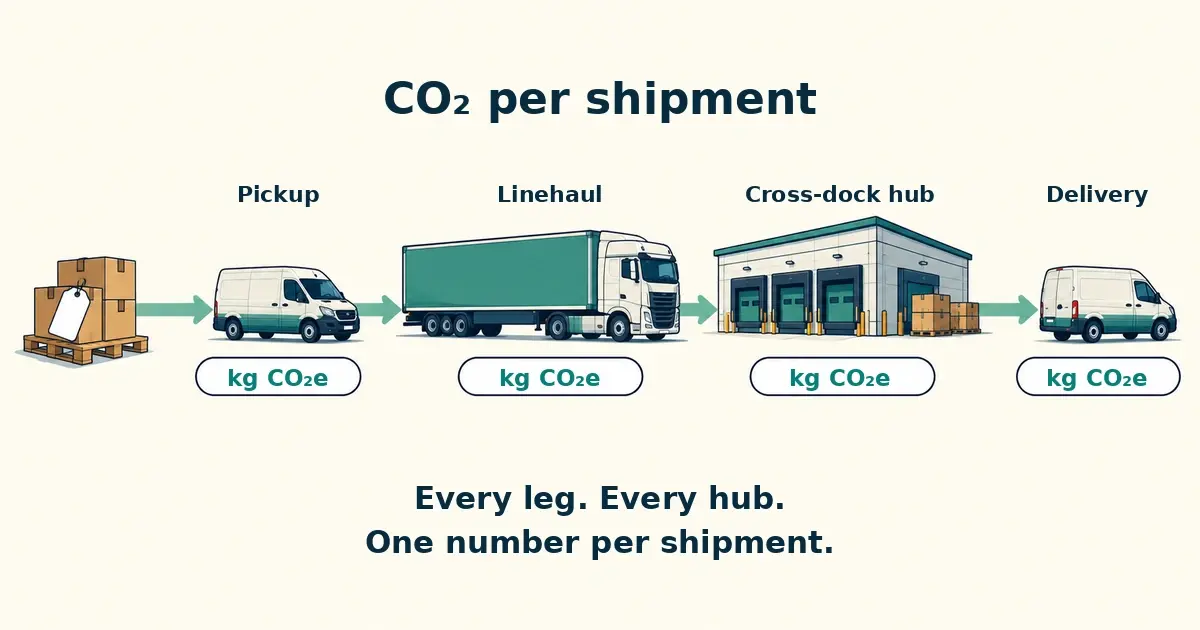
Logistics | Consignments, vehicle type, fuel, distance, load, tonne-km | An average shipment hides route differences; per-shipment figures follow ISO 14083 |
Installation | Materials, equipment, transport, subcontractor work | Use and end-of-life of equipment may matter for your own Scope 3 |
Warehousing | Pallet-days, space, handling, energy | Temperature zones and opening hours need separate treatment |
Worked example: a partial contract allocation
Take the fictional company from our Scope 1 and 2 worked example: gas 32.02 tCO₂e, fleet 73.86 tCO₂e and location-based electricity 33.00 tCO₂e. Its records support different shares for one customer's contract:
Emissions pool | Share and basis | Allocated |
|---|---|---|
Gas heating | 10%, from heated space and use | 3.20 tCO₂e |
Fleet fuel | 8%, from contract-linked fuel records | 5.91 tCO₂e |
Electricity | 10%, from meter or activity records | 3.30 tCO₂e |
Partial operational allocation | 12.41 tCO₂e |
32.022 × 10% + 73.860 × 8% + 33.000 × 10% = 12.411 tCO₂e
The shares are an example, not proof they fit a real contract. Use direct contract data where you can, explain any proxy, and make sure allocations across all customers add up to no more than 100%. Allocation is covered in Chapter 8 of the Scope 3 Standard.
Label it exactly: "Allocated Scope 1 and location-based Scope 2 contribution for the contract." Don't call it your total Scope 3, a complete cradle-to-gate service footprint, or a verified product footprint. It excludes upstream materials and subcontracted services, and the buyer must not add it on top of an existing estimate for the same service without removing the overlap.
5. If you calculate your own Scope 3, screen all 15 categories
For a services SME, these four are practical starting points:
Category | Typical sources | Records |
|---|---|---|
1. Purchased goods and services | Supplies, chemicals, IT, subcontracted services | Purchase ledger, quantities, supplier footprints |
4. Upstream transport | Third-party transport you pay for | Carrier data, shipments, distances |
6. Business travel | Flights, rail, hotels, travel not in your Scope 1 | Bookings, expense claims |
7. Employee commuting | Home–work travel | Aggregated survey, travel modes |
Category guidance: 1, 4, 6, 7. They are starting points, not the only categories that matter. Three that are often missed:
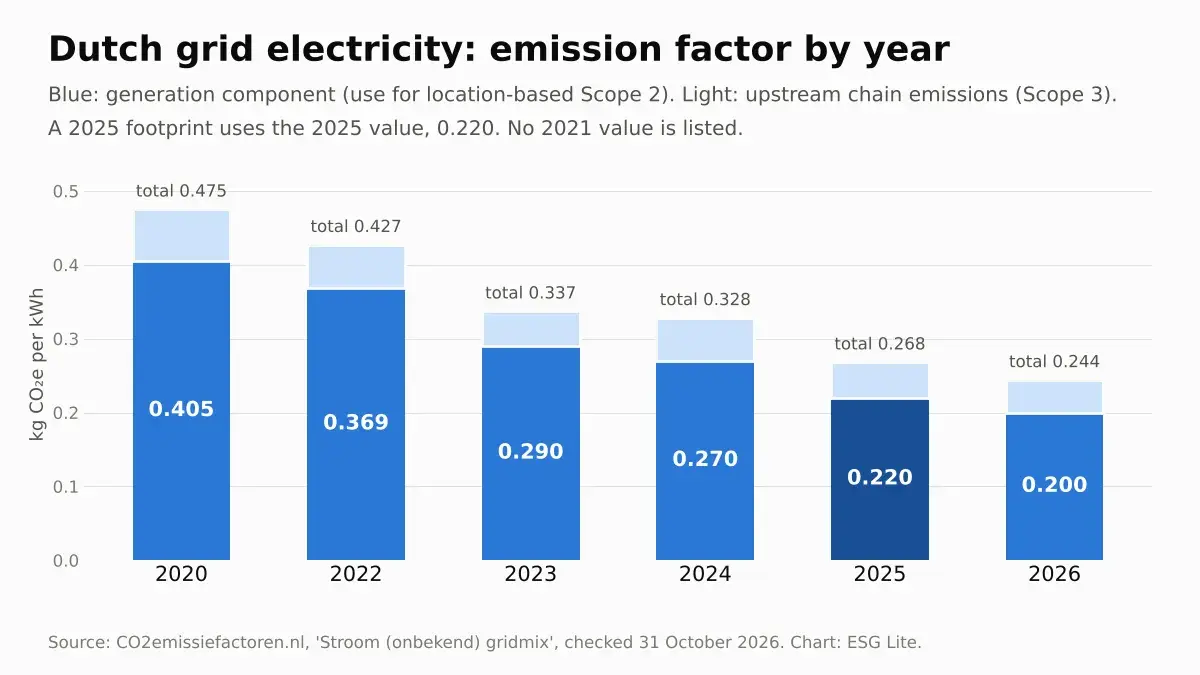
- Category 3, fuel and energy upstream. The extraction, refining and grid losses behind your fuel and power. This is the WTT column of the Dutch factor list, which stays out of Scope 1 and 2 (guidance).
- Category 5, operational waste. Use waste quantities, types and treatment routes (guidance).
- Equipment and products. Capital goods for asset-heavy firms; use and end-of-life of sold products for installers. These can outweigh business travel by far.
Mark each of the 15 categories as relevant, not relevant or to investigate, and explain significant exclusions. Keep your own fleet in Scope 1: a journey for a customer doesn't make your diesel Scope 3.
6. A spend-based first estimate, labelled as one
Estimated tCO₂e = adjusted spend × factor (kg CO₂e per currency unit) ÷ 1,000
Spend-based estimates are good for screening and finding where better data is worth collecting. They don't measure your suppliers' actual emissions.
Hypothetical screening example (factors invented for the arithmetic; never use them in a real inventory):
Purchase group | Spend | Illustrative factor | Estimate |
|---|---|---|---|
Cleaning materials | €80,000 | 0.50 kg/€ | 40 tCO₂e |
Subcontracted services | €200,000 | 0.20 kg/€ | 40 tCO₂e |
IT services | €30,000 | 0.10 kg/€ | 3 tCO₂e |
Selected Category 1 | €310,000 | 83 tCO₂e |
Call it "83 tCO₂e estimated for selected Category 1 purchases", not a Scope 3 total. And don't add it to the contract allocation: they have different boundaries.
Match the factor before you multiply
Record the dataset, version and sector code; the country and coverage; the currency and price year; purchaser or producer prices; how margins, transport and taxes are treated; and the life-cycle boundary. Example: the US EPA's Supply Chain GHG Emission Factors v1.3 are in kg CO₂e per 2022 US dollar at purchaser prices, for US industries. Using them for Dutch purchases in euros needs currency and inflation adjustment and a judgement on whether US supply chains are a fair proxy. European multi-regional input-output databases are often a better geographic fit.
Clean the ledger first. Separate payroll, taxes, financing, capital purchases, fuel, electricity and travel before you pick methods; never multiply total spend by one factor. When supplier data replaces a spend estimate, remove the estimate.
Know the blind spot. If a supplier raises prices and you buy the same quantity, a spend-based figure rises with no real change in emissions. Move important categories to quantities or supplier data, and keep the old calculation so the change is explainable.
7. Attach a data-quality note to every answer
Field | What to state |
|---|---|
Entity and period | Company, sites, year |
Boundary | Corporate inventory, selected categories, product or contract |
Coverage | What is included; explicit exclusions |
Method | Supplier-specific, activity-based, spend-based, hybrid or allocation |
Evidence | Ledger, bills, meters, travel records, surveys, supplier data |
Factors | Source, version, country, units, price year |
Estimates | What is estimated, main assumptions |
Review | Internal review; any assurance |
Intended use | Screening, input to buyer's calculation, or a defined footprint |
Write "not calculated" for missing categories and "not relevant" only when your assessment supports it. Neither means zero. Don't quote an uncertainty like "±5%" you haven't assessed.
8. Three reply templates
Case 1: you have the inventory
Subject: Scope 3 information for [Company], [year]
Thank you for your request. We can provide our [year] corporate Scope 3 inventory covering [entity and boundary]. Reported emissions are [total] tCO₂e across [categories]; the attached table explains methods, factors, estimates and exclusions. Assurance status: [status].
Please confirm whether you need this corporate inventory or a footprint for your purchases. The corporate total is not the emissions of your contract without an allocation or a product/service calculation.
Use this only when you have a real inventory. A ledger subtotal belongs in Case 2.
Case 2: you can offer operational data and a partial allocation
Subject: Emissions data available for [contract], [year]
Thank you. We don't currently have a complete corporate Scope 3 inventory. We can provide our [year] Scope 1 and 2 totals and an estimated operational contribution for your contract of [amount] tCO₂e; the attachment explains the allocation and the Scope 2 method.
This covers [sources] and excludes [upstream materials, subcontracted services, other exclusions], so it is not a complete cradle-to-gate footprint. Can you use it as an input, and which extra activity data would help most? Please also confirm the purpose of the request and flag any items requested above the value chain cap.
Case 3: you decline the above-cap item and offer what you have
Subject: Scope 3 request: available information
Thank you for confirming that the additional Scope 3 request supports your CSRD reporting and is voluntary above the value chain cap. We will not provide a company-wide Scope 3 inventory this cycle. We can share [existing report, Scope 1 and 2 data or activity records] instead.
If you use secondary data for us, we'd welcome the category and method, so we can judge whether more specific data would be useful next cycle.
Use Case 3 only once the purpose is clear. Don't claim a right to decline for a request with a different legal basis.
9. Decide commercially, with the boundary in view
Decision | Sensible when | Next step |
|---|---|---|
Answer | Evidence exists and the request is clear | Send the result with its quality note |
Estimate | The purpose accepts estimates and you can document assumptions | Agree the boundary; label it |
Partial answer | Operational or activity data helps but no full footprint exists | State exclusions and what the buyer still has to calculate |
Decline | An optional request would need disproportionate work or unsupported claims | Explain, and offer existing evidence |
The commercial director should know how the buyer will use the number; the CFO should sign off the boundary and claims. Keep a copy of what you sent, the calculation version and the stated use, so the next questionnaire gets a consistent answer.
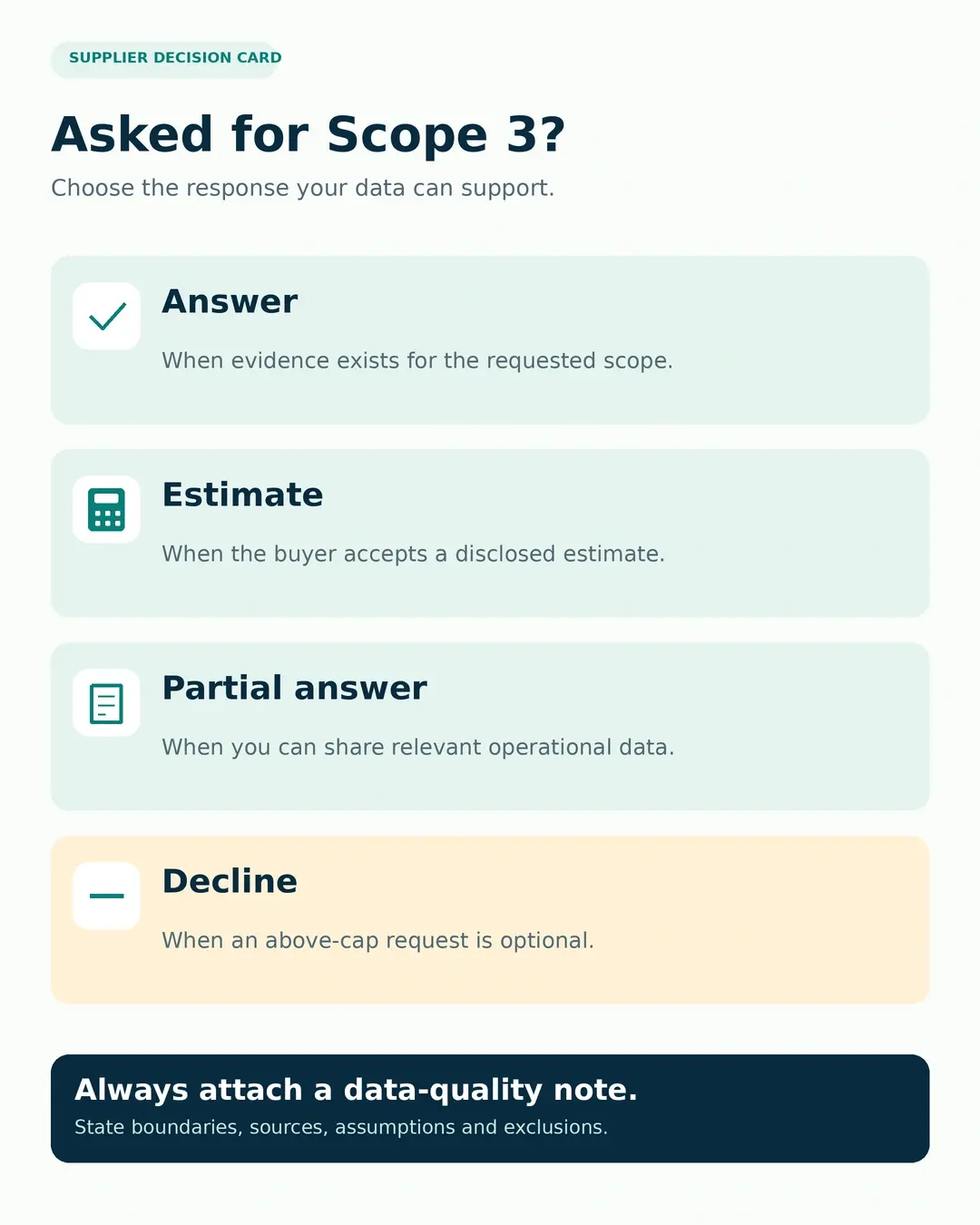
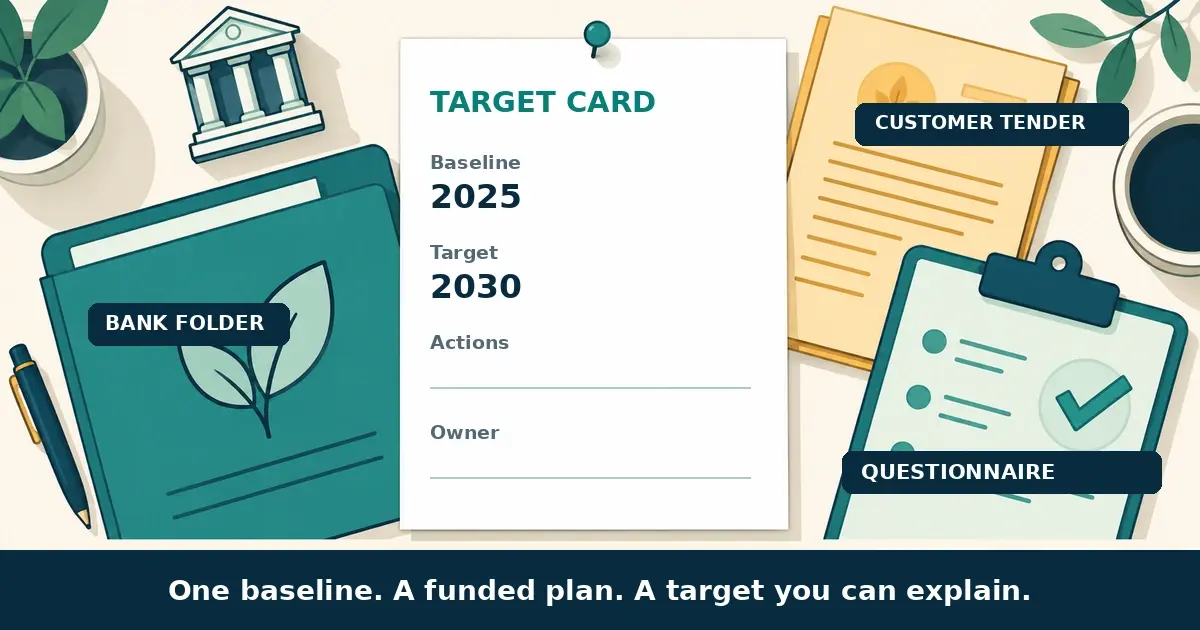
Decision card for suppliers asked for Scope 3: answer when evidence exists, estimate when the buyer accepts it, give a partial answer with operational data, or decline an optional above-cap request.
Find out which customer questions you can already answer. ESG Lite's free readiness assessment gives you a readiness score, with first results before you create an account. Use it to organise gaps before you pay for more calculations. Start the free assessment
Sources
- GHG Protocol: Corporate Value Chain (Scope 3) Standard, including Chapter 8 on allocation.
- GHG Protocol Technical Guidance: Category 1, purchased goods and services.
- Commission Delegated Regulation (EU) 2026/1560: Article 3, Annex I paragraphs 49–52, Annex II.
- European Commission: Q&A on the value chain cap, 6 May 2026. Published at the draft stage; the adopted regulation sets the final cap list.
- Category 3, fuel- and energy-related activities.
- Category 4, upstream transportation and distribution.
- Category 5, waste generated in operations.
- Category 6, business travel.
- Category 7, employee commuting.
- US EPA: Supply Chain GHG Emission Factors v1.3 (data catalogue) and methodology repository.
Make Your Business Online By The Best No—Code & No—Plugin Solution In The Market.
30 Day Money-Back Guarantee
Say goodbye to your low online sales rate!
Can a customer require my Scope 3 from 2027?
Not for its CSRD report, if you have up to 1,000 employees on average. Scope 3 is outside the value chain cap. The customer may still ask, but must flag the item as above the cap and tell you that you may decline. Requests for other purposes need separate assessment.
Is my Scope 1 part of my customer's Scope 3?
Partly. Emissions linked to what the customer buys from you can enter its Scope 3, even though they are Scope 1 or 2 in your inventory. Only the share that relates to its purchase, on an agreed boundary, belongs there.
Is a spend-based estimate acceptable?
For screening, or where the buyer accepts that method. Use a factor that matches the country, currency and price year, explain the limits, and don't present it as measured data or a product footprint.
Should I send my whole annual footprint to every customer?
You can share a corporate inventory, labelled as such, but it is not the emissions of each buyer's contract. Allocations across customers must be consistent and add up.
Which Scope 3 categories matter for a services SME?
Usually purchased goods and services, upstream transport, business travel and commuting, plus fuel- and energy-related emissions and waste. Installers and asset-heavy firms should also check capital goods and the use and end-of-life of sold products. Screen all 15 before excluding any.
Will declining damage my supplier rating?
There is no fixed outcome. Ask whether the request feeds a scoring criterion or only fills an inventory gap. The buyer's fallback estimate may be higher or lower than your real figure, and a right to decline doesn't guarantee a commercial result.
Do I need software before answering?
No. First clarify the request and check the evidence you have. A spreadsheet can support a limited, well-documented estimate. Full inventories need methods and controls that match their scope.