How to Answer a Customer ESG Questionnaire in 2027: A Supplier's Practical Playbook
Short answer: To answer a customer ESG questionnaire, first find out why the customer is asking: CSRD reporting, an ESG rating such as EcoVadis, CBAM, due diligence or a bank review. Each follows different rules. Then sort every question into inside the EU value chain cap, above it, or outside it; answer from records you already hold; state methods and gaps honestly; and save the answers as a reusable response pack.
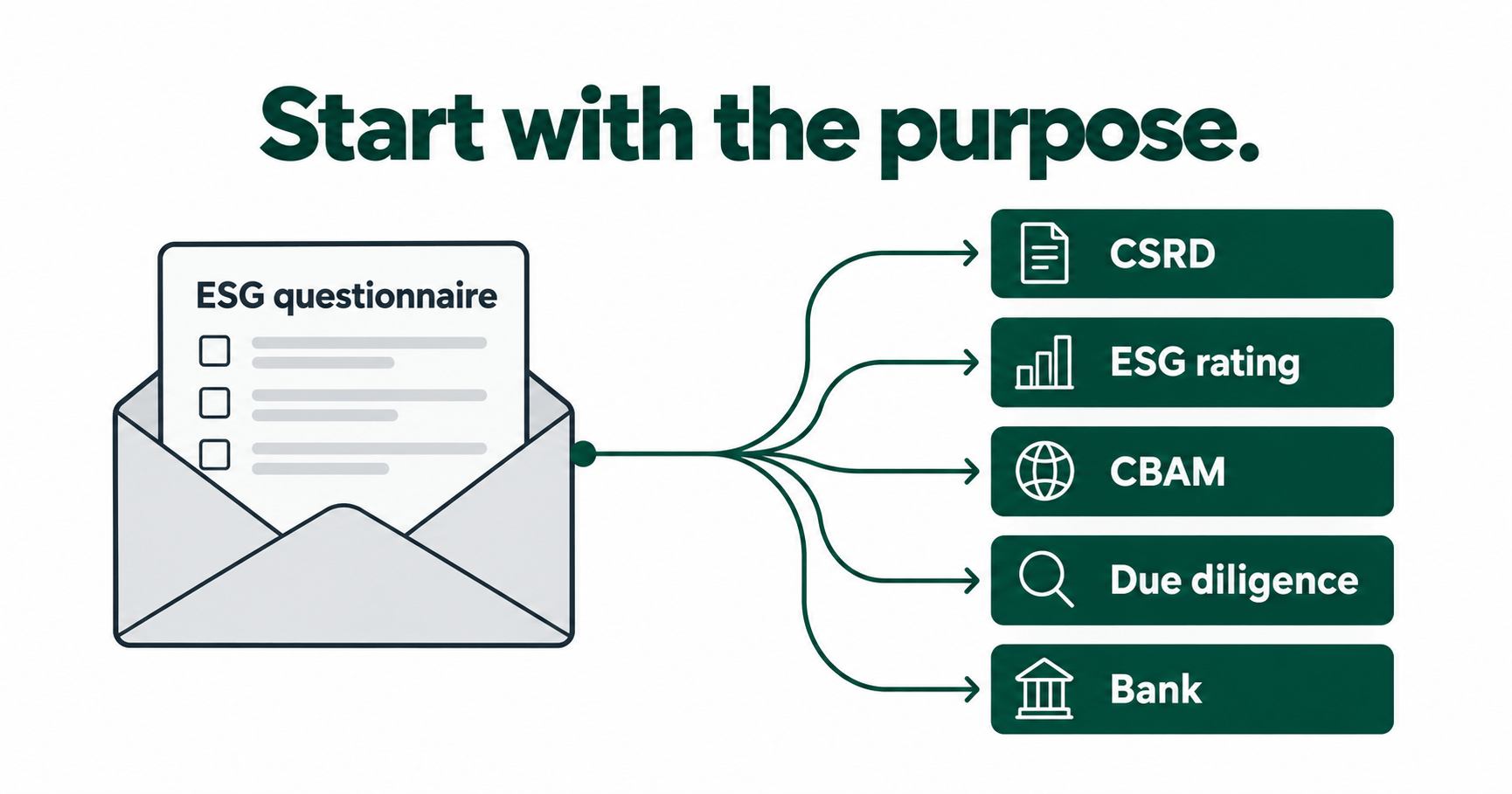
Diagram showing a customer ESG questionnaire split into five request types: CSRD, ESG rating, CBAM, due diligence and bank. |
Why the first step is the purpose, not the questions
The same question can be governed by completely different rules. “Please provide your greenhouse gas emissions” may come from a customer preparing its CSRD report, an EU importer filing a CBAM declaration, or a bank assessing credit risk. What you must provide, and in what form, depends on which.
Most supplier guides skip this step and go straight to data collection. That is how a 120-person manufacturer ends up commissioning a product carbon footprint nobody legally needed, or sending an unverified company footprint where CBAM required installation-level verified data.
Request type | Typical wording | Who sets the rules | Legal limit on what can be required |
|---|---|---|---|
CSRD value-chain request | “We need this for our sustainability statement under CSRD/ESRS.” | EU law (Directive 2026/470, Regulation 2026/1560) | From financial year 2027, the value chain cap: only Annex II datapoints from suppliers averaging no more than 1,000 employees |
ESG rating or procurement review | “Please complete our annual supplier sustainability assessment” or an EcoVadis/CDP invitation | Your contract and the platform | No statutory cap; set by your commercial terms |
CBAM embedded-emissions request | “Please provide verified embedded emissions for goods produced at your installation.” | EU CBAM Regulation | No cap; the importer needs verified actual data or must use default values |
Due-diligence / code of conduct | “Confirm compliance with our supplier code and describe your human-rights controls.” | Contract now; CSDDD from 26 July 2029 | Under CSDDD, requests only where necessary, and from partners with fewer than 5,000 employees only if the data cannot reasonably be obtained otherwise |
Bank or lender request | “Provide annual Scope 1 and 2 emissions for your credit review.” | Your loan agreement and the bank's risk rules | No statutory cap; set by the financing terms |
A customer calling a questionnaire “mandatory” does not make every question legally compulsory. If the purpose is unclear, ask. One clarifying email can save weeks.
The three-bucket triage: inside, above or outside the cap
Once you know the purpose, classify each question, not the whole questionnaire. This is the core of the playbook.
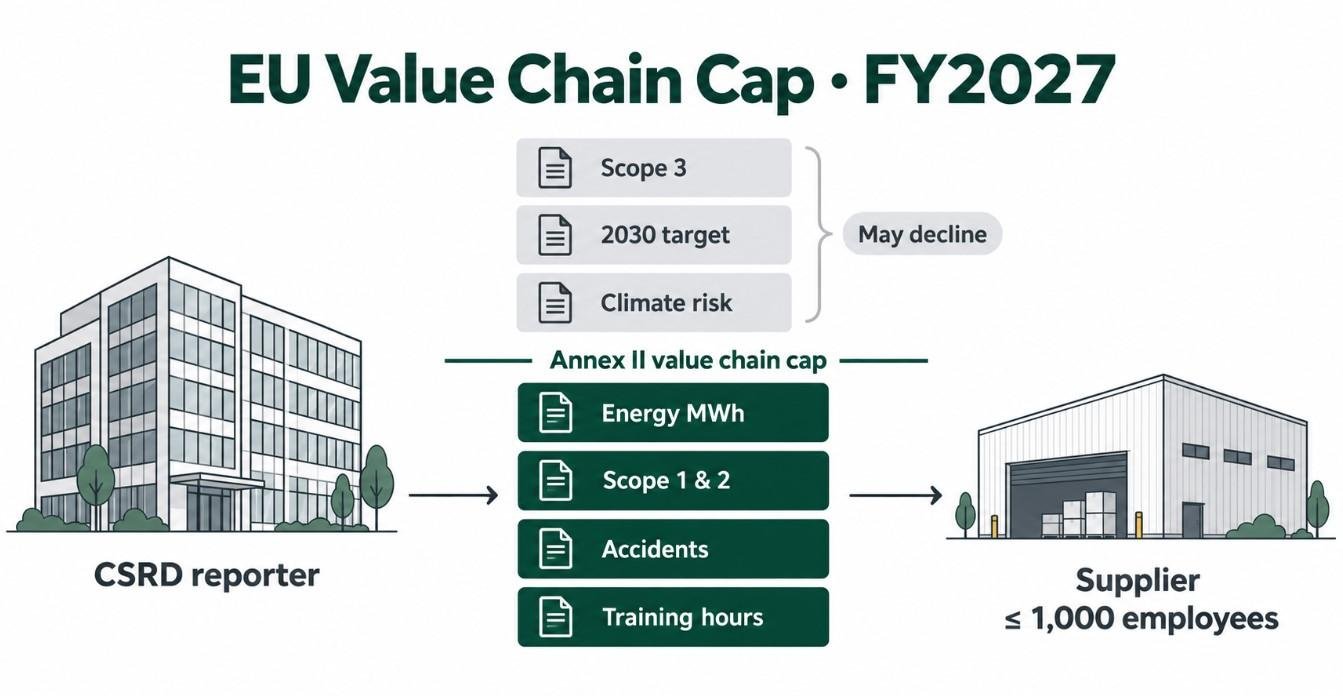
Under Commission Delegated Regulation (EU) 2026/1560, companies subject to mandatory CSRD reporting may require from smaller value-chain businesses only the datapoints listed in Annex II. The cap protects businesses averaging no more than 1,000 employees in the preceding financial year, applies to financial years starting on or after 1 January 2027, and also covers non-EU suppliers.
Bucket | What it means | Typical examples (11–1,000 employees) |
|---|---|---|
A. Inside the cap | CSRD-purpose request for an Annex II datapoint. Within what a CSRD customer may require. | Total energy in MWh; Scope 1 and location-based Scope 2; water withdrawal; waste totals; headcount by contract and gender; accident number and rate; minimum wage, collective bargaining, training hours; employee turnover; code of conduct and complaints mechanism (yes/no) |
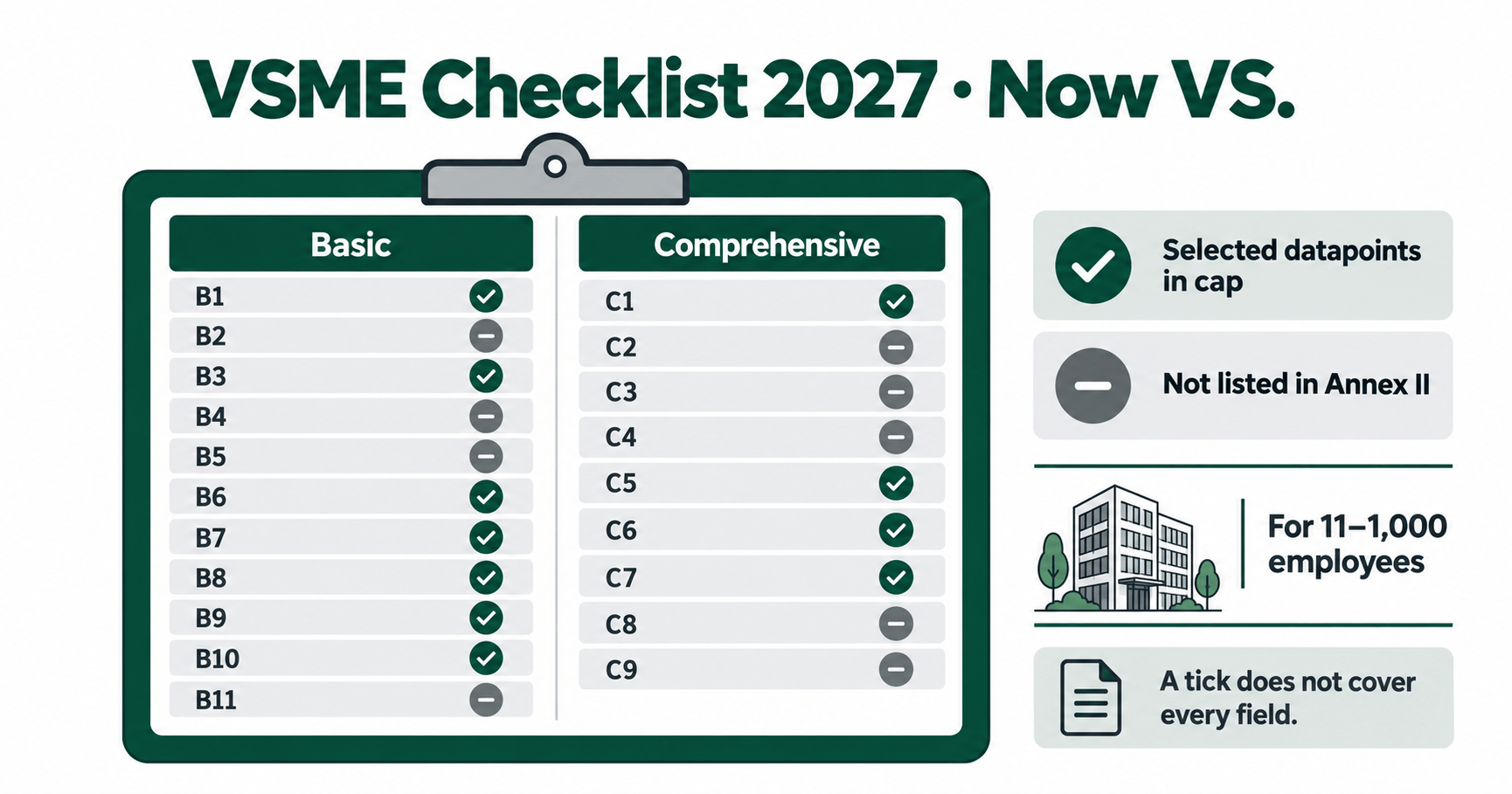
B. Above the cap | CSRD-purpose request not in Annex II. You may decline; you may also choose to answer. | Full Scope 3 inventory; product carbon footprint; emissions allocated to one customer; 2030 targets and transition plan; climate risk assessment; anti-corruption convictions (B11); gender pay gap |
C. Outside the cap | Request made for another purpose or under another law. The cap does not apply. | CBAM embedded emissions; EcoVadis or CDP assessment; bank questionnaire; contractual code-of-conduct commitments |
Two points matter. First, Bucket A sets a ceiling, not a duty: the cap does not by itself oblige you to answer. Second, for suppliers with 10 or fewer employees the Annex II list is much shorter and excludes energy and emissions altogether.
For the full datapoint list and the sub-datapoints that sit outside the cap, see our companion guide, The EU Value Chain Cap Explained.
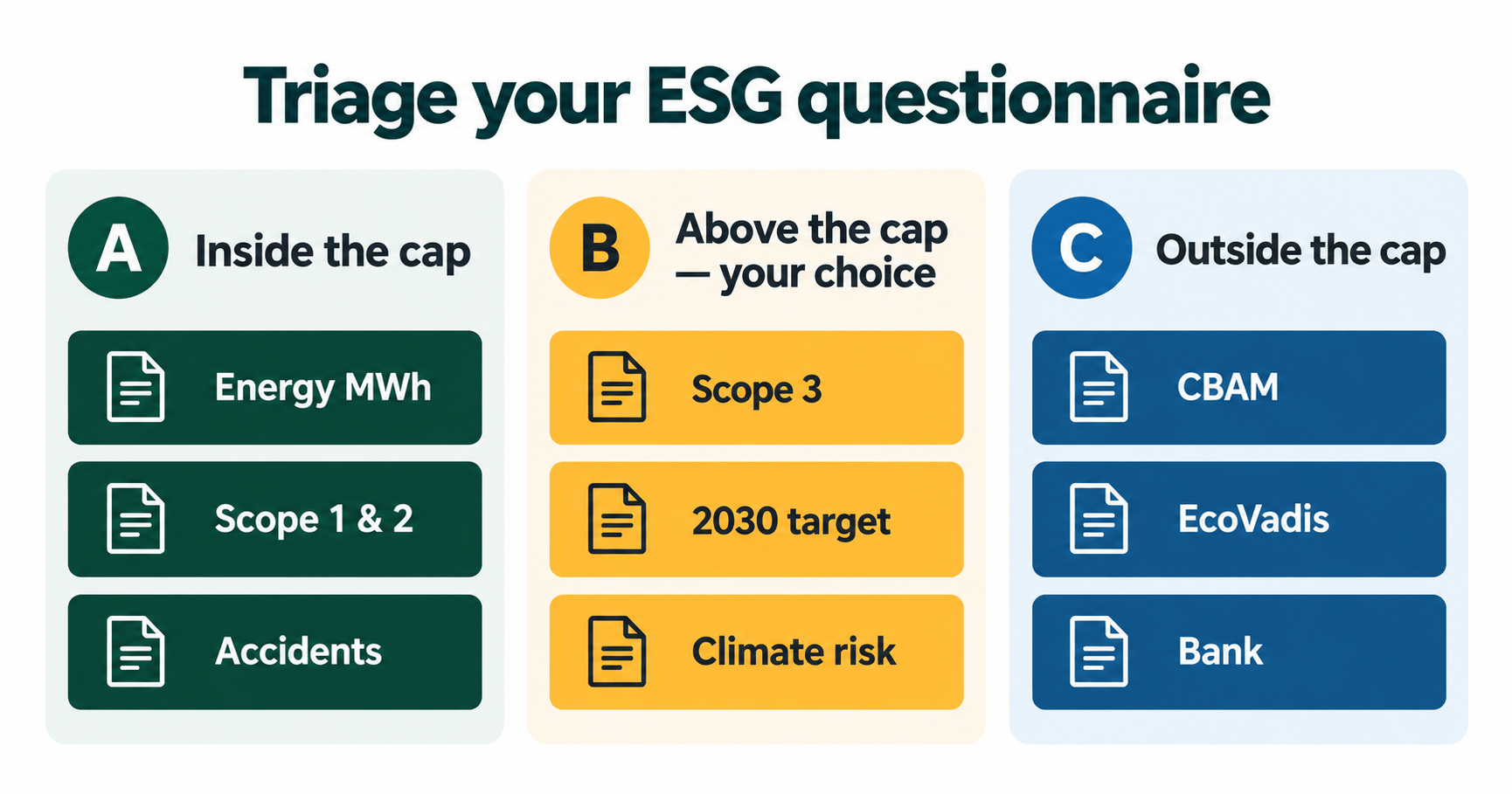
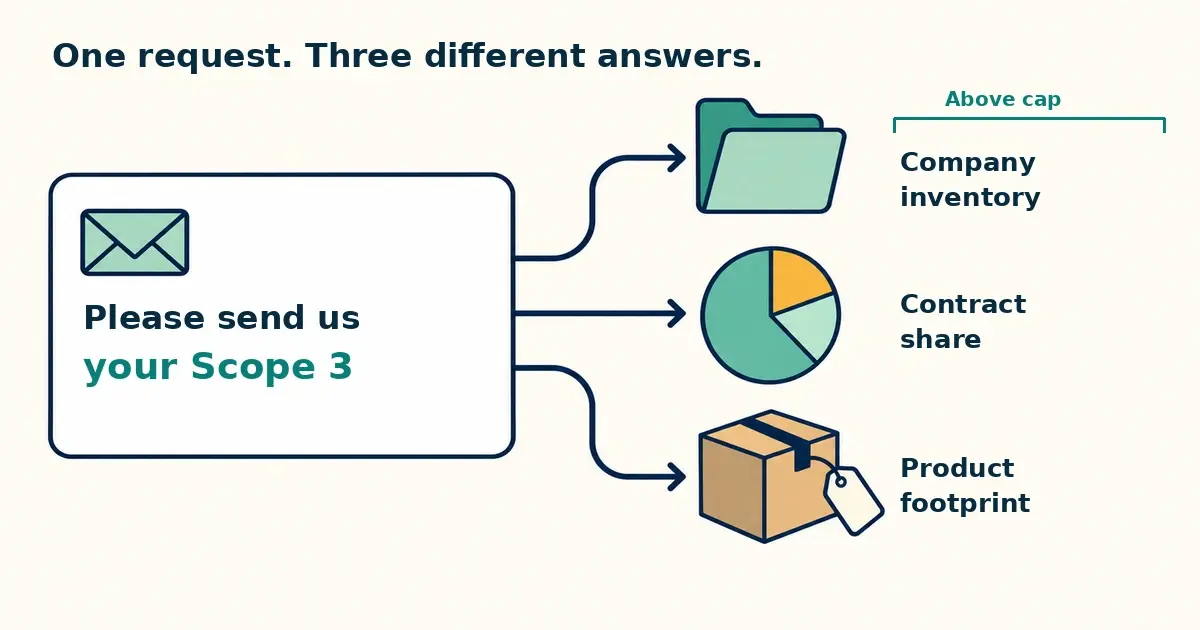
Three-bucket triage for supplier ESG questionnaires: questions inside, above and outside the EU value chain cap. |
Example: one 120-employee supplier, one mixed questionnaire
Customer question | Stated purpose | Bucket | Next action |
|---|---|---|---|
Total energy consumption in MWh | CSRD | A | Prepare from invoices |
Scope 1 and location-based Scope 2 | CSRD | A | Calculate and document the method |
Recordable accident rate | CSRD | A | Take from the safety log |
Complete Scope 3 inventory | CSRD | B | Decide whether it is worth it |
2030 reduction target | CSRD | B | Share if you have one |
Verified embedded emissions for steel | CBAM | C | Follow the CBAM methodology |
Signed supplier code of conduct | Procurement | C | Review it as a contract |
Climate risk data | Bank | C | Check the loan terms |
One question can serve two purposes. A product footprint may be above the cap for CSRD yet required under a procurement contract. Classify each request by its stated purpose.
The core dataset that answers most recurring questions
Most suppliers already hold the raw evidence across finance, operations and HR. The work is consolidating it once, consistently, for a full year.
Data category | What to prepare | Where it usually lives | In the cap? |
|---|---|---|---|
Company profile | Activities, sites, headcount, turnover, markets | Company and finance records | Yes |
Energy | Electricity, gas and fuel; total MWh | Utility invoices, meters, fuel cards | Yes (more than 10 employees) |
Scope 1 emissions | Fuel, heating and refrigerant emissions | Fuel and maintenance records | Yes (more than 10 employees) |
Scope 2 emissions | Location-based emissions from purchased energy | Electricity data plus a grid factor | Yes (more than 10 employees) |
Water | Total withdrawal | Water bills and meters | Yes (more than 10 employees) |
Waste | Total, hazardous/non-hazardous, share recycled | Waste contractor reports | Yes (more than 10 employees) |
Workforce | Headcount by contract and gender; turnover | HR and payroll | Yes |
Health and safety | Recordable accidents and rate | Incident log | Yes |
Pay and training | Minimum wage, collective bargaining, training hours | Payroll and training records | Yes |
Human rights | Policy and complaints mechanism exist; confirmed incidents | Policies and compliance records | Yes (more than 10 employees) |
Anti-corruption | Policy; convictions and fines | Compliance records | No, but often asked in procurement |
Keep the anti-corruption items in your pack even though they sit above the cap. Procurement and due-diligence questionnaires ask for them constantly.
“Your customer wants your carbon footprint”: start with Scope 1 and 2
This is the most common supplier request. Before hiring a consultant, check what the customer actually needs. For CSRD purposes, the Voluntary Standard's B3 disclosure asks for estimated Scope 1 and location-based Scope 2 emissions, calculated with reference to the GHG Protocol Corporate Standard.
- Scope 1: direct emissions from sources you own or control, such as diesel in your vans, gas in your boilers and refrigerant leaks.
- Scope 2 (location-based): emissions from generating the electricity, heat or cooling you buy, using the average grid factor for the location.
- Scope 3: all other value-chain emissions, from purchased materials to outsourced transport. Much harder to produce, and above the cap.
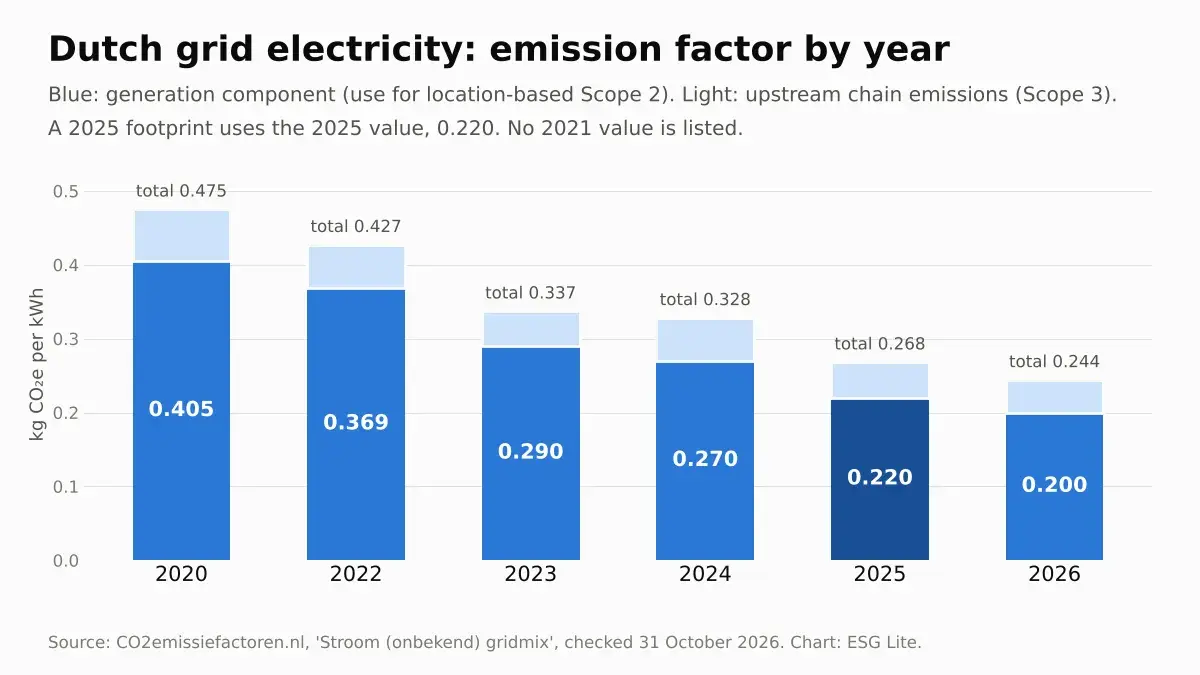
The basic arithmetic is activity data multiplied by an emission factor. A plant using 240,000 kWh of electricity a year has 240 MWh of consumption. Multiply by the location-based grid factor for its country, from a recognised published source, to estimate Scope 2.
Document five things with every figure: the sites included, the reporting period, the activity data, the emission factors and their source, and any estimates or gaps. Never call the result “verified” unless an independent verifier has checked it, and never call it a full footprint if Scope 3 is missing.
CBAM requests are different, especially for non-EU manufacturers
If you produce steel in Türkiye, aluminium in India or fertilisers outside the EU, treat CBAM requests as a separate project. CBAM is a carbon price on imports, not a reporting standard, and the value chain cap does not apply to it.
What is covered. The CBAM definitive regime has applied since 1 January 2026 to selected goods in six sectors: cement, iron and steel, aluminium, fertilisers, electricity and hydrogen. Coverage depends on the goods' customs classification. A finished product that merely contains steel is not automatically covered.
Who files. The obligation sits with the EU importer, as an authorised CBAM declarant. Importers bringing in no more than 50 tonnes of CBAM goods a year are exempt; the threshold does not apply to electricity or hydrogen. The first annual declaration and certificate surrender, covering 2026 imports, are due by 30 September 2027. Certificates go on sale from February 2027.
What the importer needs from you. Data on the installation where the goods were made, not your company-wide footprint. The importer can use either actual emissions or the Commission's default values. Actual emissions must be verified by an independent verifier accredited by an EU national accreditation body, which gives reasonable assurance on the calculation.
CBAM step | Timing |
|---|---|
Non-EU operators start monitoring embedded emissions | January 2026 |
First verifiers accredited and able to register in the CBAM Registry | Around September 2026 |
First verification reports can be issued and shared with importers | January 2027 |
Importers can buy CBAM certificates | February 2027 |
First annual declaration for 2026 imports | 30 September 2027 |
If your verified figure would be lower than the default value, verification may save your customer money and make you the preferred supplier. If a carbon price was already paid in your country, the importer can deduct it. Start early: verification capacity is new, and 2026 data must already have been monitored under the CBAM method.
Codes of conduct and the CSDDD: read them as contracts
Many questionnaires are about labour and human rights, not carbon: forced and child labour, safety, grievance mechanisms, corrective actions. These usually come from procurement or due-diligence programmes.
The EU Corporate Sustainability Due Diligence Directive, as amended by Directive (EU) 2026/470, applies from 26 July 2029 to EU companies with more than 5,000 employees and more than €1.5 billion net worldwide turnover, and to non-EU companies with more than €1.5 billion turnover in the EU. It also limits requests to suppliers: information may be sought only where necessary and, from business partners with fewer than 5,000 employees, only where it cannot reasonably be obtained by other means.
Note the different threshold: 5,000 employees under CSDDD, 1,000 under the CSRD value chain cap. Don't mix them up.
In 2027, a code-of-conduct request will usually rest on your contract, not on CSDDD. Before signing, check whether the code requires you to:
- make statements you cannot evidence;
- adopt new policies or accept audits;
- pass the requirements on to your own subcontractors;
- report incidents or carry out corrective actions on a deadline.
If a clause is too broad, ask for it to be narrowed before you sign.
Should you answer Scope 3 and other above-cap requests?
A protected supplier may decline above-cap requests made for CSRD purposes, and the customer must tell you which items exceed the cap and that you may decline. But declining has a cost: under the revised ESRS, your customer may use estimates such as sector averages instead, and those may make you look worse than you are.
Consider answering when | Consider narrowing or declining when |
|---|---|
The customer is a large, recurring account | The customer cannot explain why it needs the data |
You already hold reliable operational data | Producing it requires costly specialist work |
Your performance is likely better than a sector average | You have no reliable measurements |
Several customers ask for the same data | The deadline is unrealistic |
The scope and method are clearly defined | Method, period or boundary are undefined |
A proportionate middle path often works best:
We can provide our annual Scope 1 and location-based Scope 2 emissions with the method used. We do not currently hold a complete Scope 3 inventory. If you need product-level emissions, please confirm the products, reporting framework and method so we can assess what is feasible.
Worked example: one supplier, three questionnaires in one month
Atlas Industrial Components is a fictional 140-employee manufacturer supplying customers in Germany, the UK and elsewhere in Europe.
Request | Purpose | How Atlas handles it |
|---|---|---|
German customer asks for energy, emissions, safety, climate targets and Scope 3 | CSRD reporting | Answers the Annex II items from its core dataset; asks whether targets and Scope 3 are voluntary; decides case by case |
EU importer asks for installation-level embedded emissions | CBAM | Checks the goods' customs codes; if covered, follows the CBAM method and arranges accredited verification; does not send its company footprint instead |
UK customer runs an annual supplier review | Procurement | Reads the contract terms; answers from the same core dataset; does not invoke the EU cap, which does not govern this review |
One set of company records serves all three. What changes is the legal basis, the level of detail and the evidence each request needs.
Build a reusable ESG response pack
Stop answering the same questions from scratch. Keep one controlled set of answers and evidence that you refresh each year.
- Company profile: legal entity, activities, headcount, sites, reporting boundary and period.
- Environmental dataset: energy, Scope 1 and 2 with method notes, water and waste.
- Workforce dataset: headcount by contract and gender, turnover, training, wage compliance.
- Health and safety: recordable accidents and rate, with your definitions.
- Policies: only policies that actually exist and are approved.
- Evidence register: source, date, method and owner for every figure.
- Response log: what you sent, to whom, for which period and purpose.
Datapoint | Evidence | Owner | Refresh |
|---|---|---|---|
Electricity consumption | Utility invoices and meter readings | Finance or facilities | Annual |
Scope 1 emissions | Fuel and refrigerant records | Operations | Annual |
Scope 2 emissions | Electricity data and grid factor | Finance | Annual |
Headcount and turnover | HR system | HR | Annual |
Recordable accidents | Safety incident log | H&S manager | Annual |
Waste generated | Waste contractor reports | Operations | Annual |
Human rights policy | Approved policy document | Management | On change |
Keep CBAM installation data and customer-specific allocations in separate files. They follow their own methods and are not part of your corporate dataset.
The response log prevents a common credibility problem: telling one customer 280 MWh and another 320 MWh for the same year with no documented reason.
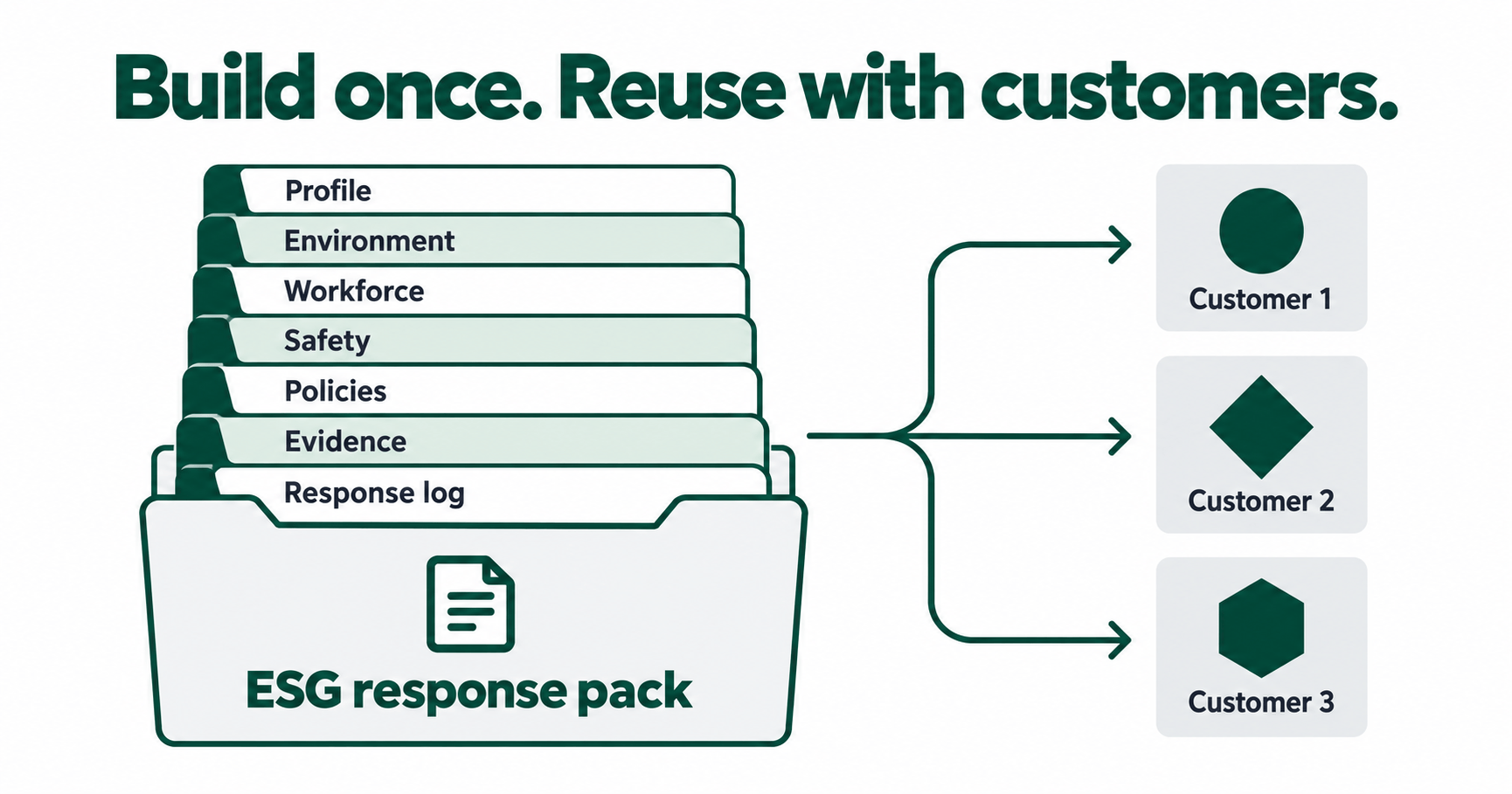
Supplier ESG response pack with seven sections reused to answer questionnaires from several customers. |
A triage record for every new questionnaire
Before answering anything, fill in one line per question:
Field | What to enter |
|---|---|
Customer and deadline | Who asked and by when |
Purpose | CSRD / Rating / CBAM / Due diligence / Bank / Other |
Reporting period | Financial year or other period |
Exact datapoint | The specific information requested |
Basis | Annex II reference, or the other legal or contractual basis |
Bucket | A inside / B above / C outside the cap |
Evidence | Yes / Partial / No |
Owner | Who in your company holds the data |
Status | Ready / Needs calculation / Clarify / Declined |
Approved by | Who signs off the answer |
What to say when information is missing
Transparency about gaps is more credible than invented precision. Never report zero when the answer is “unknown,” and never claim a policy you have not approved.
Situation | Suggested wording |
|---|---|
Not measured | “We do not currently measure this indicator. We will review adding it to our next reporting cycle.” |
Partial data | “We can provide electricity and gas use for our main site. Data for our second site is not yet consolidated.” |
Scope 3 requested | “We hold data for Scope 1 and 2 estimates but no complete Scope 3 inventory. Would a narrower dataset meet your needs?” |
Above the cap | “Some items appear to fall outside Annex II of Delegated Regulation (EU) 2026/1560. Which are required for your mandatory CSRD reporting, and which are additional requests?” |
Unclear request | “Please confirm the reporting standard, period, organisational or product boundary, and intended use of the data.” |
Sample reply email
Subject: Supplier ESG questionnaire: scope and available data
Dear [Name],
Thank you for your sustainability questionnaire. We are reviewing it against our environmental, workforce and governance records.
To make sure we provide the right data, could you confirm whether this request relates to your CSRD reporting, CBAM, supplier due diligence or your internal procurement assessment? Please also confirm the reporting period and any required calculation method.
We can provide our available energy, emissions and workforce data. For items that need additional calculations, or that go beyond the CSRD value chain cap, we are happy to discuss scope.
Kind regards, [Name, role, company]
This reply does not refuse anything. It sets up a structured conversation and stops you working on the wrong purpose.
Your five-day action plan
- Day 1, identify the purpose. Separate CSRD, rating, CBAM, due-diligence and bank questions.
- Day 2, sort the questions. Apply the three buckets, using the cap only for CSRD-purpose requests.
- Day 3, collect existing records. Energy invoices, fuel logs, payroll summaries, safety logs, waste reports, approved policies.
- Day 4, find the gaps. Separate what you can answer now from what needs calculation, verification or clarification.
- Day 5, send a proportionate response. Reliable figures, stated assumptions, honest gaps and conscious decisions on above-cap items.
A simple questionnaire may take less. A CBAM verification or product life-cycle assessment will take much longer. The goal is not to finish everything in five days; it is to stop spending weeks on the wrong requirements.
Frequently asked questions
Is a customer ESG questionnaire mandatory?
Not automatically. Whether you must answer depends on the legal basis, your contract or the commercial relationship. A customer calling it mandatory does not make every question compulsory. For CSRD-purpose requests, a supplier averaging no more than 1,000 employees may decline items beyond the Annex II value chain cap.
My customer wants my carbon footprint. Do I need a consultant?
Not necessarily. If the customer needs company-level Scope 1 and location-based Scope 2 estimates, you can usually build them from fuel and energy records using the GHG Protocol. Product footprints, full Scope 3 inventories and CBAM verification typically need specialist support.
Does CSRD apply directly to my 100-employee company?
No. After Omnibus I, mandatory CSRD reporting applies only to companies with more than 1,000 employees and more than €450 million net turnover. A 100-employee company is outside the scope but may still receive data requests from customers who are in it.
Can I refuse an EcoVadis questionnaire because of the value chain cap?
Not automatically. The cap governs requests made for a customer's CSRD reporting. An EcoVadis or CDP assessment requested for procurement rests on your commercial terms. If a CSRD reporter uses such a platform to gather its CSRD data, the cap still applies to that collection.
Is my corporate carbon footprint enough for a CBAM request?
No. CBAM needs embedded emissions for the specific installation and goods, calculated under the CBAM methodology. To use actual rather than default values, the data must be verified by a verifier accredited by an EU national accreditation body.
When is the first CBAM declaration due?
The first annual CBAM declaration, covering 2026 imports, is due by 30 September 2027. The EU importer files it, but non-EU producers usually need to supply the underlying installation data and verification report.
What happens if I leave a question blank?
It depends on the purpose. For a CSRD request, your customer may use an estimate such as a sector average. For procurement, it may affect your score. Under a separate legal requirement such as CBAM, the importer may have to use default values. Always state whether data is unavailable, not applicable, above the cap or awaiting clarification.
Final takeaway: answer the right questions, not every question
You do not need a sustainability department to answer customer ESG questionnaires professionally. You need a process: identify the purpose, sort each question, answer from evidence you already hold, and reuse that evidence every year.
See which questions you can already answer. Take ESG Lite's free readiness assessment. It takes a few minutes, needs no documents, and gives you a readiness score plus a preview of a VSME-aligned checklist, so you know where your gaps are before the next questionnaire lands. Start your free assessment
Sources
- Commission Delegated Regulation (EU) 2026/1560: Voluntary Standard and Annex II value chain cap (EUR-Lex)
- Directive (EU) 2026/470: Omnibus I amendments to CSRD and CSDDD (EUR-Lex)
- EFRAG Knowledge Hub: Voluntary Standard and Annex II
- European Commission: CBAM definitive regime
- European Commission: Verification of CBAM emissions
- European Commission: CBAM sectors
- Noerr: CSDDD amending directive and information-request limits
- GHG Protocol: corporate greenhouse gas accounting standards
Make Your Business Online By The Best No—Code & No—Plugin Solution In The Market.
30 Day Money-Back Guarantee
Say goodbye to your low online sales rate!
Is a customer ESG questionnaire mandatory?
Not automatically. Whether you must answer depends on the legal basis, your contract or the commercial relationship. A customer calling it mandatory does not make every question compulsory. For CSRD-purpose requests, a supplier averaging no more than 1,000 employees may decline items beyond the Annex II value chain cap.
Does CSRD apply directly to my 100-employee company?
No. After Omnibus I, mandatory CSRD reporting applies only to companies with more than 1,000 employees and more than €450 million net turnover. A 100-employee company is outside the scope but may still receive data requests from customers who are in it.
Can I refuse an EcoVadis questionnaire because of the value chain cap?
Not automatically. The cap governs requests made for a customer's CSRD reporting. An EcoVadis or CDP assessment requested for procurement rests on your commercial terms. If a CSRD reporter uses such a platform to gather its CSRD data, the cap still applies to that collection.
Is my corporate carbon footprint enough for a CBAM request?
No. CBAM needs embedded emissions for the specific installation and goods, calculated under the CBAM methodology. To use actual rather than default values, the data must be verified by a verifier accredited by an EU national accreditation body.
When is the first CBAM declaration due?
The first annual CBAM declaration, covering 2026 imports, is due by 30 September 2027. The EU importer files it, but non-EU producers usually need to supply the underlying installation data and verification report.
What happens if I leave a question blank?
It depends on the purpose. For a CSRD request, your customer may use an estimate such as a sector average. For procurement, it may affect your score. Under a separate legal requirement such as CBAM, the importer may have to use default values. Always state whether data is unavailable, not applicable, above the cap or awaiting clarification.