Your Customer Sent a Supplier Code of Conduct. What to Sign, What to Prove, and What the CSDDD Really Requires (2026–2029)
Short answer
- The CSDDD almost certainly doesn't apply to you directly. After Omnibus I it covers EU companies with more than 5,000 employees and more than €1.5 billion turnover, from 26 July 2029.
- But a code you sign is a contract now. Its audit, subcontractor, remedy and liability clauses bind you from the day you sign, whatever the directive says.
- Before signing, check four clauses: audit access, the subcontractor cascade, termination and remedies, and liability. Then map each promise to evidence you actually have.
- If you have 50 or more workers, the Dutch Whistleblower Protection Act already requires an internal reporting procedure, and many codes ask for exactly that.
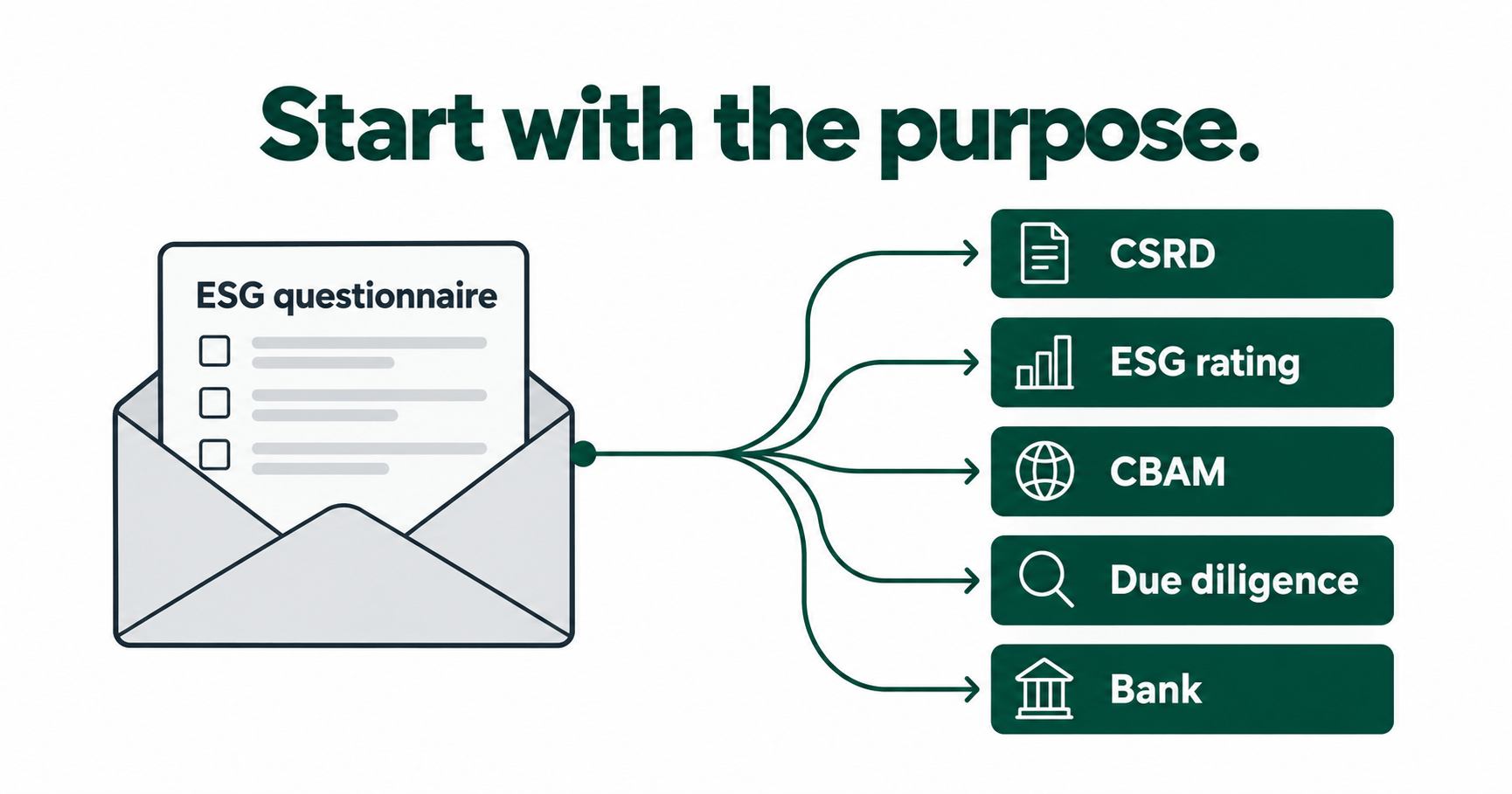
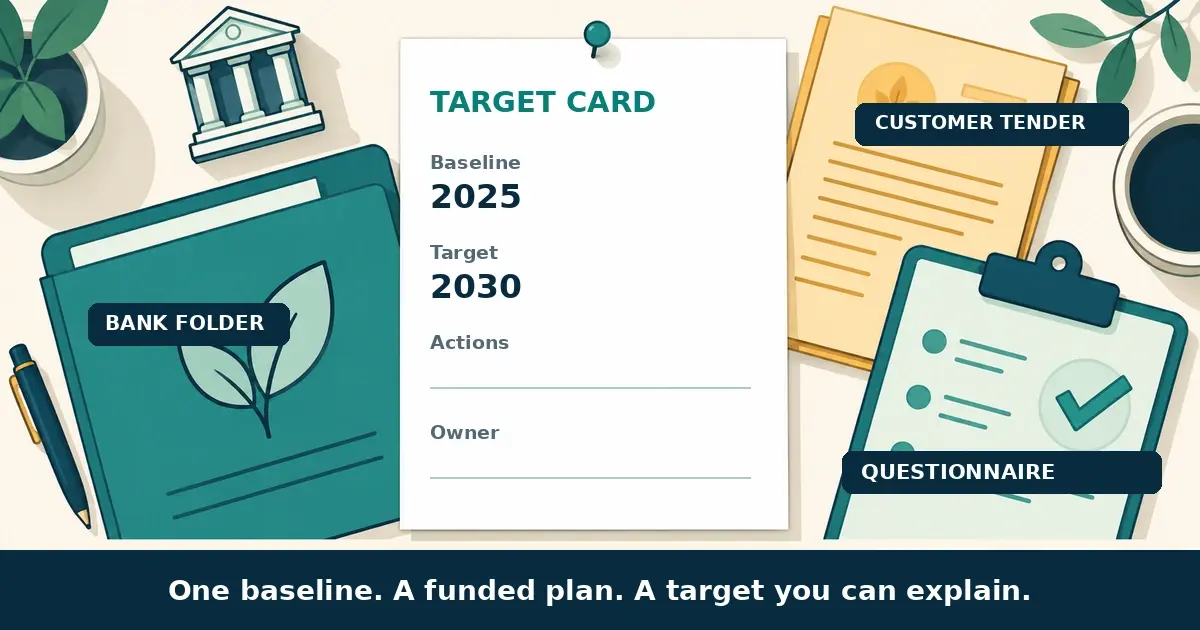
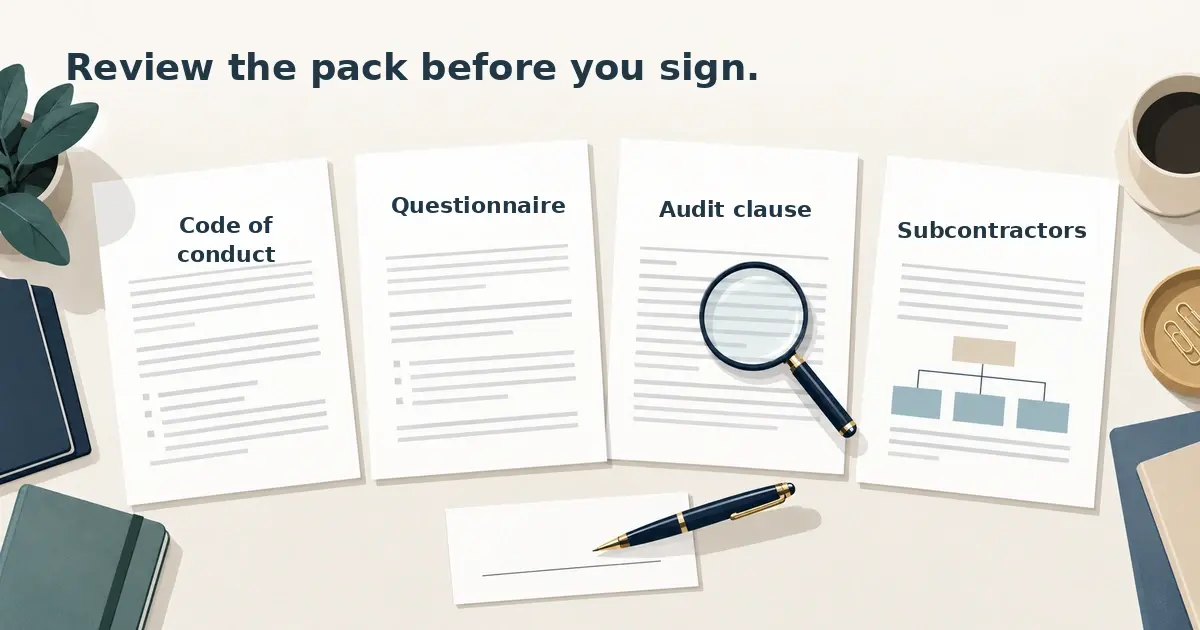
For a cleaning, facility services, security or building-services company, the procurement pack often arrives as one bundle: an ESG questionnaire, a supplier code, an audit form and a declaration about every subcontractor. These need different answers. A questionnaire asks what you know; a contractual code commits you to actions, access rights and financial consequences. This guide explains the current EU and Dutch position, maps evidence you may already hold, and gives you a clause checklist and a reply to send.
1. Separate the documents in the procurement pack
Document | What to establish | Who reviews |
|---|---|---|
Supplier code of conduct | Principles, binding promises, scope, version | Management, HR, contract owner |
Self-assessment questionnaire | Period, definitions, evidence, unknowns | The relevant data owners |
Audit clause | Access, privacy, cost, frequency, follow-up | Operations, HR, privacy and legal as needed |
Subcontractor cascade | Which obligations pass on, to whom, how | Procurement, contract owner |
Contract annex or declaration | Liability, precedence, termination, warranties | Authorised signatory; lawyer if material |
Ask two questions about every signature line. Does it acknowledge receipt, commit to future conduct, or certify that everything is already true? Those are three different decisions. And which document wins if the code conflicts with your negotiated master agreement?
For the questionnaire part, use our questionnaire triage guide, and keep factual answers separate from accepting contract terms.
2. What the amended CSDDD requires, and when
The Corporate Sustainability Due Diligence Directive is about human-rights and environmental due diligence. It is a different law from the CSRD, which is about reporting.
A standalone SME is outside direct scope
After Omnibus I (Directive (EU) 2026/470), the main test for EU companies in the consolidated CSDDD is "more than 5 000 employees on average" and a net worldwide turnover of "more than EUR 1 500 000 000". Non-EU companies have a separate EU-turnover test, and group and franchising routes exist, so "only companies above both thresholds" is shorthand. But a standalone 50–250-person supplier is not in scope just because it supplies a large customer.
The timeline
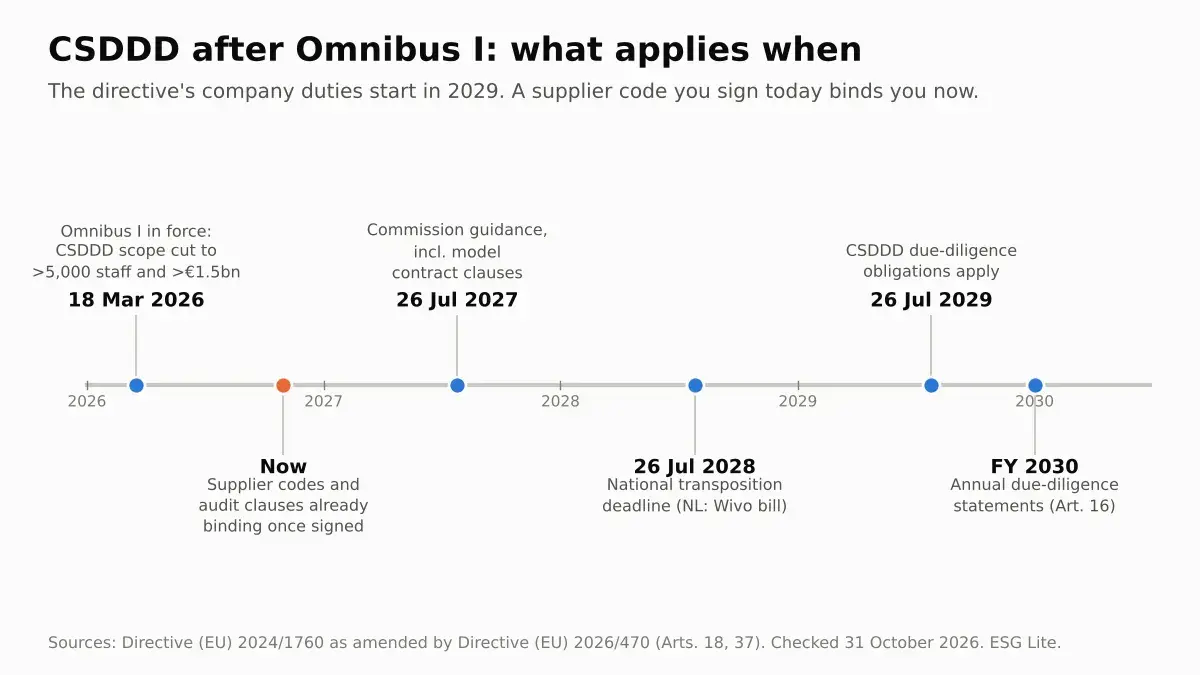
Date | What happens |
|---|---|
18 March 2026 | Omnibus I in force |
26 July 2027 | Commission guidance due, including voluntary model contract clauses (Article 18) |
26 July 2028 | Member States must transpose (Article 37) |
26 July 2029 | Company due-diligence obligations apply |
Financial years from 1 January 2030 | Annual statement duties (Article 16) apply |
A 2029 start date doesn't postpone your existing employment duties, and it doesn't make a contract signed today harmless.
The limit on information requests to smaller partners
Article 8(2a)(a) of the amended CSDDD says that, for the in-depth assessment, in-scope companies should request only necessary information, and from "business partners with fewer than 5 000 employees, only when the information cannot reasonably be obtained by other means". This is a safeguard inside the assessment process, not a general right to refuse questionnaires or audits, and it applies once the directive applies. A useful clarification today:
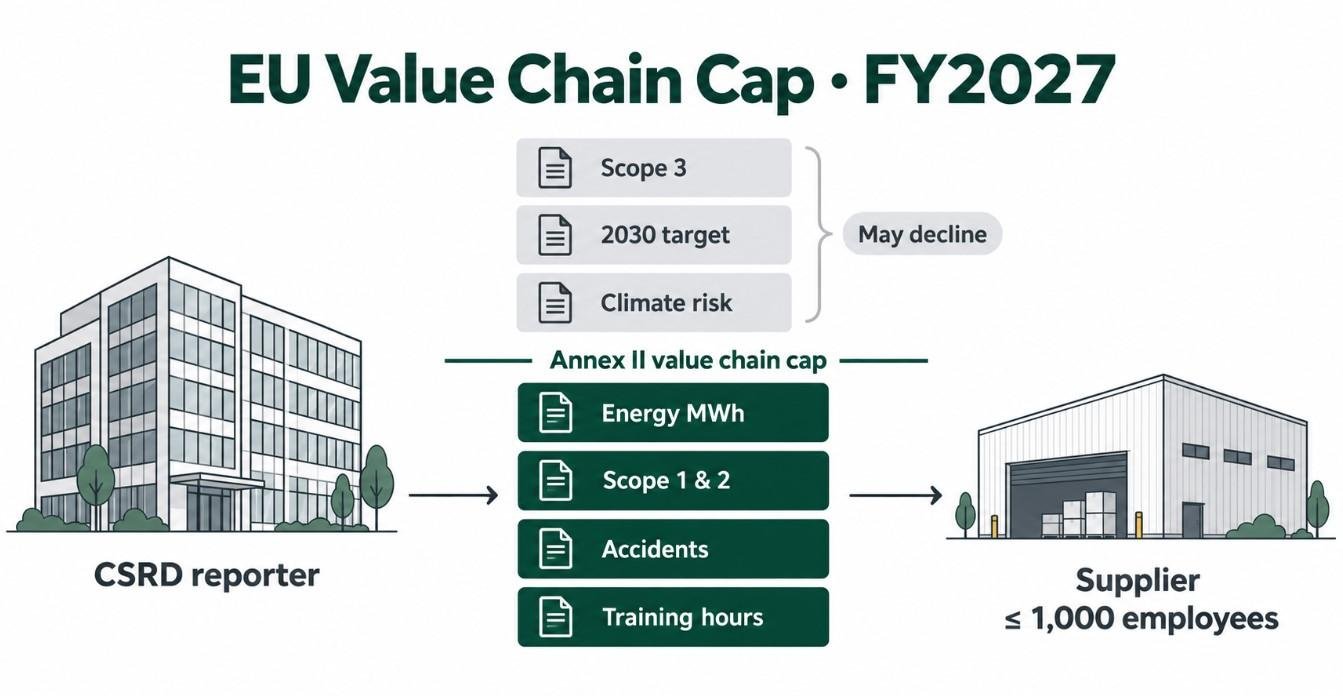
The same logic appears in the CSRD value chain cap, which limits what a reporting customer can require for its sustainability report from 2027. Codes of conduct are mostly outside that cap, because they serve due diligence and contract purposes, not reporting.
3. Is there a Dutch IMVO law already?
No. As of 31 October 2026, there is no Dutch due-diligence statute in force.
- The Wet internationaal verantwoord ondernemen (Wivo) is the government bill that will transpose the CSDDD. A first draft went to consultation in late 2024 (Stibbe). A second, shorter consultation on the post-Omnibus version ran until 3 August 2026 (Solar Magazine). Its scope follows the amended directive.
- The separate Wet verantwoord en duurzaam internationaal ondernemen (dossier 35 761) is a 2021 private member's bill. Parliament lists only its preparation stage as complete; it has not been debated or voted on.
"IMVO" is a policy field, not one law. If a customer says "Dutch IMVO law requires you to sign this", ask for the enacted provision and why it applies to you.
4. Where the Voluntary Standard overlaps: B10, C6 and C7
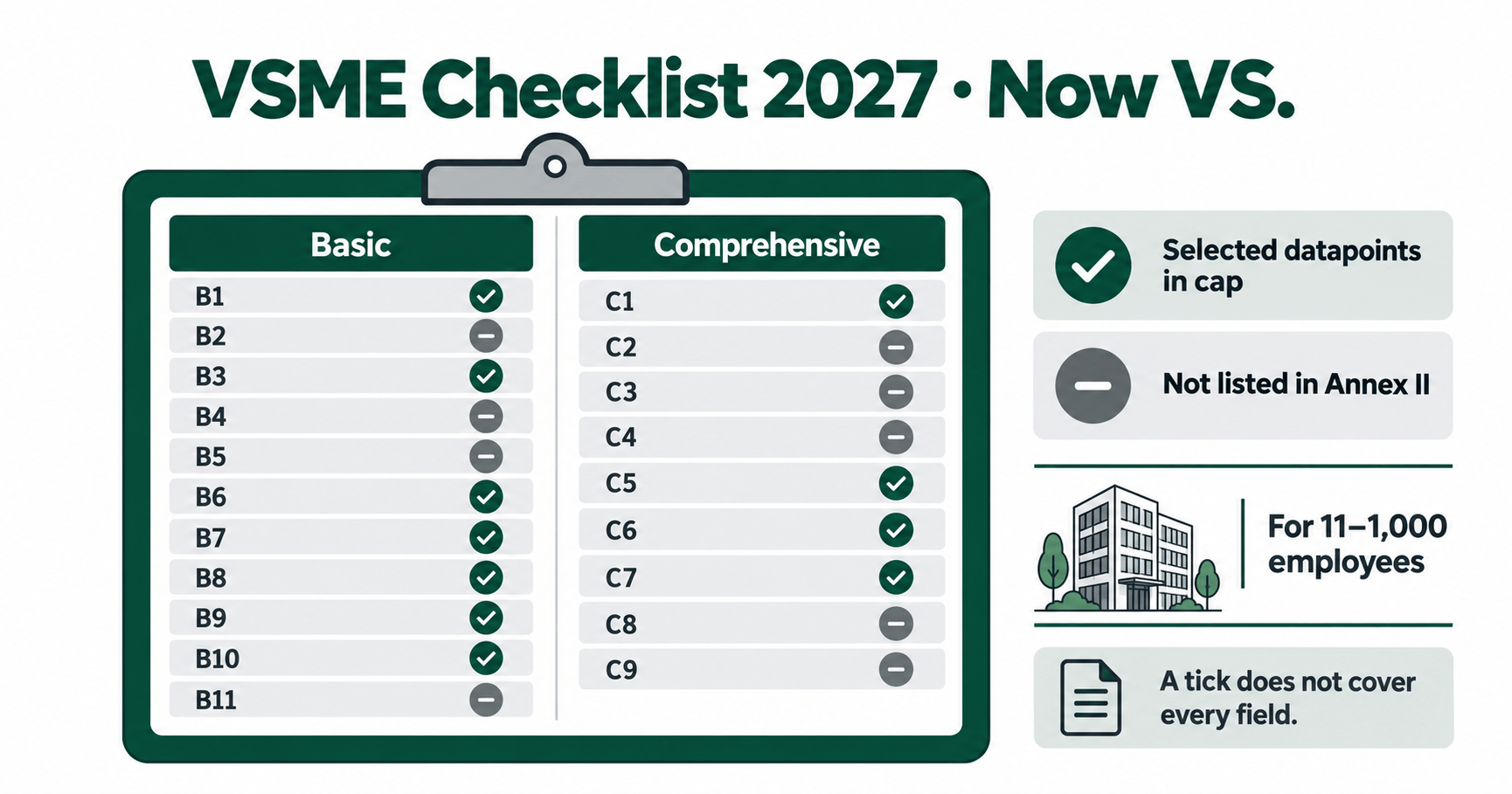
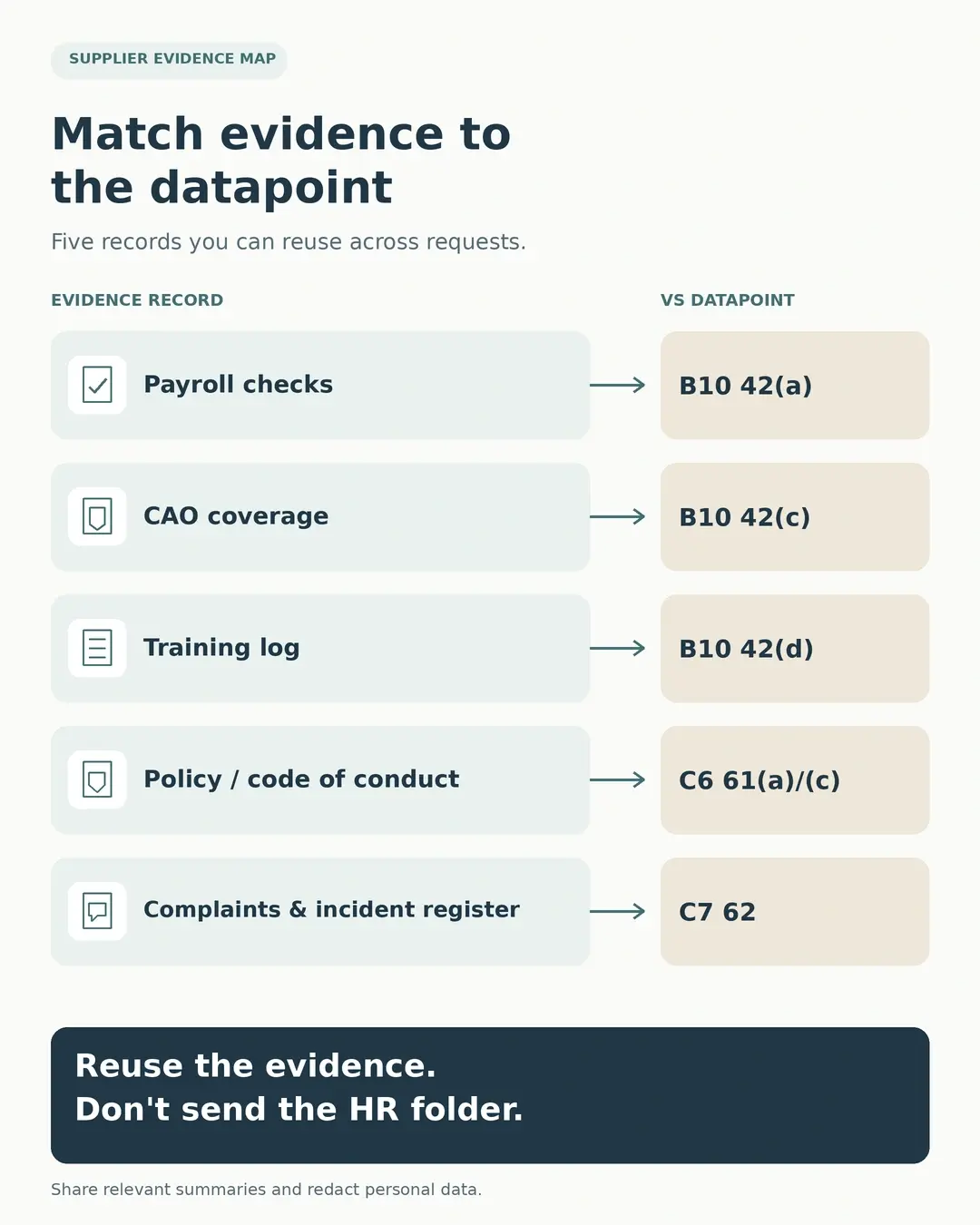
The VS helps you reuse evidence; it doesn't approve the customer's contract. These datapoints are in Annex II of Delegated Regulation (EU) 2026/1560, the list a CSRD customer can require from FY2027:
Datapoint (Annex II wording) | Evidence you can reuse |
|---|---|
B10 42(a): pay equal to or above the applicable minimum wage | Pay scales, CAO assessment, payroll checks |
B10 42(c): % of employees covered by collective agreements | Coverage register, applicable CAO |
B10 42(d): average annual training hours per employee | Attendance records and calculation |
C6 61(a): code of conduct or human-rights policy | Approved policy, version record |
C6 61(c): complaints-handling mechanism | Procedure, contact route, communication evidence |
C7 62(a)(i)–(v): confirmed incidents in own workforce | Reviewed incident register |
C7 62(c), first sentence: confirmed incidents involving value-chain workers, communities, consumers | Incident and escalation records |
Only these points are in the cap, not everything under B10, C6 or C7. The B10 pay-gap item, for example, isn't listed. And a listed datapoint doesn't entitle anyone to raw payroll files or investigation records.
"Do you have a code?" and "Will you sign our code?" are different questions. The first is a C6 datapoint. The second is a contract.
Build an evidence index instead of sending an HR folder:
- CAO: which agreement applies, to which workers and activities.
- Payroll: documented checks against pay rules and hours.
- Training: attendance, duration, period, population.
- Policies: owner, approval, effective date, how communicated.
- Complaints and incidents: keep allegations, investigations, confirmed findings and remediation separate.
Our guide to where each datapoint sits in Dutch records maps the B8–B10 sources. Treat agency workers and subcontractor staff deliberately: not everyone on your site belongs in your denominator. A "zero incidents" answer should follow a documented review, not mean that nobody checked.
5. Clauses to read before you sign
These are negotiation points, not ready-made legal wording.
Clause | Watch for | Position to discuss |
|---|---|---|
Compliance declaration | A guarantee of perfect past and future compliance | Accurate present statements, disclosed gaps, defined actions |
Audit access | Unlimited access to sites, systems and all worker records | Relevant scope, qualified auditors, confidentiality, proportionate access |
Audit costs | Every audit and re-audit charged to you | Clear allocation, triggers and caps |
Subcontractor cascade | Guaranteeing every entity in every tier | Defined relevant partners, contractual steps, checks, escalation |
Remediation | Every gap an incurable breach | Corrective actions with owners and deadlines matched to severity |
Suspension and termination | Immediate exit for any allegation | Defined triggers, fair fact-finding, urgent safeguards for serious harm |
Liability and indemnity | Unlimited exposure, including for third parties | Legal review against the master agreement and insurance |
Unilateral updates | Future website versions binding automatically | Fixed version, notice, agreed change process |
Precedence | Code overrides negotiated limits | Explicit hierarchy across the whole contract |
What the CSDDD says about SME contracts and audit costs
Articles 10(5) and 11(6) of the amended directive are the most useful text for an SME negotiating with an in-scope customer. When an in-scope company seeks contractual assurances from an SME:
- the terms "shall be fair, reasonable and non-discriminatory";
- the company must consider whether to support the SME;
- where compliance is verified, "the company shall bear the cost" of independent third-party verification;
- if the SME pays part of the cost, it may share the results with other companies.
These duties apply to in-scope companies once the directive applies in 2029, so they don't automatically make every audit free today. But they show where EU law is going, and they are a reasonable reference point in negotiation now.
Audit rights: cooperate without unrestricted access
Clarify the sites, activities, records and period in scope; who audits and how conflicts of interest are handled; notice and when unannounced visits are justified; how confidential worker interviews work; how findings are checked and followed up; and how personal data is minimised. Offer summaries, redacted records or controlled review where they answer the question. Don't send identity documents, health information or full complaint files to a procurement mailbox.
Subcontractor cascade: a process you can run
For labour-intensive services, a signed declaration from an agency proves little. Check who recruits and pays the workers, who controls schedules, which further subcontractors are involved, and how worker concerns reach someone who can act. Propose a risk-based process (checks, cooperation, remediation) rather than certifying that unknown subcontractors have always complied.
Termination: separate the law from the remedy
A contractual right to terminate immediately can have a different trigger from the directive's framework, which prefers prevention and corrective action, with suspension or termination as a last resort for severe impacts. Ask what happens to workers, site access, unpaid invoices and service continuity. A missing document and a confirmed forced-labour case shouldn't trigger the same response.
6. A one-page policy set for an SME
Use this as a drafting start, then check it against your operations:
Workforce and subcontractor conduct: policy summary
We prohibit child labour, forced labour, human trafficking, discrimination, harassment and retaliation. We respect lawful freedom of association and collective bargaining and apply the pay, working-time and safety requirements relevant to our operations.
We communicate these expectations to employees, agency partners and relevant subcontractors. HR maintains employment and pay checks; operations maintains site induction and safety records.
Workers can raise concerns through the published complaints routes. Suspected wrongdoing is handled through our protected reporting procedure, by designated people able to act independently, with confidentiality and protection against retaliation.
We assess relevant subcontractors by risk, record concerns and agree proportionate corrective actions. Serious concerns are escalated promptly, and protecting affected people comes first.
Management approves this policy. The owner records implementation, reviews material incidents and updates the policy at least annually.
Owner: [role] · Approved by: [name/role] · Effective: [date] · Review: [date] · Reporting routes: [contacts/links]
Don't publish it until the arrangements it describes exist. Back it with three records:
Record | Minimum content |
|---|---|
Complaints and reporting procedure | Routes, independent recipients, confidentiality, follow-up, escalation |
Subcontractor register | Identity, activity, workforce arrangements, checks, further subcontractors, open issues |
Action and incident register | Concern, status, evidence, owner, deadline, response, closure review |
For multilingual or mobile workforces, make the reporting route work at the actual workplace, not only on the office intranet.
7. At 50 workers, the Dutch Whistleblower Act already applies
Under the Wet bescherming klokkenluiders, every organisation with 50 or more workers must have an internal reporting procedure for suspected wrongdoing. Some sectors, such as financial services, must have one below 50. The employer FAQ from the Huis voor Klokkenluiders sets out what the procedure needs:
- one or more named independent officers who receive and follow up reports;
- reporting in writing and orally, with oral reports recorded with consent or written up for the reporter to check;
- an acknowledgement within 7 days of receipt;
- feedback on the assessment and follow-up no later than 3 months after the acknowledgement;
- information on protection and external reporting.
A reporter may go directly to a competent external authority without reporting internally first. Don't write a policy that says otherwise.
A C6 complaints mechanism and a statutory whistleblowing procedure are not automatically the same. An ordinary grievance and suspected wrongdoing may need different handling, even if one team runs both.
Plan the conflict case. In a small company, the HR manager may also manage the agencies or report to the owner named in a concern. Set up an alternative independent route before you need it. And don't promise anonymous reporting or specific outcomes unless your arrangements support them.
8. A realistic example: accept the principles, resolve the gaps
A fictional facility services firm with 120 employees and three labour subcontractors receives a code requiring immediate certification that:
- every subcontractor has always complied;
- the buyer can obtain all personnel records on demand;
- every complaint is resolved within 48 hours;
- any issue permits immediate termination and unlimited recovery of losses.
The firm has an approved workforce policy and payroll checks, but hasn't finished reviewing one subcontractor and has no alternative reporting route. A good response does four things: confirm what is supported, disclose the gaps, propose dates and owners, and negotiate the guarantees, access, remedies and liability before signing. Note that a 48-hour is achievable; a 48-hour of a complex complaint is not, and the statutory whistleblowing timelines are 7 days and 3 months.
This opens a discussion; it doesn't change the buyer's terms. Get any exceptions agreed in the form the contract requires.
9. When to involve a lawyer
Get legal review before signing when the code:
- creates unlimited liability, unusual indemnities or exposure beyond your insurance;
- overrides protections in the main agreement;
- makes you guarantee all subcontractors' conduct without limits;
- grants broad access to worker data, systems or investigations;
- can change unilaterally;
- uses foreign law, personal guarantees or unfamiliar dispute rules;
- requires a statement you can't substantiate;
- arrives alongside a serious allegation or threatened termination.
Give the lawyer the whole pack: main contract, schedules, referenced website policies, insurance details and your evidence-and-gap summary.
See how your social and governance basics score. ESG Lite's free readiness assessment covers the VS social and governance datapoints, not just carbon, with first results before you create an account. Start the free assessment
Sources
- Directive (EU) 2026/470 (Omnibus I).
- Consolidated CSDDD, Directive (EU) 2024/1760 as amended (version of 18 March 2026): Articles 2, 8(2a), 10(5), 11(6), 16, 18, 37.
- European Commission: Corporate sustainability due diligence.
- Stibbe: draft Wivo published for consultation (Dec 2024).
- Solar Magazine: second Wivo consultation until 3 August 2026.
- Tweede Kamer: dossier 35 761.
- Commission Delegated Regulation (EU) 2026/1560: Annex II.
- Wet bescherming klokkenluiders: main features.
- Huis voor Klokkenluiders: FAQ for employers (PDF).
- Huis voor Klokkenluiders: information for employers.
Make Your Business Online By The Best No—Code & No—Plugin Solution In The Market.
30 Day Money-Back Guarantee
Say goodbye to your low online sales rate!
Must an SME sign a customer's supplier code of conduct?
No law requires you to sign a particular customer's wording, but the customer can make it a commercial condition. Being outside the CSDDD doesn't protect you from obligations you accept by signing, so review the clauses first.
Does the CSDDD apply directly to a 120-person cleaning company?
No, not as a standalone company. The amended directive covers EU companies with more than 5,000 employees and more than €1.5 billion turnover, from 26 July 2029. Check group structures, and remember that employment law and signed contracts still apply.
Where is the limit on information requests to smaller partners?
In Article 8(2a)(a) of the amended CSDDD. For partners with fewer than 5,000 employees, an in-scope company may request information only when it cannot reasonably be obtained by other means. It is part of the in-depth assessment, not a general ban on questionnaires.
Who pays for supplier audits under the CSDDD?
When an in-scope company verifies an SME's compliance with contractual assurances, the company bears the cost of independent third-party verification (Articles 10(5) and 11(6)). This applies from 2029 and only within the directive's framework; existing contracts set their own cost rules.
Does having a code prove that we meet VS C6?
It answers whether a code or policy exists. It doesn't prove the practices are implemented or that your complaints mechanism works.
Is an email address enough for the Dutch Whistleblower Act?
No. With 50 or more workers you need a procedure with independent officers, written and oral reporting, acknowledgement within 7 days and feedback within 3 months. An email address can be one route within it.
Can we wait until 2029 to fix our policies?
No. The CSDDD timeline doesn't postpone employment law, the Whistleblower Act or contracts you sign today. Customers also send codes now.