Your Shipper Wants CO₂ per Shipment: ISO 14083, GLEC and CountEmissionsEU for SME Carriers and Warehouses
Short answer
Shipment emissions = shipment transport activity (tonne-km) × emissions intensity (kg CO₂e per tonne-km), plus any hub contribution.
- Pool a full year's fuel and electricity for one comparable operation, including empty running.
- Convert it to well-to-wheel CO₂e (fuel supply plus combustion), as ISO 14083 and the GLEC Framework do.
- Divide by the operation's total tonne-km to get an intensity.
- Multiply by the shipment's mass × distance, and add hub emissions per tonne handled.
- Report kg CO₂e with the boundary, distance method, data sources and exclusions.
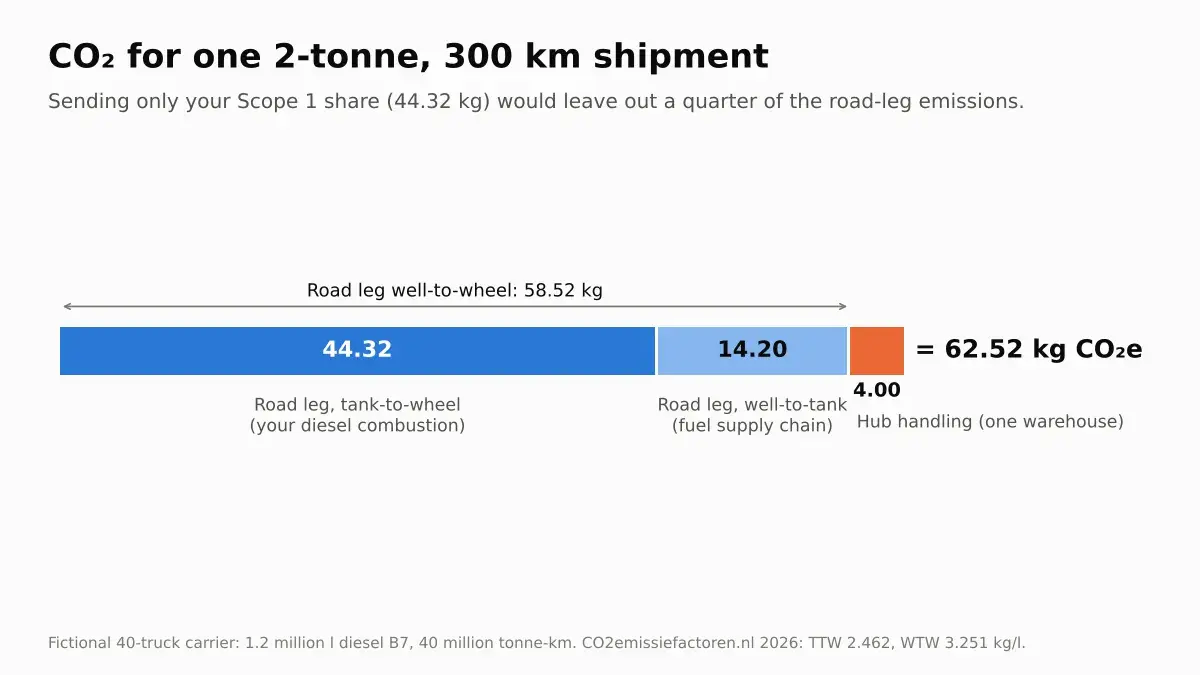
In our 40-truck example, a 2-tonne, 300 km shipment comes to 58.52 kg CO₂e on the road and 62.52 kg with one hub.
The arithmetic fits in a spreadsheet. The hard part is making the fuel, activity, distance and allocation boundaries match. This guide explains ISO 14083, the new GLEC v3.3, the CountEmissionsEU timetable and how all of it relates to your company's VS/VSME report, with a worked example and a reply template.
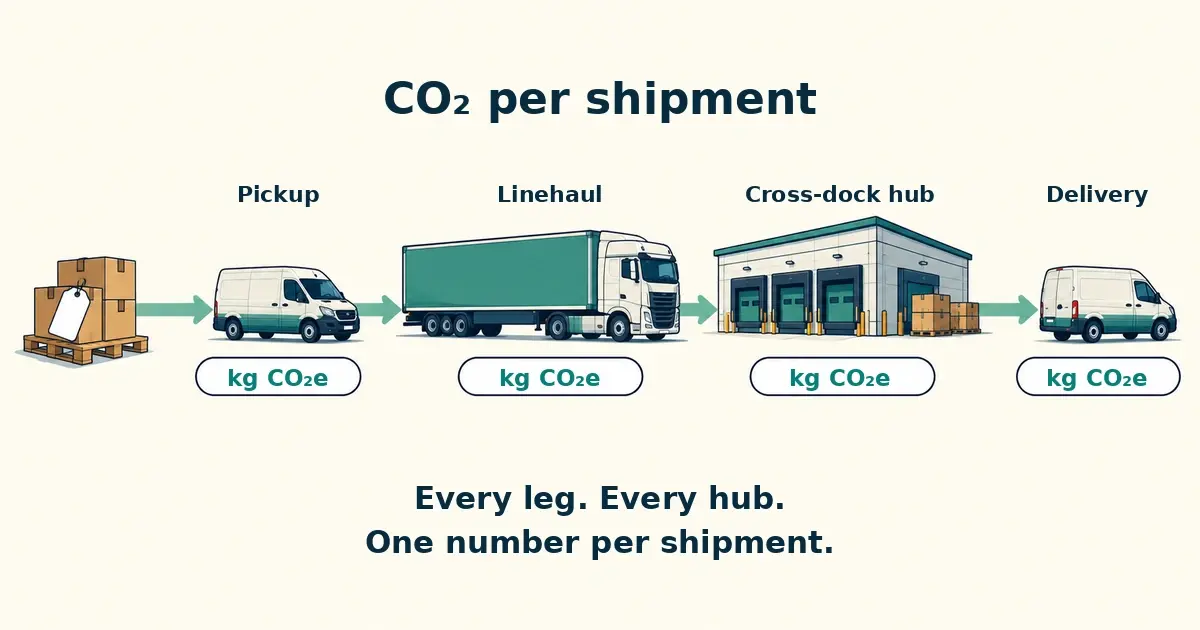
1. What your shipper actually wants
The request | Establish first |
|---|---|
An estimate before booking | Route, cargo, vehicle assumptions, whether defaults are accepted |
Emissions after delivery | Service boundary, period, operational data |
Monthly emissions per customer | Shipment IDs, allocation method, reconciliation |
Door-to-door emissions | Every leg, subcontractor and hub |
Your company's annual emissions | Organisational boundary; Scope 1, 2 and 3 separately |
Your Scope 1 becomes their Scope 3. Diesel burned in a truck you control is your Scope 1. For the shipper, transport it buys normally falls in Scope 3 Category 4 (upstream transportation and distribution). Transport of sold products that the shipper does pay for falls in Category 9. Who buys the service decides which, per the GHG Protocol Category 4 guidance. For the wider supplier-request logic, read our guide to Scope 3 requests.
2. ISO 14083, GLEC and CountEmissionsEU: three roles
Framework | What it is | What it means for you |
|---|---|---|
ISO 14083:2023 | The international standard for "quantification and reporting of greenhouse gas emissions arising from transport chain operations" (ISO) | The calculation and reporting basis |
GLEC Framework | Smart Freight Centre's practical guidance, aligned with ISO 14083 | Methods, data guidance, default factors |
CountEmissionsEU | EU Regulation (EU) 2026/1030 | Makes the ISO-based method the rule when emissions are disclosed |
GLEC v3.3 is out (27 October 2026)
Smart Freight Centre published GLEC Framework v3.3 on 27 October 2026, with a crosswalk document explaining the changes from v3.2. Record the version you actually used, read the crosswalk before switching, and keep earlier calculations as they were.
What is binding, and when
Regulation (EU) 2026/1030 entered into force on 1 June 2026 and "shall apply from 2 December 2030". It covers transport services that start or end in the EU where emissions are calculated and disclosed "on a voluntary or contractual basis for commercial purposes" or because another law requires it. It doesn't oblige every carrier to report; it sets the method for those who do.
Milestone | Date |
|---|---|
Entry into force | 1 June 2026 |
EU database of energy emission factors | by 2 June 2028 |
EU database of emission intensities (defaults) | by 2 December 2029 |
Implementing acts for the EU calculation tool | by 2 June 2030 |
General application | 2 December 2030 |
SMEs and verification. Article 12 requires calculated output data to be verified by a conformity assessment body, "with the exception of SMEs", who "may undergo a verification … upon their request". The exemption covers verification, not the method. A 40-truck fleet doesn't prove SME status, so check the employee, financial and group criteria, especially at exactly 250 employees.
In practice, shippers already write ISO 14083 or GLEC into contracts, so the method matters now even though the regulation applies later.
3. Start with the boundary, not a default factor
Write down what the number includes: which legs (pickup, linehaul, delivery), hubs and transhipments, own and subcontracted transport, energy supply as well as vehicle operation, temperature control and refrigerant losses, and the period. Keep materially different operations (dry linehaul, refrigerated distribution, urban parcels) in separate groups.
Well-to-wheel is not Scope 1
Figure | Covers |
|---|---|
Tank-to-wheel (TTW) | Burning the fuel in the vehicle: your Scope 1 |
Well-to-tank (WTT) | Producing and delivering the fuel: Scope 3 category 3 |
Well-to-wheel (WTW) | Both: the basis for transport-service emissions |
An electric truck has no exhaust, but its electricity has emissions, so it isn't zero. And WTW is still not a full life-cycle assessment of trucks and roads, so don't call it "all lifecycle emissions".
Keep distance definitions consistent
Freight activity is mass × distance. The GLEC Framework discusses the shortest feasible distance (SFD) and great-circle distance (GCD). The intensity and the shipment distance must use the same definition. GCD is shorter than the road distance, so an intensity per GCD tonne-km is higher than the same operation's intensity per SFD tonne-km. Keep actual vehicle-km for checks, and record the distance method you allocate with.
4. Collect the data you already have
Data | Source | Check |
|---|---|---|
Fuel by vehicle and type | Fuel cards, bulk tank, fleet system | Purchases vs consumption; missing transactions |
Truck electricity | Chargers, meters, invoices | Not counted again in the depot bill |
Total, loaded and empty km | Telematics, odometers | Same vehicles and period |
Shipment mass and locations | TMS, manifests, CMRs | Real mass, full coverage |
Load utilisation | Capacity and load records | Weight- vs volume-limited |
Subcontracted transport | Carrier reports, invoices | Legs included, method, quality |
Hub energy and refrigerants | Meters, bills, maintenance logs | Shared-site allocation |
Hub throughput | WMS | Defined unit and counting rule |
Run three reconciliations: fuel (fleet records against invoices and tank movements), activity (the shipments cover the same operation as the fuel pool) and charging (no double counting with the site bill).
5. Worked example: a 40-truck carrier
A fictional Dutch carrier runs 40 comparable diesel trucks in one operating group. This shows the allocation arithmetic, not a verified ISO 14083 calculation.
Annual input | Value |
|---|---|
Diesel B7 consumed | 1,200,000 litres |
Vehicle-km (total) | 4,000,000 km |
of which empty | 800,000 km (20%) |
Transport activity | 40,000,000 tonne-km |
Distance basis | Shortest feasible distance, applied consistently |
The 40 million tonne-km is the sum of each consignment's mass × distance, not trucks × maximum payload. All fuel, including empty running, sits in the pool.
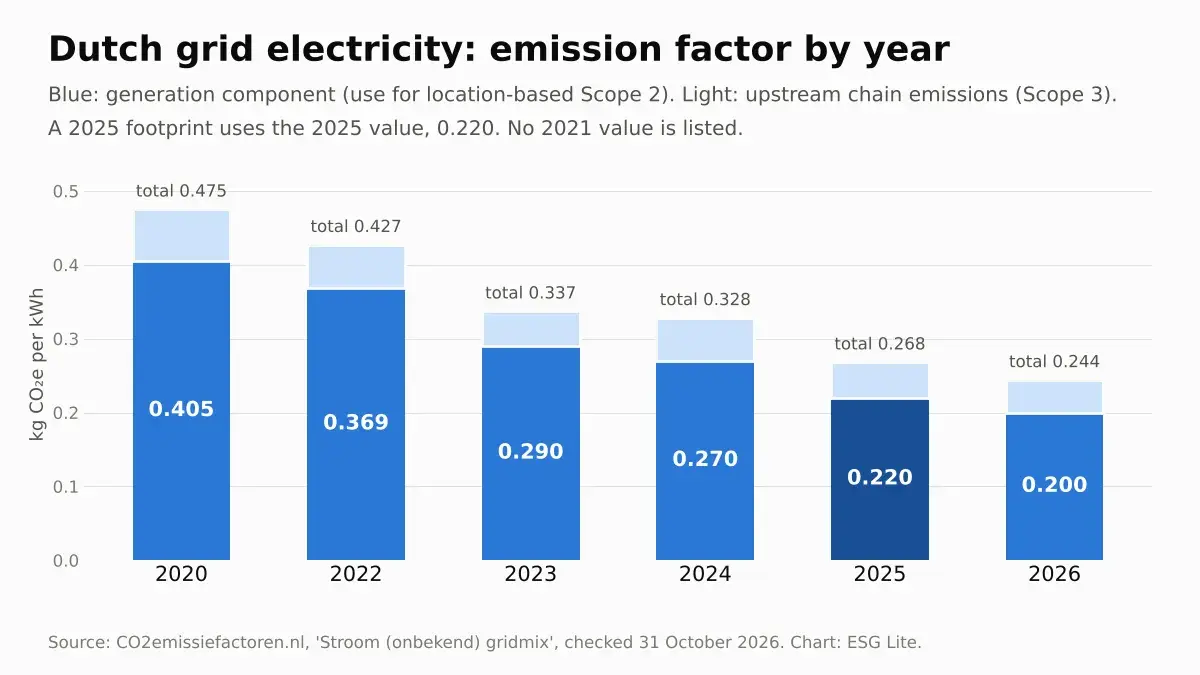
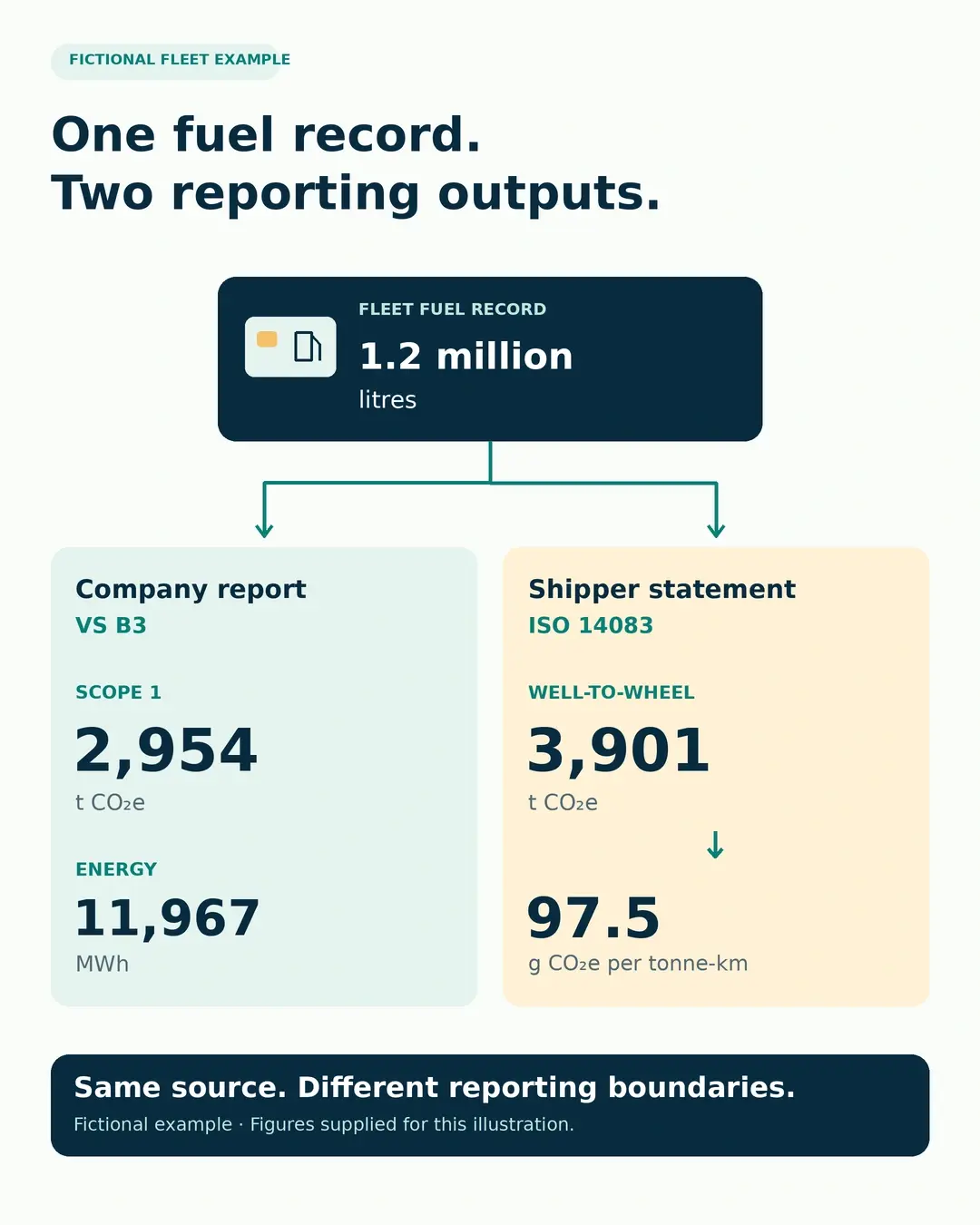
A. Operation emissions (WTW). Dutch 2026 diesel B7 well-to-wheel factor: 3.251 kg CO₂e per litre (CO2emissiefactoren.nl). 1,200,000 × 3.251 = 3,901,200 kg CO₂e (3,901.2 t).
B. Intensity. 3,901,200 ÷ 40,000,000 = 0.09753 kg CO₂e per tonne-km (97.53 g). Empty running is already inside; don't add another 20%.
C. One shipment. 2 tonnes × 300 km = 600 tonne-km. 600 × 0.09753 = 58.52 kg CO₂e for the road leg. It is an allocation from an annual intensity, not a measurement of that truck's exhaust.
D. Add the hub. A fictional hub emits 200,000 kg CO₂e a year over 100,000 tonnes handled: 2.00 kg per tonne, so 4.00 kg for this shipment. Segment total: 62.52 kg CO₂e (road leg plus one hub, not door-to-door).
Why sending "Scope 1 ÷ tonne-km" undercounts
The same fuel page splits diesel B7 into 2.462 kg combustion (TTW) and 0.788 kg supply chain (WTT). If you divide only your Scope 1 by tonne-km, you report 44.32 kg for this shipment instead of 58.52. That is 24% less, because the fuel supply chain is missing. Shippers working to ISO 14083 or GLEC expect WTW, so the gap will be spotted.
When to split the pool. Separate groups if the pool mixes very different vehicles, services or patterns, and check multi-stop routes, mixed loads, volume-limited freight and dedicated services against the relevant method. The aim is to allocate the full pool consistently, not to pick the lowest intensity per customer.
6. Warehouses and hubs need their own figure
A truck-only number can miss a material part of the service. Fraunhofer IML's REff resources cover hub-operation categories, energy collection, allocation and reporting for warehouses, distribution centres and transhipment sites. Separate ambient from temperature-controlled handling, and long-term storage and value-added services from transhipment, where they differ. The 2.00 kg per tonne above is a made-up teaching value, not a benchmark.
7. Primary data vs defaults: aim for representative, not low
Approach | Use when | Explain |
|---|---|---|
Primary operational data | Reliable energy and activity records for a suitable operation | Coverage, period, allocation |
Modelled estimate | Some operational inputs can be estimated soundly | Model, inputs, assumptions |
Default intensity | No suitable data; a justified default exists | Dataset, version, operating assumptions |
Your own data may give a higher or lower result than a default. Its value is that it represents your service. Don't claim "100% primary data" just because you have fuel invoices: weights, distances and subcontractor data may still be estimated.
What the Dutch reference values tell you
The Ministry of Infrastructure and Water Management's Referentiewaardes CO₂-prestatie transport (31 March 2025) describes a 2024 baseline from about 600 logistics companies, with segment values per tonne-great-circle-kilometre:
Segment | Reference value (kg CO₂ per tonne-GCD-km) |
|---|---|
Linehaul | 0.174 |
Distribution | 0.204 |
Construction logistics | 0.515 |
They are segment averages, not shipment factors, and they use great-circle distance. Don't compare them directly with the example's 97.53 g per SFD tonne-km until segment, boundary, units and distance basis line up.
8. What your VS report covers, and what it doesn't
Output | Relationship to the Voluntary Standard |
|---|---|
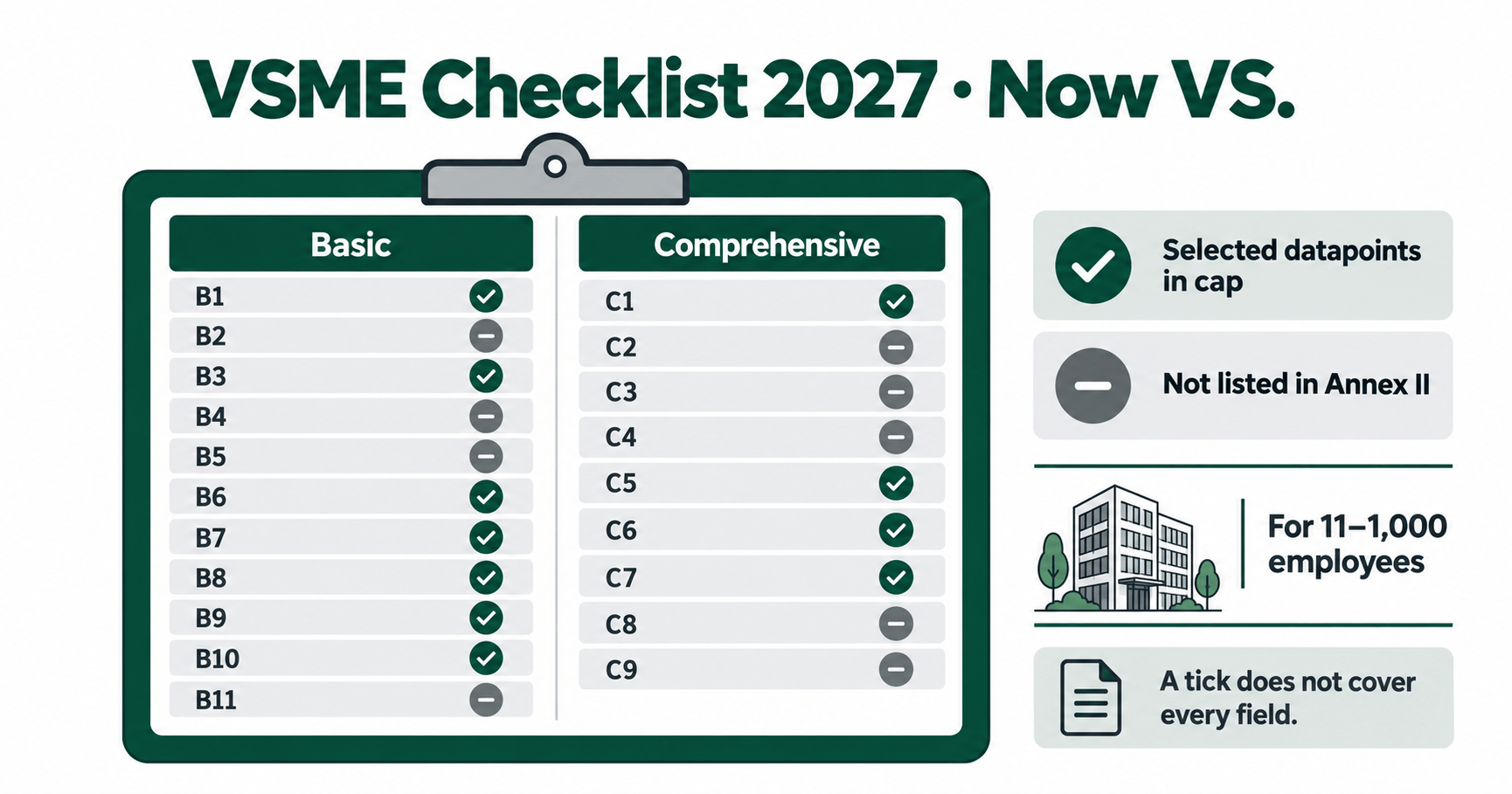
Company total energy (MWh) | B3 datapoint, inside the value chain cap |
Company gross Scope 1 and location-based Scope 2 | B3 datapoints, inside the cap |
CO₂e per shipment or per customer | Not a B3 datapoint |
Transport-service WTW emissions | Different boundary from Scope 1 |
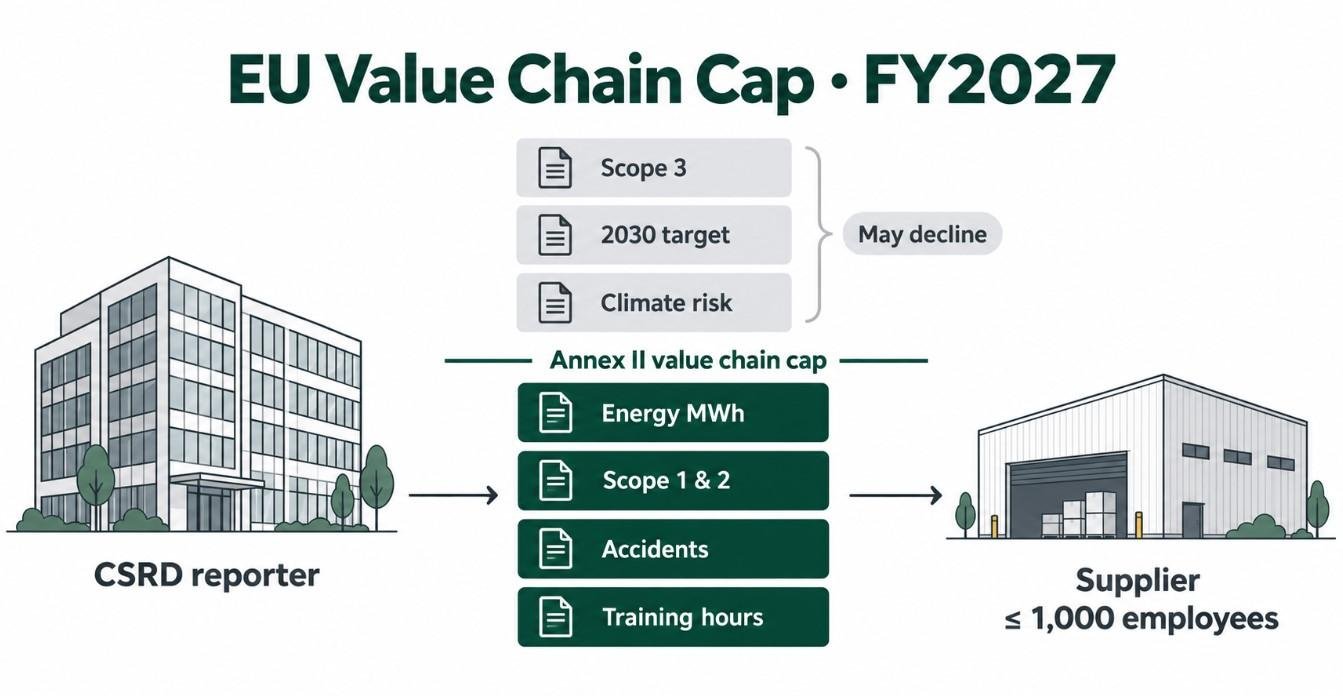
Annex II of 2026/1560 lists the company-level B3 figures; it says nothing about shipment allocation, and the cap concerns CSRD reporting requests. See our value chain cap explainer.
Reuse the fuel data, not the wrong total:
From the same 1.2 million litres | Result |
|---|---|
Fleet fuel energy (× 35.9 MJ/l ÷ 3,600) | 11,966.67 MWh |
Fleet combustion for Scope 1 (× 2.462 kg/l) | 2,954.40 tCO₂e |
Transport-service WTW (× 3.251 kg/l) | 3,901.20 tCO₂e |
The fleet figures are contributions to B3, not the whole company: add your premises and other sources, and report biogenic CO₂ from the bio blend separately. Our Scope 1 and 2 one-afternoon calculation covers the full company inventory.
A shipment moving through pickup, a linehaul truck, a warehouse hub and final delivery, each stage tagged for its own CO2e contribution.
9. A one-page response for your shipper
Field | Your response |
|---|---|
Entity | [Legal entity] |
Customer and reference | [Contract, shipment or batch IDs] |
Service period | [Dates] |
Included elements | [Pickup, road leg, hub, delivery] |
Result | [kg CO₂e per element and total] |
Intensity | [g CO₂e/tonne-km; kg CO₂e/tonne for hubs] |
Activity | [Mass, distance, tonne-km; hub throughput] |
Method | [ISO 14083 as assessed; GLEC version used] |
Emissions boundary | [WTW; other sources included] |
Distance method | [SFD, GCD or other] |
Empty running | [How included] |
Inputs and factors | [Primary/modelled/default; dataset, year, units] |
Subcontractors | [Included, estimated or excluded] |
Hubs | [Included or excluded; allocation basis] |
Limitations | [Missing legs, estimates, gaps] |
Review | [Internal review; any external verification] |
Contact | [Name; how evidence can be checked] |
Don't add an ISO conformity, certification or CountEmissionsEU statement unless an actual assessment supports it.
10. Checks before you send
- Reported CO₂e in the right unit (g, kg, t).
- WTW boundary stated, not Scope 1 only.
- Fuel and activity from the same period and operation.
- Empty running included once.
- Intensity and shipment distance on the same definition.
- Hubs and subcontracted legs included or explicitly excluded.
- Allocations add back up to the pool.
- Factors, estimates and review status recorded.
Don't divide annual fleet emissions by the number of shipments. A 2-tonne long-haul shipment and a small local parcel aren't the same unit.
Your fleet data already answers part of VSME B3. Check your ESG Lite readiness score for free and see which company energy and emissions questions your fuel, electricity and premises records can already answer, with first results before you create an account. Start the free assessment
Sources
- GHG Protocol: Category 4, upstream transportation and distribution.
- ISO 14083:2023.
- Smart Freight Centre: GLEC Framework v3.3 and crosswalk (27 October 2026).
- Regulation (EU) 2026/1030 (CountEmissionsEU): Articles 1, 5, 7, 8, 12, 20.
- European Commission: new transport-emissions rules take effect (1 June 2026).
- CO2emissiefactoren.nl: diesel B7.
- Fraunhofer IML: REff logistics sites.
- Rijksoverheid: Referentiewaardes CO₂-prestatie transport (31 March 2025).
- Commission Delegated Regulation (EU) 2026/1560: B3 and Annex II.
Make Your Business Online By The Best No—Code & No—Plugin Solution In The Market.
30 Day Money-Back Guarantee
Say goodbye to your low online sales rate!
Is ISO 14083 mandatory for carriers?
Not by law yet. CountEmissionsEU makes its method the rule for disclosed transport emissions from 2 December 2030. Many shippers already require ISO 14083 or GLEC in contracts, so the method often applies commercially now.
Which GLEC version should I use?
The latest is GLEC Framework v3.3, published on 27 October 2026 with a crosswalk from v3.2. Record the version you used and don't silently recalculate earlier statements.
Can I calculate CO₂ per shipment in a spreadsheet?
Yes, for a documented calculation with clear boundaries and reconciled data. A spreadsheet is not a certified calculation tool, and complex networks may need specialised software.
Do empty return trips count?
Yes. Their fuel belongs in the operation's emissions pool and is spread over the loaded tonne-km through the intensity. Don't add them a second time.
Can I send Scope 1 divided by tonnes transported?
No. Scope 1 leaves out the fuel supply chain (about a quarter of well-to-wheel emissions for diesel), and tonnes alone ignore distance. Use well-to-wheel CO₂e per tonne-km.
Do SMEs need CountEmissionsEU verification?
No. Article 12 exempts SMEs from mandatory verification, though they may request it. They still need to use the regulation's method when it applies, and contracts may ask for more.
Does my VS/VSME report include CO₂ per shipment?
No. B3 asks for company totals: energy, Scope 1 and location-based Scope 2. Per-shipment figures are a separate transport-service calculation using the same fuel records.