
Your Bank and Customers Want a Climate Target. How a 50–250-Person Company Sets One It Can Defend (2027)
Short answer
A defensible SME climate target states five things:
- the baseline year and emissions,
- the scopes and sites covered,
- the target year and the emissions ceiling in tonnes,
- the actions that deliver the reduction, with owners and a budget, and
- its status: internal, aligned with a named pathway, or validated by SBTi.
Back it with consumption records and a yearly progress check. No EU rule requires a 50–250-person company to set one, but banks, tenders and EcoVadis increasingly ask, and the EU value chain cap does not stop them.
"Reduce our carbon footprint by 40%" leaves too much open. Forty per cent of what, compared with which year? Does it include the rented warehouse and the vans? Can the company pay for it? This guide shows a founder, GM or CFO how to answer those questions in a short plan that needs no sustainability department, using a fictional 120-person company, a tested emissions projection and a one-page climate-risk register.
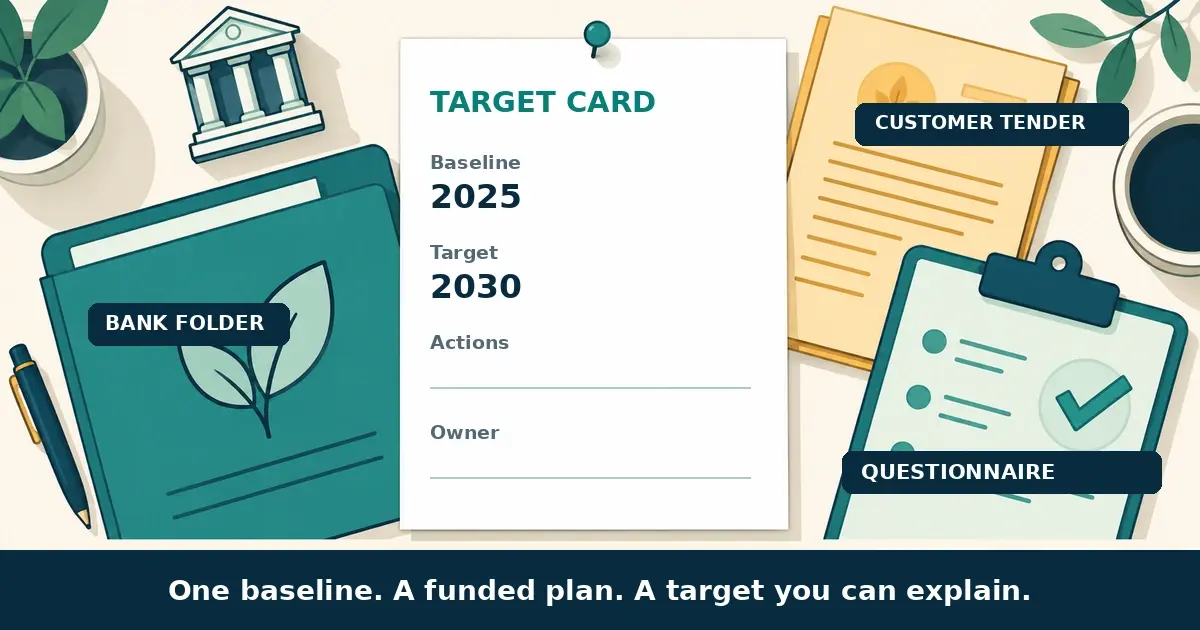
A one-page SME climate target card with baseline year, target year, actions and owner, shared with a bank, a customer tender and an EcoVadis questionnaire.
1. Why you are asked, and what the value chain cap changes
Who asks | The decision behind it | What your answer must show |
|---|---|---|
Bank | Can you fund the investments and absorb changing costs and risks? | Budget, funding need, cash effects, dependencies |
Customer or tender | Does your commitment meet our sourcing criteria? | Boundary, target, dates, validation status |
EcoVadis | Does the policy evidence meet the scoring criteria? | Explicit target wording with baseline year, target year and value |
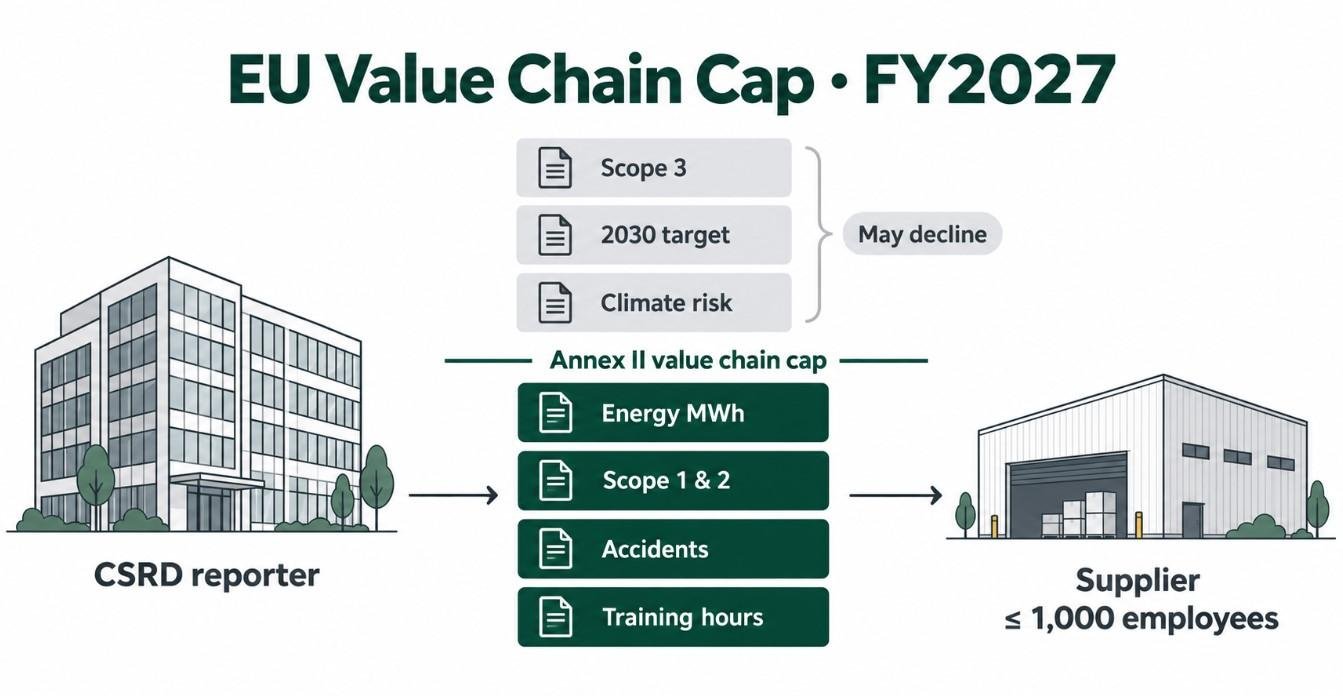
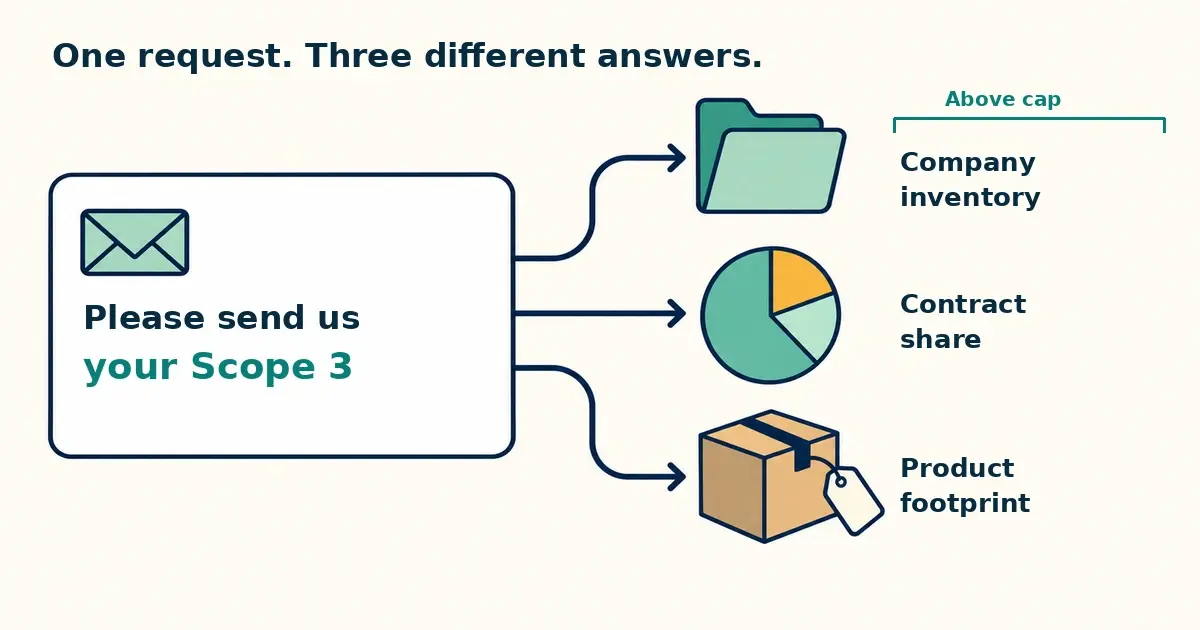
The cap does not cover targets. Under Delegated Regulation (EU) 2026/1560, a company reporting under the CSRD may only the Annex II datapoints from a supplier with up to 1,000 employees, from financial year 2027. C3 (targets and transition) and C4 (climate risks) are not on that list, so for CSRD purposes a customer can ask but must tell you it is beyond the cap and that you may decline. Banks, raters and tenders ask for their own reasons, and the cap does not govern those requests. See our value chain cap explainer.
The practical move: ask what decision the information supports and which criteria apply. A generic "ESG requirement" is not an explanation.
Why 2027 matters for credit reviews. The EBA Guidelines on the management of ESG risks apply from 11 January 2026, and to small and non-complex institutions by 11 January 2027 at the latest. They set expectations for banks, not an obligation for every borrower to buy a transition plan. At EFRAG's 9 October 2026 outreach event, banks backed the Voluntary Standard as a common base but said they still need some extra datapoints for risk management. Climate targets and risks are the obvious candidates.
2. What VS C3 and C4 ask, in plain English
Disclosure | What it asks | Condition |
|---|---|---|
C3 targets | Absolute Scope 1 and 2 targets; significant Scope 3 targets if you have any; base year and value; target year and value; units; share of emissions covered; main actions | Only if you have set targets |
C3 transition plan | Whether and when you will adopt a transition plan | Only for companies in high-climate-impact sectors without a plan; those with one describe it |
C4 climate risks | The hazards and transition events; how you assessed exposure and sensitivity; time horizons; whether you took adaptation actions | Only if you have identified climate risks; financial effects and risk ratings are optional |
The Voluntary Standard defines short term as one year, medium term as two to five years and long term as more than five years. High-climate-impact sectors are set by NACE section in a footnote; sections A to H cover, among others, manufacturing, construction, and transport and storage. Check your NACE code against the footnote rather than assuming that owning buildings puts you in or out.
These are conditional disclosures in a voluntary standard, not an instruction to set a target. EFRAG's C3 supporting guide is a good working method, but it was written for the 2025 VSME Recommendation, so its paragraph numbers are out of date.
Three different jobs:
- A target defines the outcome and deadline.
- A transition plan explains the operational and financial changes that deliver it.
- A climate-risk assessment looks at what climate hazards and the transition could do to your business.
A heat pump cuts emissions. Raised racking in a flood-prone warehouse cuts disruption. Plan both in one process, but keep their purposes apart.
3. Fix the baseline and boundary first
Pick a recent, representative year with records you can find. For a 2027 review, 2025 is usually the right completed year; move to 2026 when its inventory is done and better reflects the business. Never pick an unusually high year to make the cut look bigger.
Your baseline file holds the legal entity and sites, the consolidation approach and lease treatment, fuel, electricity, heat and refrigerant data, factors and versions, and which figures are measured or estimated. If you don't have one yet, start with our Scope 1 and 2 one-afternoon calculation, which covers rented buildings.
Decide the Scope 2 method before the percentage. B3 uses location-based Scope 2. A target set on market-based Scope 2 is a different target. If you use market-based, keep the location-based inventory and explain the difference. A green electricity contract does not reduce a location-based figure (GHG Protocol Scope 2 Guidance).
Write a recalculation rule now. Decide what triggers a restated baseline (acquisitions, disposals, outsourcing, boundary changes, material errors) before your first progress report, following the GHG Protocol Corporate Standard. Keep both versions. Normal growth is not a reason to restate.
Keep absolute emissions in view. Emissions per pallet or per unit help operations, but they can fall while total emissions rise. Report intensity next to the absolute figure, never instead of it.
4. Choose a target route
Route | Use it when | Strength | Limit |
|---|---|---|---|
SBTi validation (SME route if eligible) | A customer or lender asks specifically for SBTi | External, recognised criteria | Eligibility rules, fee, fixed target options, ongoing reporting |
A documented sector or national pathway | A pathway exists for your assets (for example buildings) | Ties to equipment and investment timing | You must show alignment; it is not SBTi validation |
An internal target | You need an accountable commitment and don't claim validation | Fits your assets and budget directly | Needs a stated rationale; can't be called "science-based" |
Option A: the SBTi SME route
Headcount alone does not qualify you. Under the SME definition in force since 1 January 2024, you must meet all of these:
- under 10,000 tCO₂e across Scope 1 and location-based Scope 2;
- not a financial institution or oil and gas company;
- not required to use sector-specific SBTi methods;
- not a subsidiary of a group that must use the standard route.
And at least three of four: fewer than 250 employees, turnover under €50 million, total assets under €25 million, and not in a mandatory FLAG sector. Exactly 250 employees is not "fewer than 250".
The route offers predefined Scope 1 and 2 target options rather than a target you design. It doesn't require a near-term Scope 3 target, but you must commit to measuring and reducing Scope 3. Check the current options and fee with SBTi Services before you build your plan around your own baseline year, because the SME options have historically fixed the base and target years.
Should you wait for SBTi V2.0? SBTi announced in June 2026 that the Corporate Net-Zero Standard V2.0 "can be used for target validation from February 1 2027" and that Version 1 stays open for submissions until the end of 2027 (its transition note says January 2028). Companies that don't meet V2.0's larger-company thresholds may request SME status. Don't wait to collect data or plan equipment; choose the submission version against your eligibility and customer deadline.
Option B: a named pathway
Property-heavy businesses can look at the SBTi Buildings Criteria, which cover operational and embodied emissions with a whole-building approach. Manufacturers need a process- or product-specific pathway; logistics firms should check transport methods. Record the pathway's name, version, geography, coverage, metric and dates. A national economy-wide percentage is not automatically a fair company target.
Option C: an honest internal target
An internal target works if management approves it, the calculation can be reproduced and the actions are funded. Say why you chose the level of ambition and, where relevant, how it compares with a benchmark. Never call it "science-based", "Paris-aligned" or "validated" without the evidence for that exact claim.
5. Write the target as one complete sentence
Using the 2025 baseline from our Scope 1 and 2 worked example:
The arithmetic: target-year emissions = baseline × (1 − reduction %), so 138.882 × 0.60 = 83.33 tCO₂e. The 40% is a fictional example, not a claim that it meets SBTi criteria or a temperature pathway.
6. Turn the target into funded actions
The fictional 2025 baseline:
Source | 2025 quantity | tCO₂e |
|---|---|---|
Natural gas | 18,000 m³ | 32.02 |
Diesel B7 (vans) | 30,000 litres | 73.86 |
Grid electricity | 150,000 kWh | 33.00 |
Total | 138.88 |
The action plan (illustrative budget, excluding VAT, grants and financing; real costs depend on the site, lease rights and quotes):
Action | When and who | Budget | Effect assumed |
|---|---|---|---|
Metering, heating controls, schedules | 2027; operations manager | €8,000 | Enables the heating savings; not counted separately |
LED lighting and ventilation upgrades | 2027–28; facilities lead | €18,000 | −20,000 kWh electricity |
Route optimisation and staged EV vans with charging | 2027–30; fleet lead | €90,000 (extra cost) | Diesel −60%; +45,000 kWh charging |
Heating retrofit with partial electrification | 2028–29; facilities lead | €45,000 | Gas −50%; +25,000 kWh electricity |
Rooftop solar for own use | 2028–29; facilities lead | €40,000 | 40,000 kWh self-consumed |
Refrigerant register and replacement plan | From 2027; maintenance lead | €3,000 | No reduction credited |
Landlord data, permissions, power contract review | 2027; CFO | €2,000 | No location-based reduction credited |
Total | 2027–2030 | €206,000 | Quotes and funding still needed |
Model route savings and vehicle replacement together. Two separate percentage cuts applied to the same litres double-count.
Check the electricity side of electrification
This is where most SME plans overstate. EVs and heat pumps add electricity. In the example, grid electricity becomes 150,000 − 20,000 + 45,000 + 25,000 − 40,000 = 160,000 kWh, higher than today.
A quick sense check that the added load is realistic:
- EVs: 18,000 litres of diesel saved at about 8 litres per 100 km is roughly 225,000 km. At about 0.20 kWh per km, that is roughly 45,000 kWh.
- Heat pump: 9,000 m³ of gas avoided is about 79,000 kWh of fuel (8.79 kWh/m³), or about 71,000 kWh of heat at a 90%-efficient boiler. At a seasonal efficiency of 3, that needs roughly 24,000 kWh of electricity.
These consumption figures are rules of thumb; replace them with your own vehicle and heat-load data.
Test whether the plan reaches the target
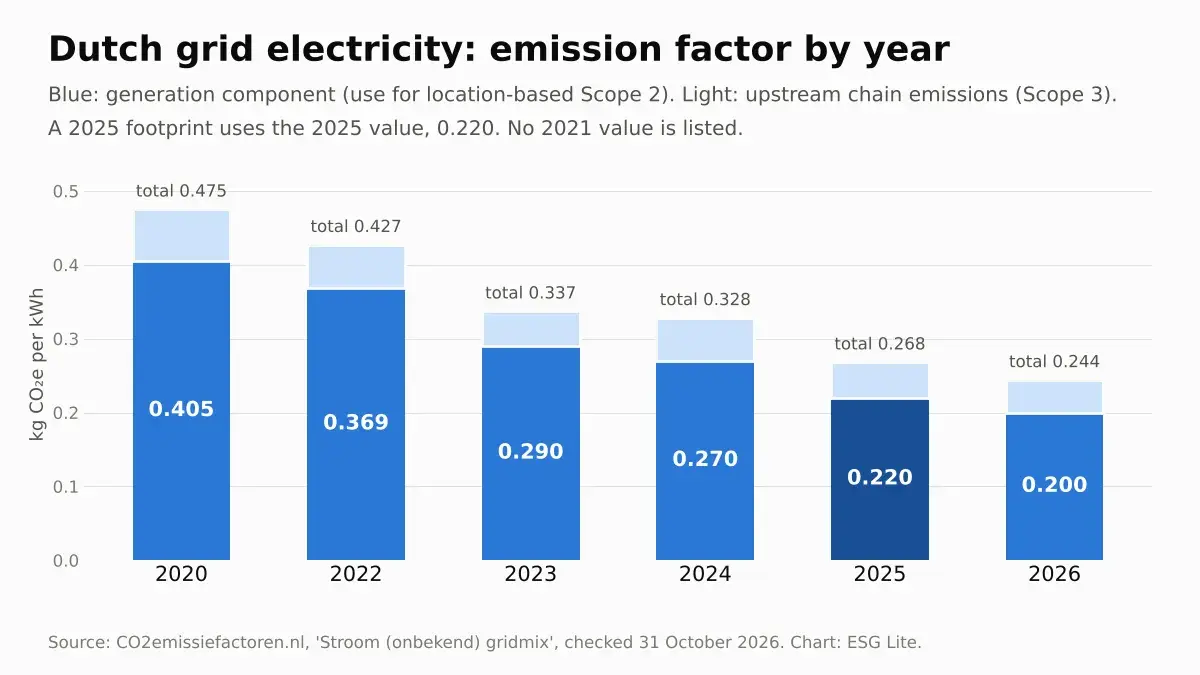
Hold the 2025 factors constant (gas 1.779 kg/m³, diesel 2.462 kg/litre, electricity 0.220 kg/kWh, from CO2emissiefactoren.nl) so the comparison shows the effect of your actions, not of a cleaner grid.
Source | Calculation | 2030 tCO₂e |
|---|---|---|
Natural gas | 9,000 × 1.779 ÷ 1,000 | 16.01 |
Diesel B7 | 12,000 × 2.462 ÷ 1,000 | 29.54 |
Grid electricity | 160,000 × 0.220 ÷ 1,000 | 35.20 |
Total | 80.76 |
That is a 41.9% cut, 2.57 t under the 83.33 t limit. The margin is thin, so stress-test it:
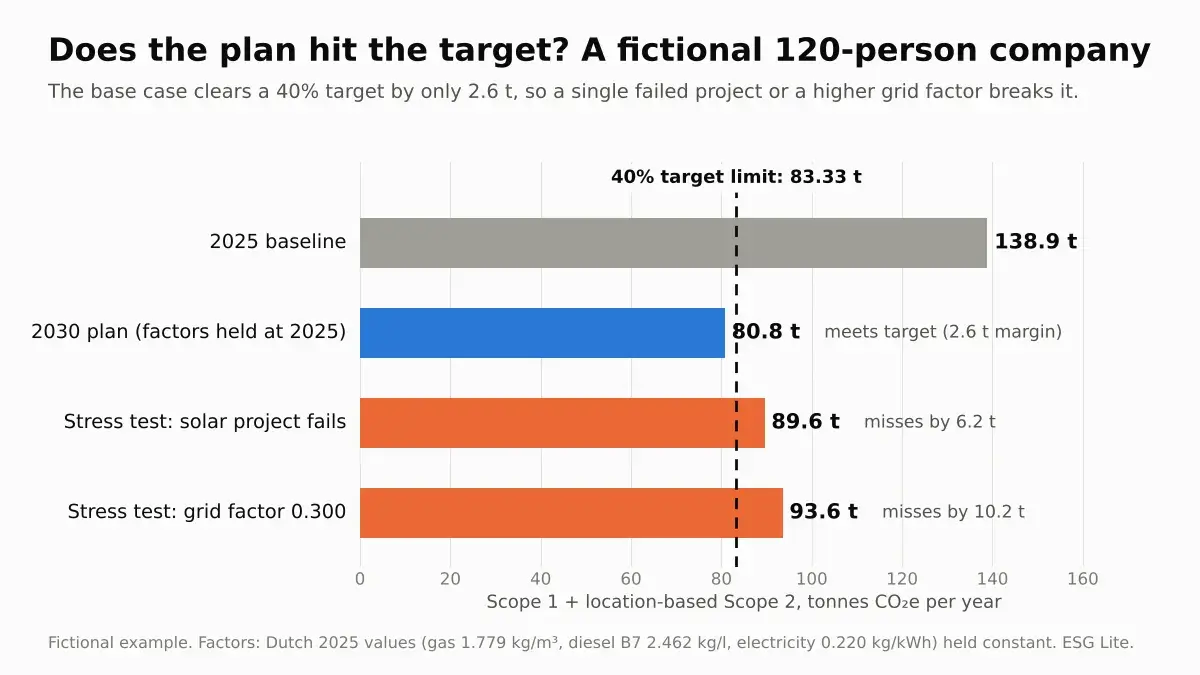
Scenario | 2030 tCO₂e | Result |
|---|---|---|
Plan as modelled | 80.76 | Meets target (2.57 t margin) |
Solar project fails (+40,000 kWh from grid) | 89.56 | Misses by 6.23 t |
Grid factor 0.300 kg/kWh, all else equal | 93.56 | Misses by 10.23 t |
These are stress tests, not forecasts. Real progress reports use each year's factors; the Dutch grid factor fell from 0.270 (2024) to 0.200 (2026), so separate the reduction you caused from the one the grid gave you. A plan with one point of failure needs a reserve action.
Don't forget the site-level rules. Locations using 50,000 kWh of electricity or 25,000 m³ of gas equivalent a year fall under the Dutch energy-saving obligation: all measures with a payback of five years or less, reported by 1 December 2027. A corporate target does not replace that. See Energy Label C and the Dutch energy-saving obligation.
Make each investment reviewable: upfront cost, annual operating-cost change, lifetime, funding source, permissions and date. Compare EVs against a like-for-like diesel replacement; include network charges for heat pumps; test solar self-consumption and export separately. Simple payback (net investment ÷ annual net savings) is a screen, not a decision, especially when the asset outlives the lease.
Bar chart for a fictional 120-person company: 2025 baseline 138.9 tonnes; 2030 plan 80.8 tonnes, meeting a 40% target limit of 83.33 tonnes by 2.6 tonnes; if the solar project fails, 89.6 tonnes, missing by 6.2; at a grid factor of 0.300, 93.6 tonnes, missing by 10.2.
7. Put climate risk on one page (C4)
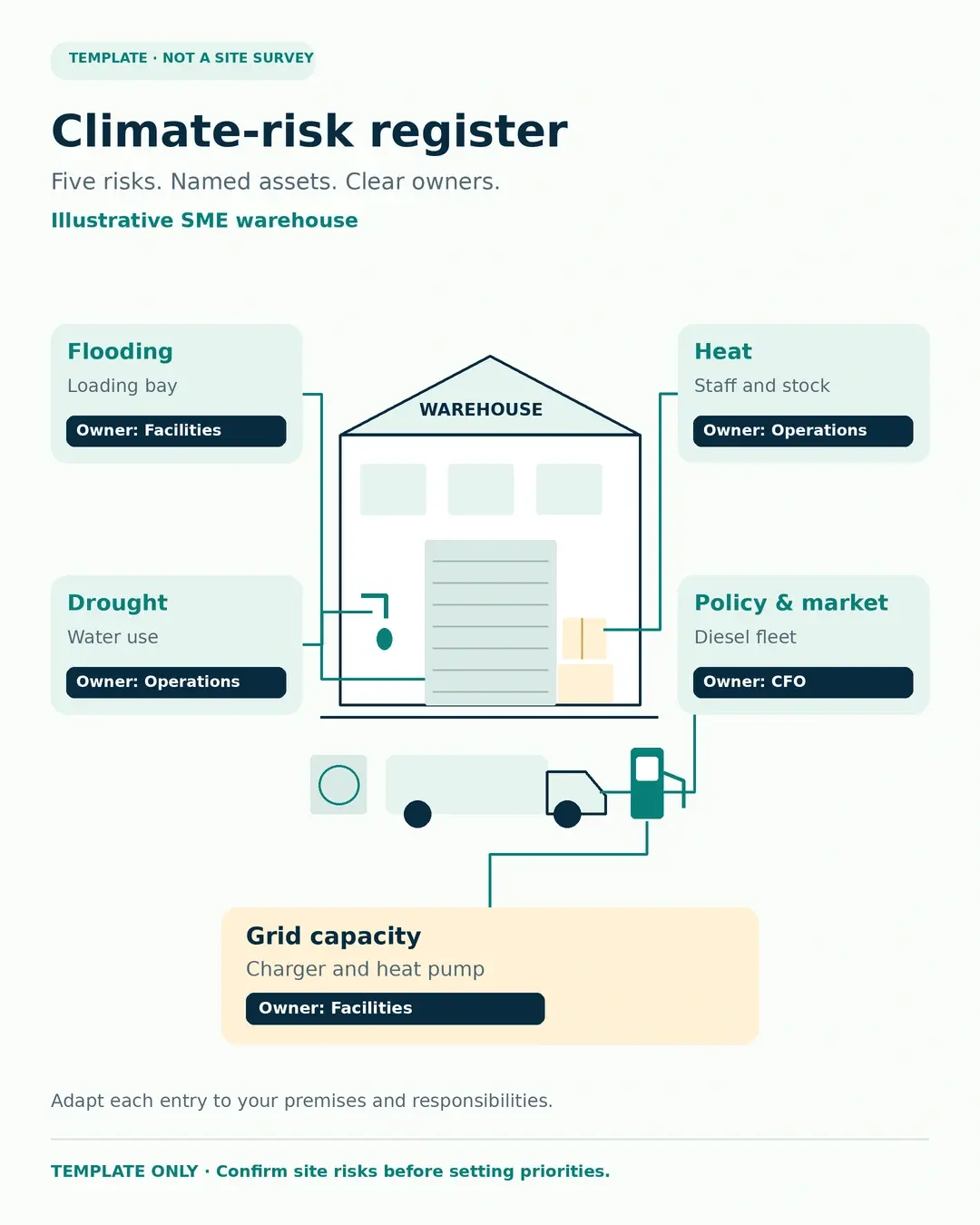
A useful register links a hazard to an asset, a consequence, an owner and an action. "Flood risk: medium" does none of that.
For Dutch sites, the Klimaateffectatlas (Climate Impact Atlas) maps flooding, waterlogging, heat and drought. Record the layer, scenario, horizon and date, then check on site. A map is a screening input, not a survey or an insurance quote.
Hazard or event | What to check | Evidence | Response and owner |
|---|---|---|---|
Flooding or heavy rain | Ground-floor stock, loading bays, electrics, access | Maps, site levels, drainage, incident log | Drainage, storage height, recovery plan; facilities lead |
Heat | Staff exposure, temperature-sensitive goods, cooling | Heat maps, indoor temperatures | Shading, ventilation, shift times, equipment sizing; operations lead |
Drought or water limits | Water-dependent processes, suppliers | Local water information | Efficiency, continuity options; production lead |
Policy, technology, market | Fossil equipment, customer specs, replacement cycles | Rules, tenders, asset register | Replacement schedule; CFO and operations |
Grid capacity | Chargers and heat pumps that need a bigger connection | Connection data, load study | Confirm capacity, stage the work; project owner |
Add columns for time horizon (short, medium, long), inherent risk, controls, residual risk, deadline and review date. Leave a rating "not yet assessed" until there is evidence. In the Netherlands, grid capacity is a real transition risk for electrification plans, so put it in the register even though it is not a weather hazard.
Put a number on it without false precision. A fictional warehouse outage costing two days of contribution at €12,000 a day plus €15,000 repair and restart is a €39,000 gross scenario, before insurance. A bank can challenge those assumptions; it can't assess "medium".
8. One plan, three audiences
Audience | Lead with | Attach |
|---|---|---|
Bank | Target, investment schedule, cash effects, funding request, main risks | Baseline summary, quotes, approvals, sensitivities, risk register |
Customer or tender | Boundary, target, deadlines, progress, validation status | Target policy, action schedule, evidence |
EcoVadis | The target as written in your policy | Dated document with baseline year, target year and target value |
EcoVadis now rejects targets without a baseline year. From EcoVadis's Q3 2026 methodology update, quantitative targets in questionnaires submitted from 14 October 2026 must state a baseline year in the supporting evidence. If not, the declaration "will be rejected and will not contribute to the Policy indicator score" (summary by Sunhat). Put the baseline year in the target document itself, not in a separate spreadsheet.
A complete target does not guarantee a rating, a tender win, a loan or a lower rate.
9. Review before the next questionnaire
Each quarter, track gas use (with weather and activity notes), fuel litres and charging, grid electricity and solar output, completed actions and spend, and any change in boundary or data quality. Update the inventory at least once a year and compare it with both the target and the plan's assumptions.
Year | Straight-line reference (tCO₂e) |
|---|---|
2025 baseline | 138.88 |
2027 | 116.66 |
2028 | 105.55 |
2029 | 94.44 |
2030 target limit | 83.33 |
This is an internal monitoring line, not an SBTi pathway. Real cuts come in steps when projects go live. Record the steps and act early on slippage.
Turn your gaps into a plan. ESG Lite's free readiness assessment gives you a score and a VSME-aligned checklist preview, with first results before you create an account. The paid ESG Lite roadmap then sets out your actions in order. Start the free assessment
Sources
- Commission Delegated Regulation (EU) 2026/1560: Article 3, Annex I (C3, C4, time horizons) and Annex II.
- EBA: Guidelines on the management of ESG risks (EBA/GL/2025/01).
- EFRAG outreach event, 9 October 2026: summary report.
- EFRAG: VSME supporting guide on Disclosure C3.
- GHG Protocol: Scope 2 Guidance.
- GHG Protocol: Corporate Standard.
- SBTi: updated SME definition and fees (effective 1 January 2024).
- SBTi Services: SME validation process and current target options.
- SBTi: Corporate Net-Zero Standard V2.0 announcement (June 2026).
- SBTi: Buildings sector criteria.
- CO2emissiefactoren.nl: 2025 factors for natural gas, diesel B7 and grid electricity.
- RVO: Energiebesparingsplicht.
- Klimaateffectatlas (Climate Impact Atlas).
- Sunhat: EcoVadis methodology updates Q3 2026, summarising EcoVadis update 34.4.
Make Your Business Online By The Best No—Code & No—Plugin Solution In The Market.
30 Day Money-Back Guarantee
Say goodbye to your low online sales rate!
Is a climate target mandatory for SMEs in 2027?
No EU rule requires a 50–250-person company to set one. The Voluntary Standard only asks you to disclose targets if you have them. But banks, tenders and EcoVadis may ask, and the value chain cap doesn't limit their requests.
Can my company set a target without SBTi validation?
Yes. Call it an internal target, document how you chose it and don't imply external validation. Check first whether the customer or lender asking requires a specific route.
What baseline year should an SME use?
A recent, representative year with reliable records and a clear boundary, usually 2025 for plans made in 2027. Note that the SBTi SME route has used fixed base-year options, so check before you submit.
Who qualifies for the SBTi SME route?
Companies under 10,000 tCO₂e of Scope 1 and location-based Scope 2 that are not financial institutions, oil and gas, sector-method or standard-route subsidiaries, and that meet three of four tests: fewer than 250 employees, turnover under €50 million, assets under €25 million, not a mandatory FLAG sector.
Can a tenant have a credible transition plan?
Yes, if it separates what the tenant controls from what needs the landlord's agreement. Document permissions, lease length and who pays for capital works before counting those savings as secured.
Does buying green electricity help a location-based target?
No. Green contracts can lower market-based Scope 2. A location-based target only falls when you use less grid electricity or the grid gets cleaner.
What does EcoVadis need for a target to count?
For questionnaires submitted from 14 October 2026, a quantitative target must show a baseline year in the supporting document, alongside the target year and target value. Otherwise it doesn't contribute to the Policy score.