


Why IoT Data is the Missing Link in ESG Reporting for Commercial Buildings
Introduction
In today’s commercial real estate landscape, Environmental, Social, and Governance (ESG) reporting is no longer optional — it’s a regulatory, financial, and reputational imperative. Europe’s Corporate Sustainability Reporting Directive (CSRD), Canada’s adoption of TCFD guidelines, and increasing investor pressure are pushing building owners and managers to deliver evidence-based, auditable ESG data.
Yet, most ESG reports still fall short. Why? Because they rely on estimates, proxies, or outdated utility bills, rather than on the most powerful tool available today: IoT and Building Management System (BMS) data.
This blog explores why IoT data is the missing link in ESG reporting for commercial buildings, how Insurmatics’ pilots in the Netherlands and Canada demonstrate this in practice, and what global research says about the future of IoT-enabled ESG.
The Problem: ESG Without Data Integrity
According to the Global ESG Benchmark for Real Assets (GRESB), fewer than 35% of real estate portfolios provide auditable, sensor-based ESG data. Most rely on utility invoices or estimated benchmarks — both of which lack granularity, transparency, and real-time accuracy.
Weaknesses of traditional ESG reporting:
Delayed insights: Energy bills arrive monthly or quarterly, too late for corrective action.
Aggregation risk: Portfolio-level data hides inefficiencies at site level.
Audit challenges: Regulators and investors increasingly demand source-traceable data.
Insurance blind spots: Without operational data, underwriters can’t link ESG to actual risk reduction.
This creates a compliance gap and, more importantly, an opportunity cost: commercial buildings miss out on 5–15% avoidable energy waste and 20–40% fewer IAQ incidents that IoT could prevent.
The Solution: IoT Data as ESG Evidence
IoT is redefining ESG reporting by shifting from estimates → evidence.
1. Data Integration
MQTT, Modbus, BACnet protocols allow seamless access to HVAC, lighting, and energy systems.
Integration across vendors and sites breaks down data silos.
2. ESG Mapping
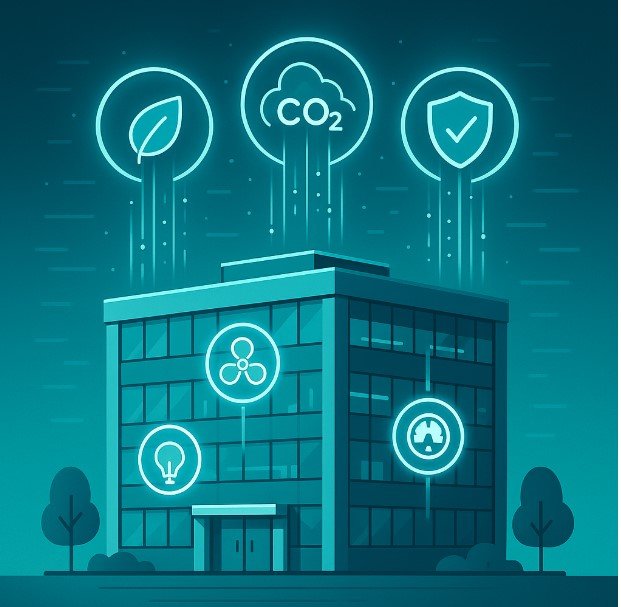
IoT streams translate directly into GHG emissions, intensity, comfort, and health KPIs.
Standards alignment: CSRD, TCFD, GHG Protocol.
3. Real-Time Monitoring
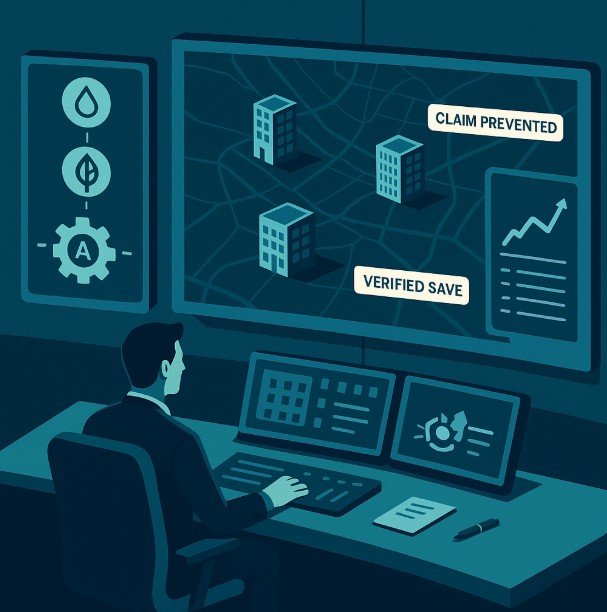
Detect anomalies instantly (e.g., lighting running overnight).
Verify interventions with before/after data.
4. Risk-Linked Reporting
Provides insurers with objective operational signals, lowering underwriting uncertainty.
Creates evidence-based proof for investors and auditors.
Global Research Insights
Recent studies confirm IoT’s transformative role:
McKinsey (2024): IoT-enabled energy management in commercial real estate can cut operational costs by 10–20% and carbon emissions by 15%.
World Economic Forum (2023): Real-time building data is essential to make ESG reporting trustworthy and investment-grade.
IEA (International Energy Agency, 2025): Buildings account for 30% of global energy use; without IoT-driven efficiency, net-zero targets are out of reach.
PwC ESG Pulse (2024): 70% of investors believe ESG disclosures lack credibility without sensor-based evidence.
Tangible Benefits
For building owners:
5–15% reduction in energy waste.
Faster ESG report preparation.
Increased asset value through compliance & efficiency.
For insurers:
Evidence-based underwriting.
Better portfolio risk modeling.
Stronger client engagement through verified ESG performance.
For investors:
Trustworthy ESG metrics.
Lower greenwashing risk.
Improved portfolio attractiveness.

Conclusion
IoT is the missing link in ESG reporting for commercial buildings. By transforming raw operational data into evidence-backed ESG outcomes, it empowers owners, investors, and insurers alike.
As Insurmatics expands pilots in the Netherlands and Canada, we’re proving that real-time, auditable data is the foundation of credible ESG reporting — and the path to more sustainable, resilient, and insurable commercial real estate.
📩 To join our pilots or learn more, contact us at [email protected].
Make Your Business Online By The Best No—Code & No—Plugin Solution In The Market.
30 Day Money-Back Guarantee
Say goodbye to your low online sales rate!
Q1: Why can’t we rely on utility bills for ESG reporting?
A: Bills are aggregated, delayed, and lack operational detail. IoT provides granular, real-time, auditable evidence.
Q2: Is IoT integration expensive for older buildings?
A: Not necessarily. With open protocols (MQTT/Modbus), retrofits are affordable and often deliver ROI within 1–2 years.
Q3: How does IoT data support insurance?
A: Insurers need proof of risk reduction (e.g., fewer IAQ incidents, lower equipment stress). IoT provides this in measurable terms.
Q4: What frameworks does IoT data align with?
A: CSRD, TCFD, and GHG Protocol — ensuring compliance with EU and Canadian ESG rules.
Q5: What’s the role of AI in IoT-enabled ESG?
A: AI enhances anomaly detection, predictive maintenance, and net-zero roadmaps, making ESG actionable.