AI Agents and IoT: The Future of Intelligent, Autonomous Systems
Introduction
The Internet of Things (IoT) has already transformed how we sense, connect, and monitor the world. Yet, the true revolution begins when AI agents — autonomous, goal-driven systems powered by machine learning and large language models (LLMs) — are embedded into IoT ecosystems.
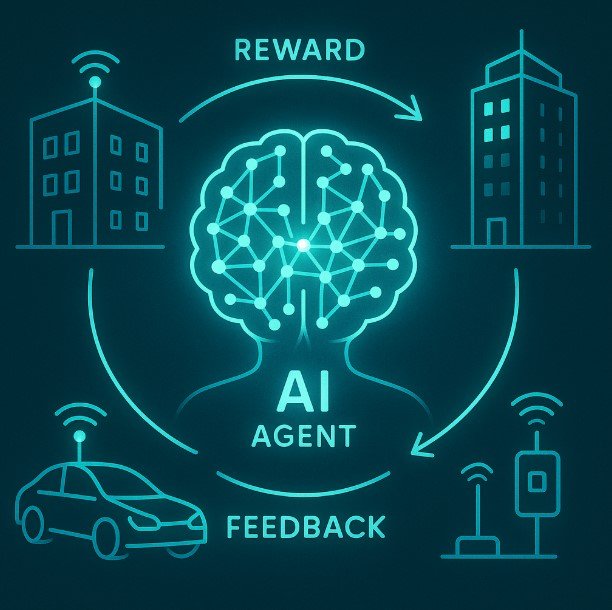
Unlike traditional software, AI agents can perceive data, reason in real time, make independent decisions, and take action — closing the loop between sensing and acting. This evolution is driving the next wave of smart buildings, industrial automation, healthcare monitoring, and insurance innovation.
In this blog, we explore the role of AI agents in IoT, key trends shaping adoption in 2025 and beyond, challenges to overcome, and why AI-agent solutions are becoming the backbone of the next generation of autonomous, scalable, and sustainable IoT systems.
🔍 What Are AI Agents?
AI agents are software entities capable of:
Perception — ingesting IoT sensor streams (temperature, motion, vibration, occupancy).
Reasoning — analyzing patterns, anomalies, and goals using AI/ML models.
Decision-Making — choosing the best action based on policies, rewards, and objectives.
Action — triggering IoT actuators, sending alerts, or autonomously reconfiguring systems.
Learning — adapting over time by retraining models or refining rules.
In other words, AI agents turn IoT networks into living ecosystems, where connected devices no longer just “report data” but also act intelligently and autonomously.
🌐 Latest Trends in AI Agents + IoT (2025)
1. Autonomous Edge Agents
AI agents are increasingly deployed at the edge, closer to IoT devices, to minimize latency and bandwidth usage.
Example: A predictive maintenance agent running locally on a factory gateway can shut down equipment before it overheats, even without cloud connectivity.
2. Multi-Agent Systems (MAS)
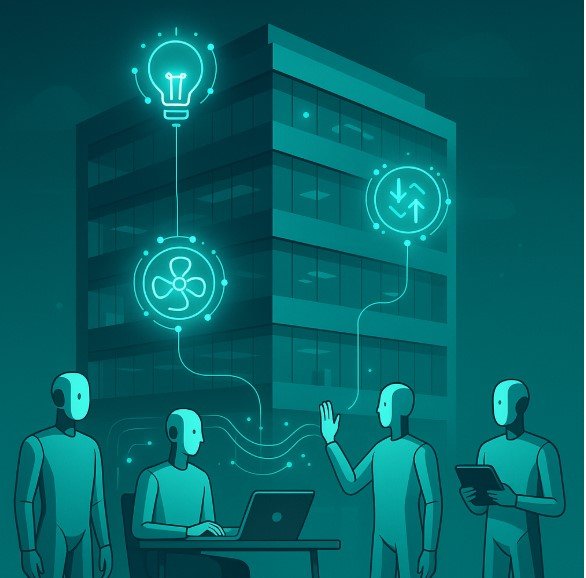
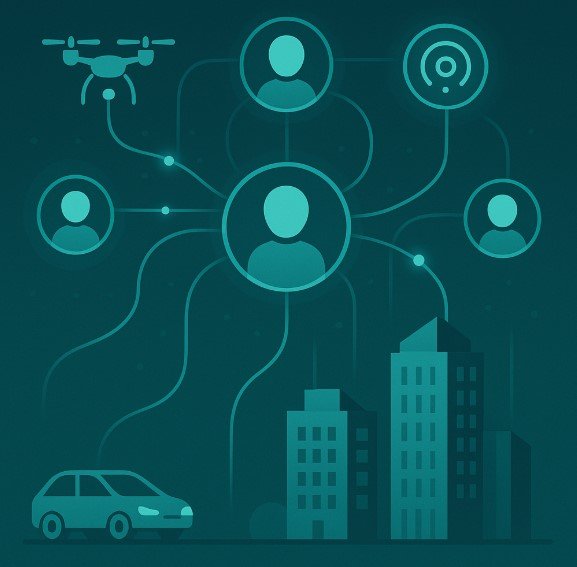
Inspired by swarm intelligence, multiple AI agents collaborate to optimize large systems.
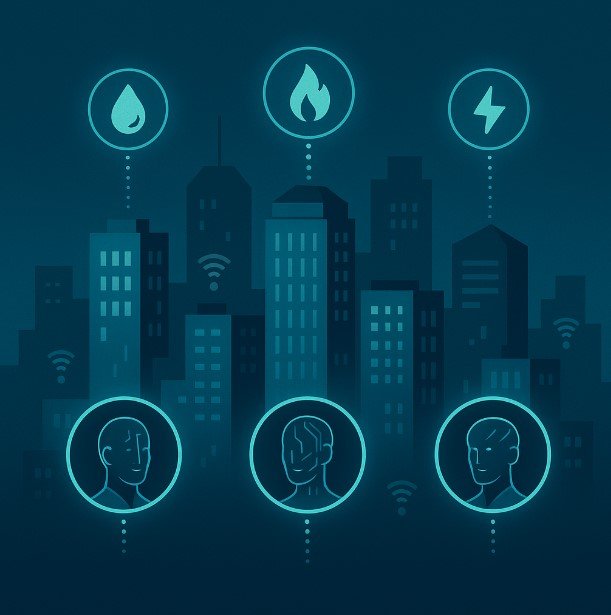
Example: In smart grids, agents coordinate between distributed energy resources to balance supply, demand, and carbon footprint.
3. AI Agents with LLM Capabilities
The rise of LLMs (e.g., GPT-4/5, Gemini) enables natural language interfaces for IoT.
Example: A facility manager can “ask” an AI agent about building energy efficiency, and the agent queries IoT data, reasons, and replies in human-like language.
4. ESG-Driven IoT Agents
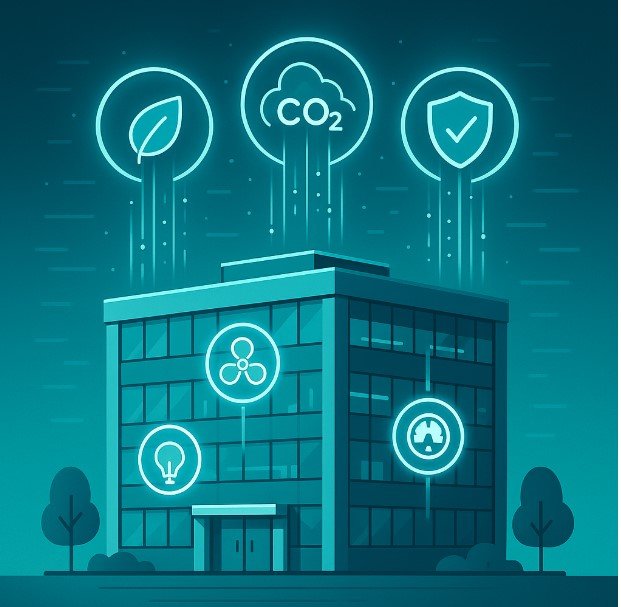
Agents are being designed to automatically collect, normalize, and report ESG data for compliance with CSRD, TCFD, and GHG protocols.
Example: Agents aggregate CO₂, energy, water, and air quality metrics across commercial buildings and produce audit-ready reports.
5. IoT Security & Self-Healing Agents
Security remains the top IoT concern. AI agents are now tasked with detecting intrusions, anomalies, and self-healing networks.
Example: An agent identifies abnormal traffic from a compromised sensor and quarantines it without human intervention.
6. Insurance & Risk-Based IoT Agents
Insurers are piloting AI agents that monitor property, auto, and health IoT devices in real time, linking risk prevention directly to underwriting.
Example: Agents in buildings detect indoor air quality issues, reducing claims and improving risk scoring.
📈 Global Research Insights
MarketsandMarkets (2025): AI in IoT is expected to reach USD 31.2 billion by 2029, at a CAGR of 25%.
Gartner (2024): By 2027, over 40% of new IoT deployments will rely on autonomous agents for decision-making.
PwC (2024): 70% of executives believe AI agents will reduce operational costs by >15% in IoT-enabled industries.
World Economic Forum (2025): AI agents are critical to scaling autonomous, sustainable smart cities.
🏢 Business Case Scenarios for AI-Agent IoT
1. Smart Buildings & Facilities
AI agents balance HVAC loads, detect anomalies, and adjust lighting based on occupancy.
Benefits: 10–20% energy savings, better ESG reporting, improved tenant satisfaction.
2. Industrial IoT (IIoT)
Predictive maintenance agents monitor vibration and temperature in machines.
Benefits: Fewer breakdowns, extended equipment life, optimized production schedules.
3. Healthcare & Wearables
AI agents on wearables track patient health signals, detect anomalies, and notify doctors.
Benefits: Improved preventive care, reduced hospital readmissions.
4. Insurance & Risk Management
IoT-AI agents analyze risk in real time for buildings, vehicles, and individuals.
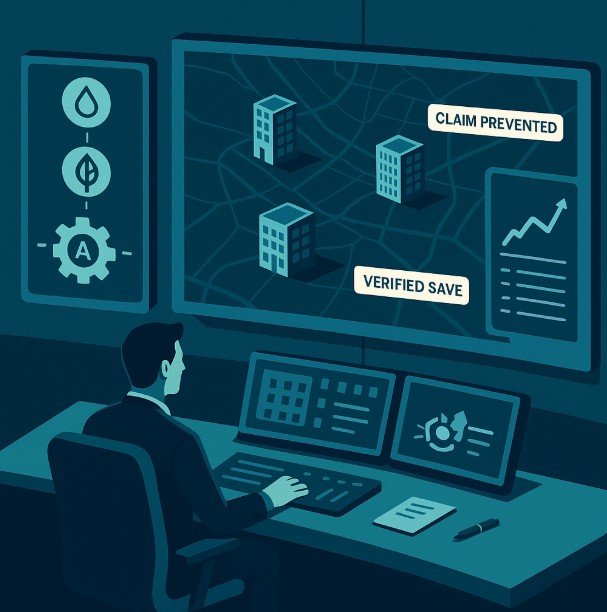
Benefits: Smarter underwriting, fewer claims, stronger insurer-client relationships.
5. Smart Grids & Energy
Multi-agent systems balance renewable energy resources dynamically.
Benefits: Reduced carbon footprint, reliable supply, lower costs.
⚙️ Challenges to Overcome
Interoperability — Standardizing protocols and APIs for IoT agents.
Data Privacy & Governance — Ensuring compliance (GDPR, HIPAA).
Trust in Autonomy — Humans still hesitate to give agents full control.
Cost & ROI — Hardware and infrastructure investments must yield measurable value.
Scalability — Moving from pilots to enterprise-wide rollouts.
✅ Conclusion
AI agents are not just an upgrade to IoT — they are the missing intelligence layer that enables autonomy, predictive action, and sustainable outcomes.
From smart buildings to insurance risk prevention, AI-agent solutions are driving efficiency, lowering costs, and ensuring compliance with ESG frameworks. The challenge is not adoption — it’s scaling, integrating, and building trust.
For organizations ready to lead in the age of autonomous IoT, investing in AI-agent solutions today means future-proofing tomorrow.
Make Your Business Online By The Best No—Code & No—Plugin Solution In The Market.
30 Day Money-Back Guarantee
Say goodbye to your low online sales rate!
Q1: How are AI agents different from traditional IoT automation?
A1: Traditional IoT rules are static (“if X then Y”). AI agents continuously learn, reason, and adapt to changing conditions.
Q2: What industries benefit most from AI-agent IoT?
A2: Real estate, insurance, manufacturing, healthcare, and energy lead adoption due to high risk exposure and efficiency gains.
Q3: Can AI agents improve ESG reporting?
A3: Yes — they automate collection, normalization, and reporting of ESG KPIs, reducing compliance costs and greenwashing risks.
Q4: Are AI agents secure?
A4: When combined with anomaly detection and cybersecurity frameworks, agents actually strengthen IoT security by detecting intrusions in real time.
Q5: What’s the future outlook?
A5: By 2030, most IoT systems will embed AI agents for autonomous operation, turning passive devices into intelligent ecosystems.