How to Calculate an ESG Score: The Formula, Three Rating Methods and a Worked Example for a 120-Person Company
Short answer. An ESG score is calculated in four steps: choose indicators, put each one on a common scale, give each a weight, and add them up. No law or standard fixes the formula. Every provider picks its own indicators, scale and weights, so one company can hold three different scores at the same time. For a company with 50 to 250 employees the useful question is which score a customer or bank will really use, and which data goes into it.
What an ESG score is, and what it is not
An ESG score is one number or letter that sums up how a company handles environmental, social and governance matters. The European Commission describes ESG ratings as information on a company's sustainability performance, based on its exposure to sustainability risks or its impact on people and the environment. Providers call the result a rating, a score or an opinion. The idea is the same.
Three kinds of score exist, and people mix them up all the time.
Investor ratings, such as those of MSCI and Sustainalytics, are made for fund managers and cover companies that issue shares or bonds. Supplier scorecards, such as EcoVadis, are made for purchasing departments, and it is your customer who asks for one. Readiness scores, such as the one ESG Lite gives, are self-checks. They show how prepared you are to answer a request.
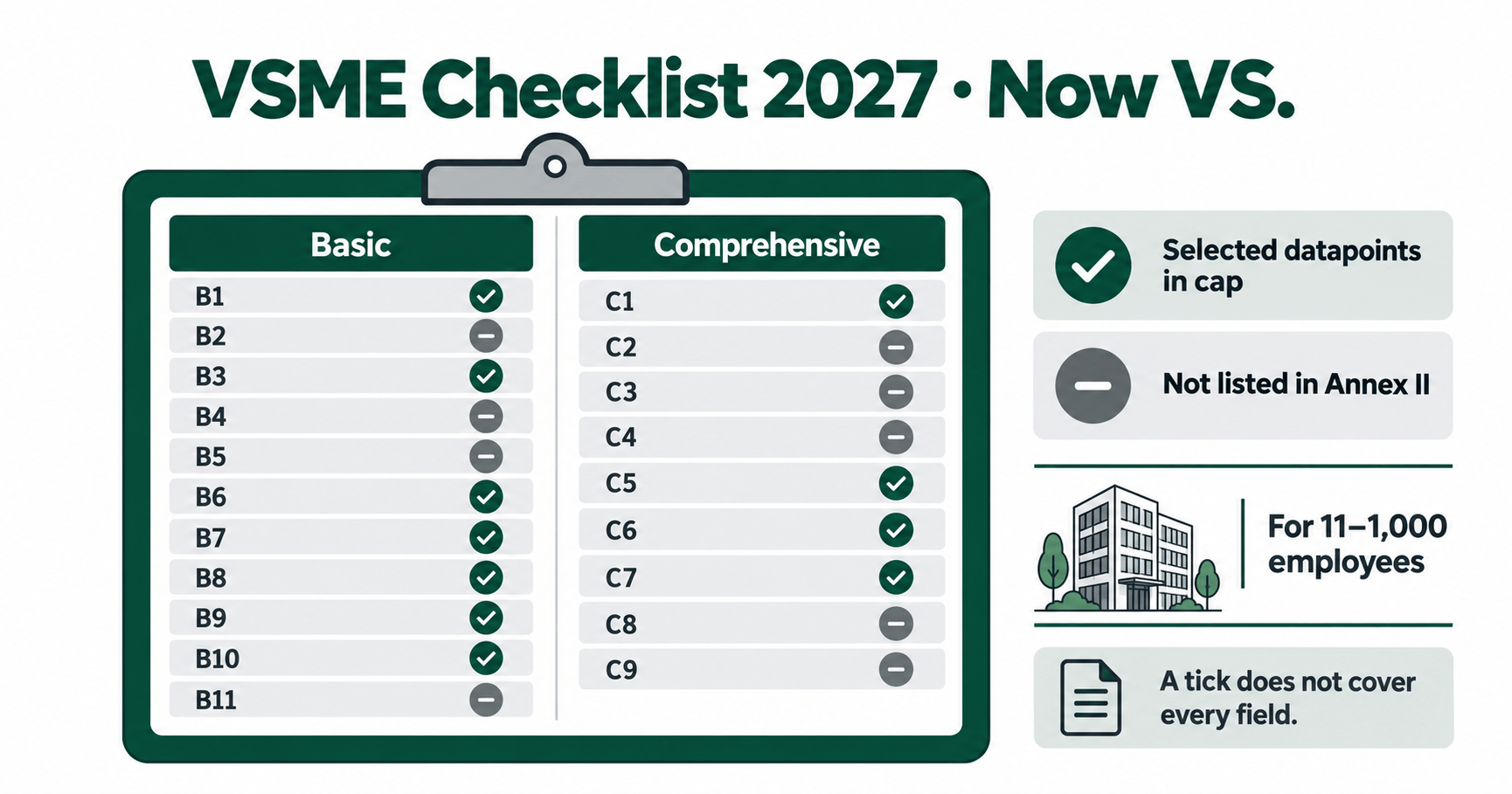
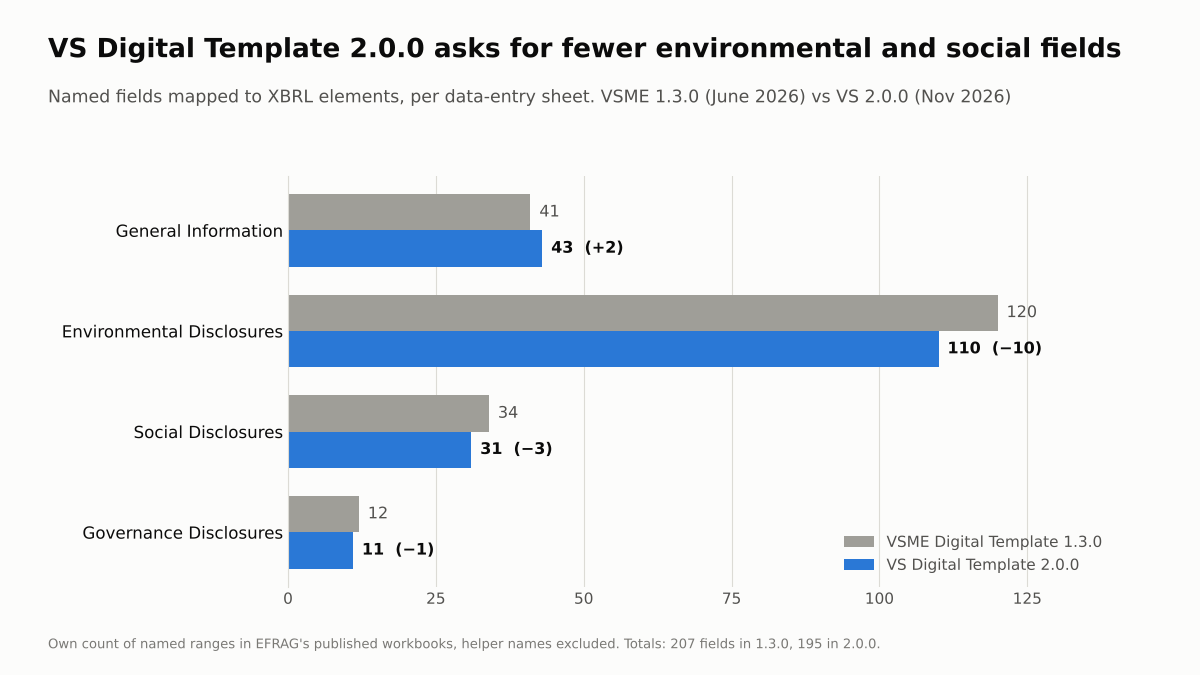
A score is also not a report. The EU's Voluntary Standard for smaller companies (the VS, known until 2026 as the VSME) lists what to disclose: energy, emissions, workforce, policies. It has no scoring rule. Nobody holds "a VSME score of 72", because the standard does not define one. Our VSME checklist lists every disclosure it does ask for.
Since 2 July 2026 the EU regulates the providers themselves. Under Regulation (EU) 2024/3005, firms that issue ESG ratings in the EU must be authorised by or registered with ESMA, the European securities regulator, and must disclose how they work.
The four steps behind every ESG score
Take away the branding and every method does the same four things.
- Choose indicators. Energy use per m², accident rate, training hours, whether an anti-corruption policy exists.
- Put each indicator on a common scale, often 0 to 100 or 0 to 10. A raw value such as 95 kWh per m² says nothing until you compare it with a reference: a benchmark, a peer group or a target.
- Weight the indicators. A logistics firm may give emissions more weight than a software firm would.
- Add up the weighted values. Some providers then adjust the result for controversies or compare it with industry peers.
In one line:
ESG score = (weight 1 × indicator score 1) + (weight 2 × indicator score 2) + … with all weights adding up to 100%.
The arithmetic is easy. The choices are hard, and they explain most of the differences between providers.
How three well-known providers calculate their scores
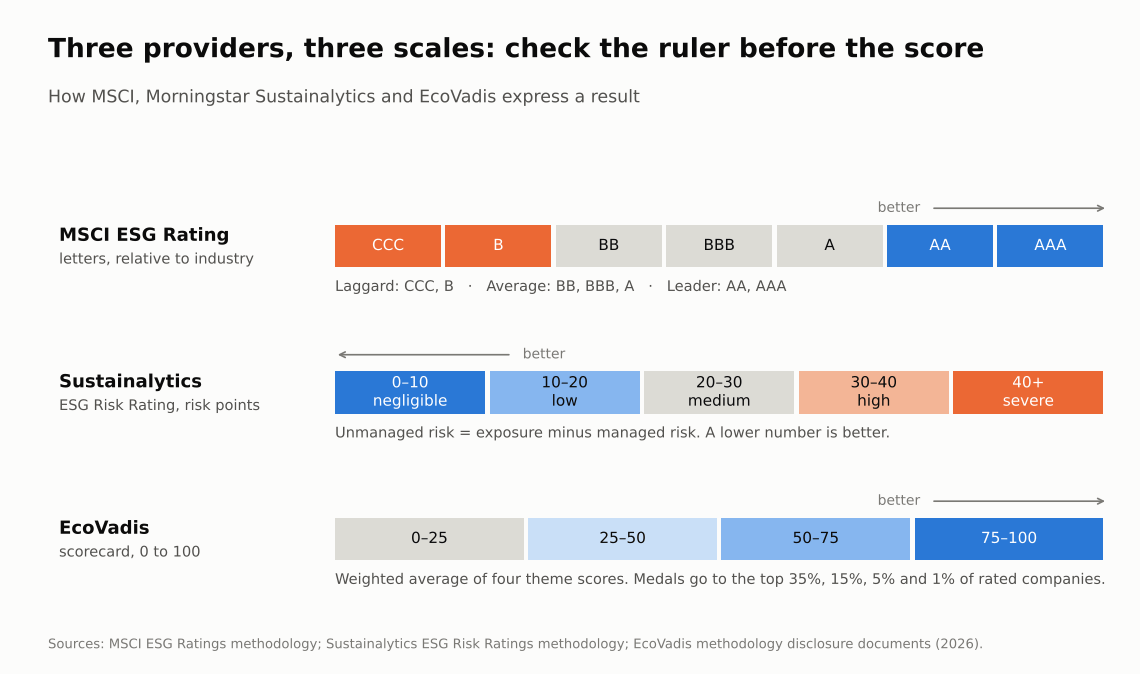
MSCI ESG Rating | Sustainalytics ESG Risk Rating | EcoVadis scorecard | |
|---|---|---|---|
Made for | Investors | Investors | Buyers and their suppliers |
Result | A letter from CCC to AAA | Risk points in five categories | 0 to 100, plus four theme scores |
Which way is good | AAA is best | Lower is better: 0 to 10 is negligible risk, 40 or more is severe | Higher is better |
How it is built | Scores of 0 to 10 on the issues that matter in the industry, weighted, then compared with industry peers | Exposure to ESG risk minus the part the company manages. What is left is "unmanaged risk" | Weighted average of four themes: Environment, Labor & Human Rights, Ethics, Sustainable Procurement |
Compared with | Peers in the same industry | All companies, on one scale | All rated companies (medals by percentile) |
MSCI groups its letters into laggards (CCC, B), average (BB, BBB, A) and leaders (AA, AAA). Sustainalytics measures unmanaged risk, so a company wants a low number. EcoVadis weights each theme from 1 to 4, depending on the company's industry, size and risk profile. It gives medals to the top 35% (bronze), 15% (silver), 5% (gold) and 1% (platinum) of rated companies.
Do these methods agree with each other? Not much. A study in the Review of Finance compared six rating providers and found correlations between their ratings of 0.38 to 0.71. More than half of the disagreement (56%) came from measuring the same thing in different ways. Another 38% came from looking at different things, and only 6% from different weights.
Keep that in mind when someone asks for "your ESG score". The first reply should be: which one?
Who will actually score a company with 50 to 250 employees
The investor ratings cover listed companies and bond issuers. A private company with 120 staff is normally outside their universe. You cannot order an MSCI rating the way you order an audit.
What reaches a company of that size looks different.
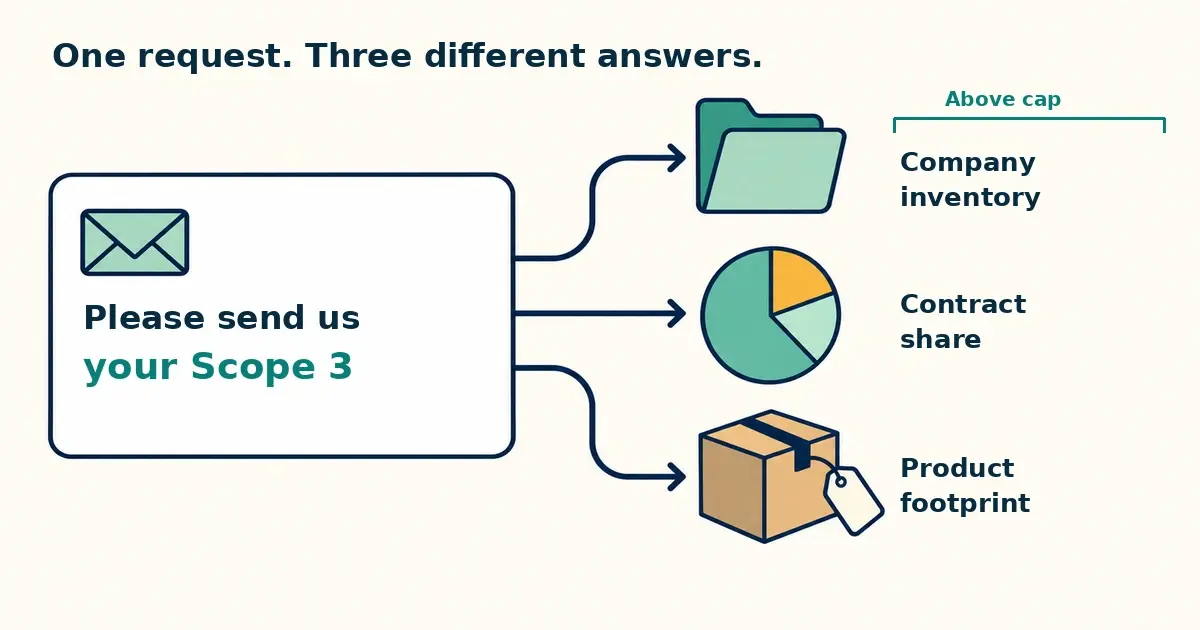
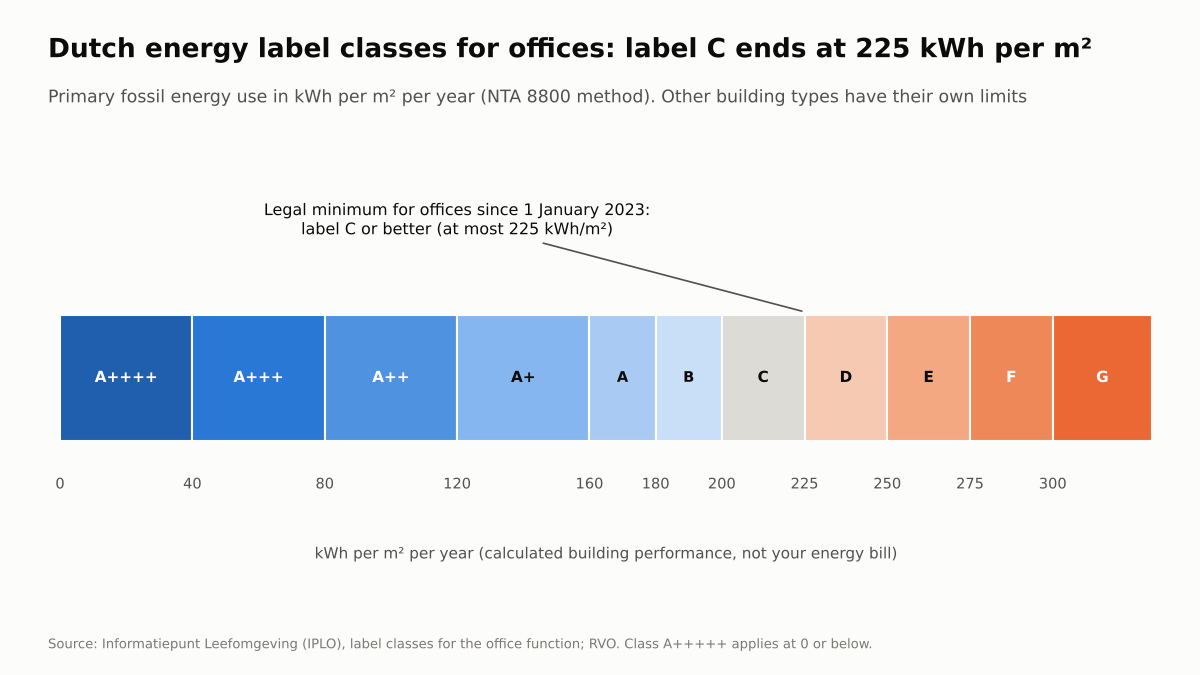
A customer may invite you to EcoVadis, or send its own supplier scorecard. Our questionnaire playbook shows how to sort such requests before you answer. Your bank may score ESG risk inside its own credit process. It will ask for emissions, energy use and often the energy label of the building. A customer that reports under the CSRD may send questions based on the Voluntary Standard, which you can answer with EFRAG's VS Digital Template. That last request carries no score at all. From 2027 it also has a ceiling, the EU value chain cap. Ratings and bank requests sit outside that cap.
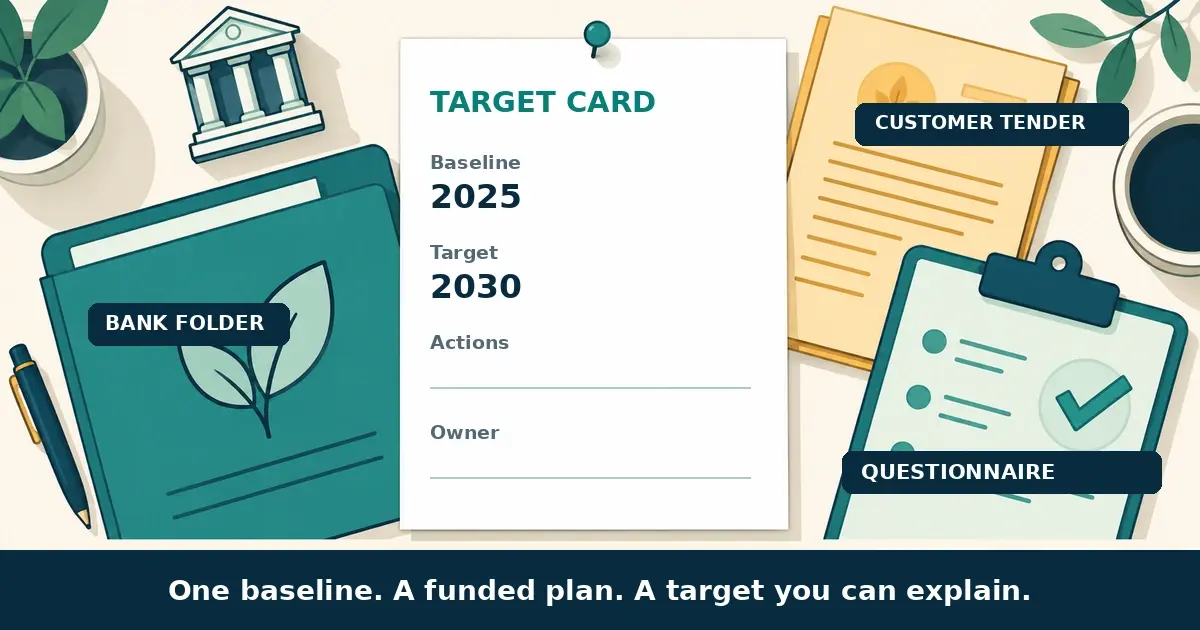
All three run on the same raw data: energy, emissions, workforce figures, policies. Collect them once, starting with Scope 1 and 2, and you can feed every request from one file. If a bank or EcoVadis also wants a reduction target, our guide to setting a climate target covers that part.
Calculate your own ESG score in a spreadsheet: a worked example
You can build an internal score in an afternoon. It will not be a rating, and no customer has to accept it. It is good for one thing: seeing year on year whether you improve on the points your customers ask about.
Take a facility-services company with 120 employees. The inputs below are an example, not a benchmark.
Step 1: choose indicators. Eight are enough to start: three environmental, three social, two for governance.
Step 2: set a scale for each. Pick a "worst acceptable" value that earns 0 points and a target value that earns 100. Everything in between sits on a straight line:
indicator score = (worst − actual) ÷ (worst − target) × 100
Where a higher value is better, turn it around: (actual − worst) ÷ (target − worst) × 100.
Indicator | Actual | 0 points at | 100 points at | Score |
|---|---|---|---|---|
Energy use of buildings (kWh per m²) | 95 | 180 | 60 | 70.8 |
Scope 1 and 2 emissions per employee (tCO₂e) | 2.4 | 5.0 | 1.0 | 65.0 |
Waste sent to recycling | 55% | 20% | 80% | 58.3 |
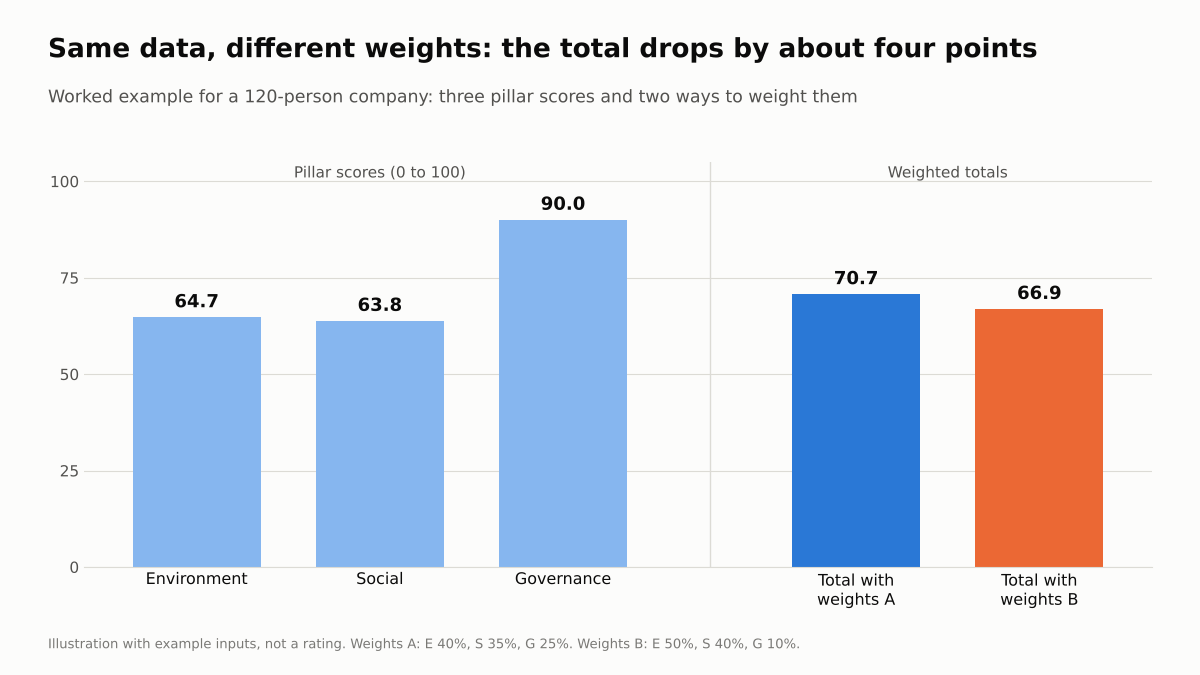
Environment (average of three) | 64.7 | |||
Recordable accident rate | 2.1 | 6.0 | 0 | 65.0 |
Training hours per employee | 14 | 0 | 24 | 58.3 |
Staff turnover | 18% | 35% | 10% | 68.0 |
Social (average of three) | 63.8 | |||
Core policies in place (out of 5) | 4 | 0 | 5 | 80.0 |
No convictions or fines for corruption | Yes | No | Yes | 100.0 |
Governance (average of two) | 90.0 |
Step 3: weight the pillars. Say Environment 40%, Social 35%, Governance 25%.
Step 4: add up. 0.40 × 64.7 + 0.35 × 63.8 + 0.25 × 90.0 = 70.7.
Now change only the weights, to 50%, 40% and 10%. The total becomes 66.9. Nothing in the company changed, and the score fell by almost four points.
Two rules keep such a score honest. Write the method on the same page as the number. And never present an internal score as a rating from someone else.
How ESG Lite calculates its environmental readiness score
ESG Lite does not blend E, S and G into one number. The example above shows why: the blend depends on weights that nobody has agreed on. The tool reports its results side by side.
The environmental readiness score runs from 0 to 100 and rests on one quantity, the energy use of your building per m². There is no AI in the calculation. The same inputs always give the same score, and you can repeat it by hand:
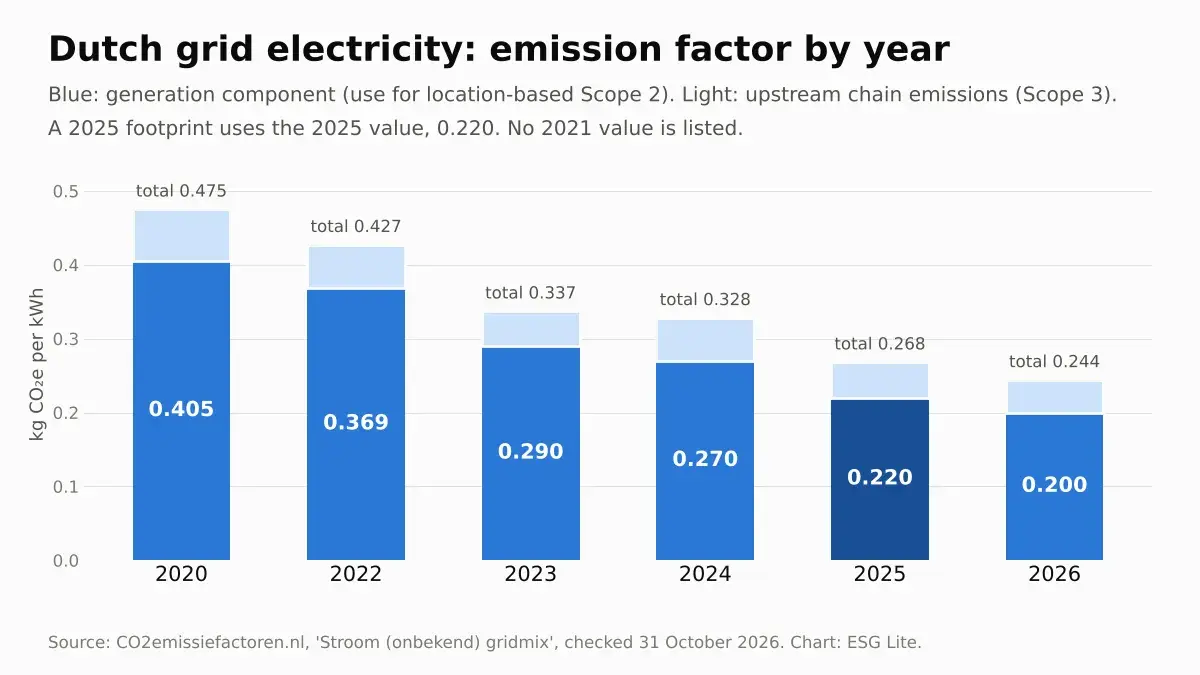
- Annual kWh = annual energy spend ÷ the average electricity price of the country (€0.27 per kWh for the Netherlands in the current rules).
- Energy intensity = kWh ÷ floor area in m².
- The intensity is placed between four benchmark points for your building type. The score falls in a straight line from one point to the next.
- A declared share of renewable electricity adds up to 15 points (15 at 100%). The score cannot go above 100.
Building type | Excellent (score 90) | Good (75) | Average (60) | Poor (40) |
|---|---|---|---|---|
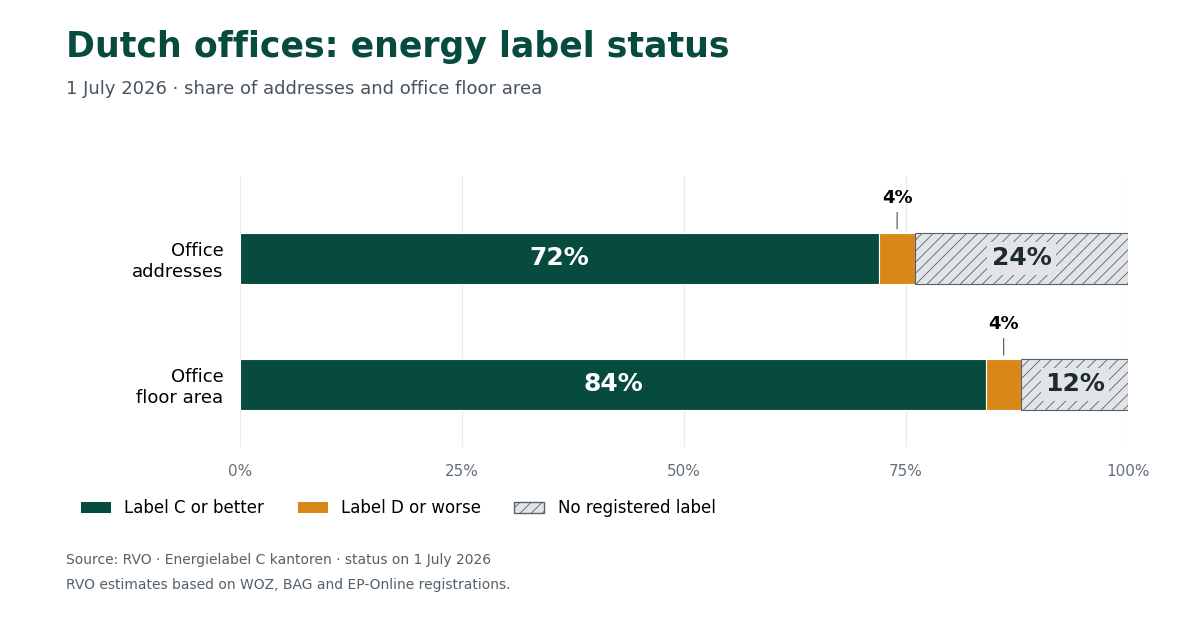
Office | 80 | 120 | 180 | 250 |
Retail | 100 | 150 | 220 | 300 |
Warehouse | 40 | 60 | 90 | 150 |
Manufacturing | 150 | 250 | 400 | 600 |
Hotel | 120 | 180 | 250 | 350 |
Values are in kWh per m² per year. They are indicative benchmarks. They are not adjusted for opening hours, climate or process loads.
An example. A 3,000 m² warehouse in the Netherlands spends €40,500 a year on energy and declares 10% renewable electricity.
- 40,500 ÷ 0.27 = 150,000 kWh a year
- 150,000 ÷ 3,000 = 50 kWh per m²
- 50 lies halfway between Excellent (40) and Good (60): 75 + ((60 − 50) ÷ (60 − 40)) × 15 = 82.5
- Renewable bonus: 10% × 15 = 1.5
- Score: 84 out of 100, in the "Good" band
Next to this score ESG Lite shows a VSME readiness estimate. It is the share of 26 weighted indicators (20 from the Basic Module, 6 from the Comprehensive Module) for which you already hold the data. Social topics are not scored. Governance shows only whether a sustainability policy exists.
All of this is an indicative readiness estimate. It is not a certified rating, an audit or an official VSME filing, and ESG Lite does not verify the data you enter. The rules are on the methodology page.
Check your own numbers. Enter six facts about your building and get your environmental readiness score, plus a list of the VSME data points you are still missing. The check is free and needs no account. Start the free check
Five questions to ask before you trust any ESG score
- Who or what is rated: the company, one site or a product?
- Which way does the scale run? At Sustainalytics a low number is the good one.
- Which indicators are in, and which year is the data from?
- What are the weights, and who set them?
- Who checked the inputs: the company itself, the provider or an auditor?
A provider that cannot answer these in writing deserves caution. The EU rules that started on 2 July 2026 push in the same direction: rating providers have to disclose their methods to the public and to the companies they rate.
Sources
- European Commission, ESG rating activities, Regulation (EU) 2024/3005
- ESMA, ESG Rating Providers
- MSCI, ESG Ratings
- Morningstar Sustainalytics, ESG Risk Ratings
- EcoVadis, Sustainability Rating methodology disclosure document (2026) and Understanding EcoVadis Medals
- Berg, Kölbel and Rigobon (2022), Aggregate Confusion: The Divergence of ESG Ratings, Review of Finance 26(6), 1315 to 1344
- Commission Delegated Regulation (EU) 2026/1560, the Voluntary Standard
- ESG Lite, methodology
Make Your Business Online By The Best No—Code & No—Plugin Solution In The Market.
30 Day Money-Back Guarantee
Say goodbye to your low online sales rate!
Is there an official formula for an ESG score?
No. No law or standard sets one. Each provider chooses its own indicators, scale and weights. The EU regulates how rating providers work and what they disclose, not the formula.
What is a good ESG score?
It depends on the ruler. AAA or AA marks a leader at MSCI. At Sustainalytics a result below 10 means negligible risk and 40 or more means severe risk. At EcoVadis medals start at the top 35% of rated companies, with at least 30 points in each theme.
Can a small private company get an MSCI or Sustainalytics rating?
Normally not. Those ratings cover listed companies and issuers of bonds. A small supplier is far more likely to be asked for an EcoVadis scorecard or a customer questionnaire.
Does the VSME, now the Voluntary Standard, give a score?
No. It lists disclosures in a Basic and a Comprehensive Module and has no scoring rule. Any percentage or score built on it, including ESG Lite's readiness estimate, is the provider's own method.
How is the EcoVadis score calculated?
As a weighted average of four theme scores, each from 0 to 100: Environment, Labor & Human Rights, Ethics and Sustainable Procurement. The weight of a theme runs from 1 to 4 and depends on your industry, size and risk profile.
Are free ESG score calculators reliable?
Only as far as you can see the method. Check which inputs the tool uses, what it leaves out and whether you can repeat the calculation by hand. A calculator with six inputs can estimate energy performance. It cannot judge your labour practices.
Why do two providers give the same company different scores?
Mostly because they measure the same topics in different ways. In the study by Berg, Kölbel and Rigobon, measurement explained 56% of the disagreement, scope 38% and weights 6%.