Energy Labels in the Netherlands: A Business Guide to Classes, Rules, Fines and the 2030 Changes
Short answer. A Dutch energy label rates a building from A+++++ (best) to G (worst). The class comes from a calculation of how much fossil energy the building needs per m² per year. It does not come from your energy bill. A business building needs a valid label when it is sold, when a lease starts or is renewed, and when it is delivered after construction or a major renovation. A label is valid for ten years at most. Offices must also hold label C or better, and from 2030 the government plans a minimum of label D for most other business buildings.
Key facts
What it is | An energy performance certificate for a building or a unit, registered in the national database EP-Online |
Scale for business buildings | A+++++ to G |
Unit | Primary fossil energy use in kWh per m² per year, calculated with the NTA 8800 method |
Needed when | Sale. Start, extension or renewal of a lease. Delivery of a new building. After a major renovation |
Valid for | 10 years at most |
Issued by | An energy adviser working for a company certified under BRL 9500-U |
Who arranges and pays | The owner, as seller or landlord |
Who checks | The inspectorate ILT at sale and letting. The municipality for the label C rule for offices |
Extra rule for offices | Label C or better since 1 January 2023 |
Planned | A minimum of label D, or low measured energy use, from 1 January 2030. A new A to G scale in 2030 |
How the label class is calculated
An energy adviser records the building: insulation of walls, roof and floor, glazing, heating, cooling, ventilation, lighting, solar panels. Software then works out how much fossil energy the building would need in a year. According to RVO, the Dutch enterprise agency, the calculation assumes average use and the average Dutch climate.
The result is one figure, primary fossil energy use in kWh per m² per year, and that figure decides the letter.
Two things follow from this method. The label covers the building only. Computers, cold stores and production machines are left out, so the energy on the label is never the same as the energy on your bill. And two identical buildings get the same label, even if one is open 60 hours a week and the other 168.
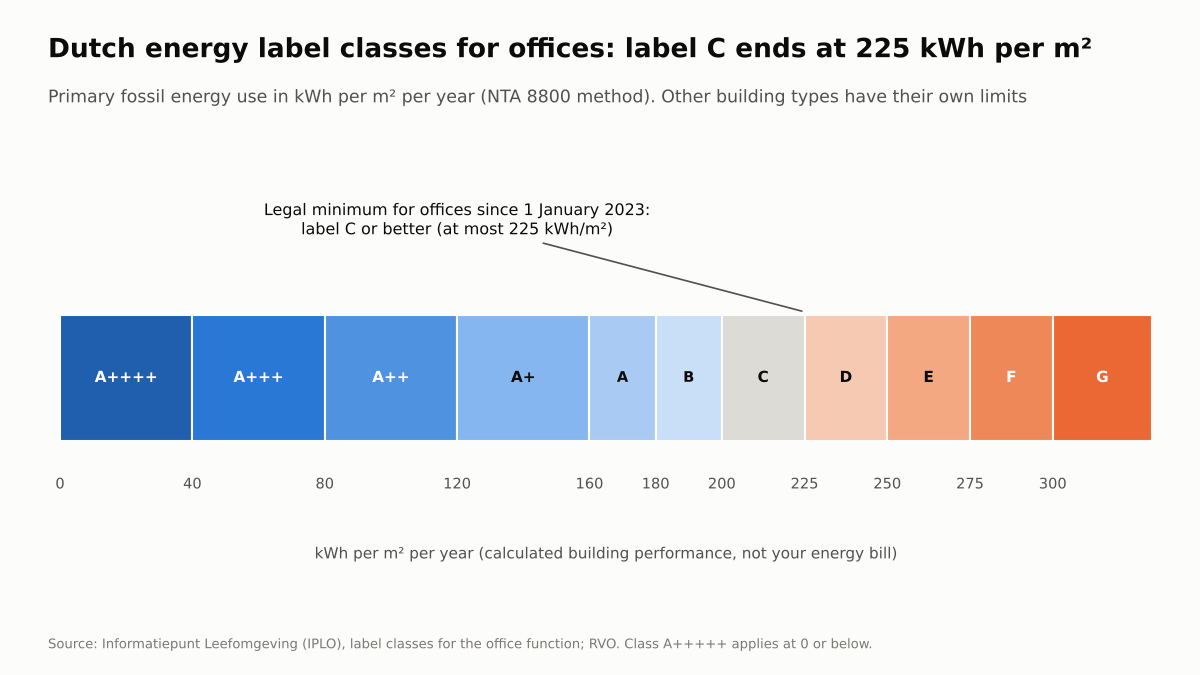
For offices the classes are these:
Label | kWh per m² per year | Label | kWh per m² per year |
|---|---|---|---|
A+++++ | 0 or less | B | 180.01 to 200 |
A++++ | 0.01 to 40 | C | 200.01 to 225 |
A+++ | 40.01 to 80 | D | 225.01 to 250 |
A++ | 80.01 to 120 | E | 250.01 to 275 |
A+ | 120.01 to 160 | F | 275.01 to 300 |
A | 160.01 to 180 | G | Above 300 |
Source: Informatiepunt Leefomgeving. Shops, schools, hotels, care and sports buildings use the same letters, but each building type has its own limits.
Since 29 May 2026 the label has a new design with more information. New buildings from construction year 2026 that count as zero-emission get the extra mark "A0". Labels issued before that date stay valid until they expire.
When a business building needs a label
RVO names four moments: a sale, the start, extension or renewal of a lease, the delivery of a new building, and the end of a major renovation. Delivery as an empty shell counts too. The owner must give the buyer or tenant a copy. For a lease that means on the start date at the latest.
The duty covers offices, shops, schools, care buildings, hotels, sports halls and meeting places such as restaurants and theatres. Buildings owned or used by a government body must have a valid label at all times. Monuments lost their exemption on 29 May 2026.
Two smaller duties are easy to miss. A building with a valid label must show it where the public can see it, for example at the entrance or the reception. And when you advertise a building for sale or rent, the advertisement must state the label letter and the energy performance figure.
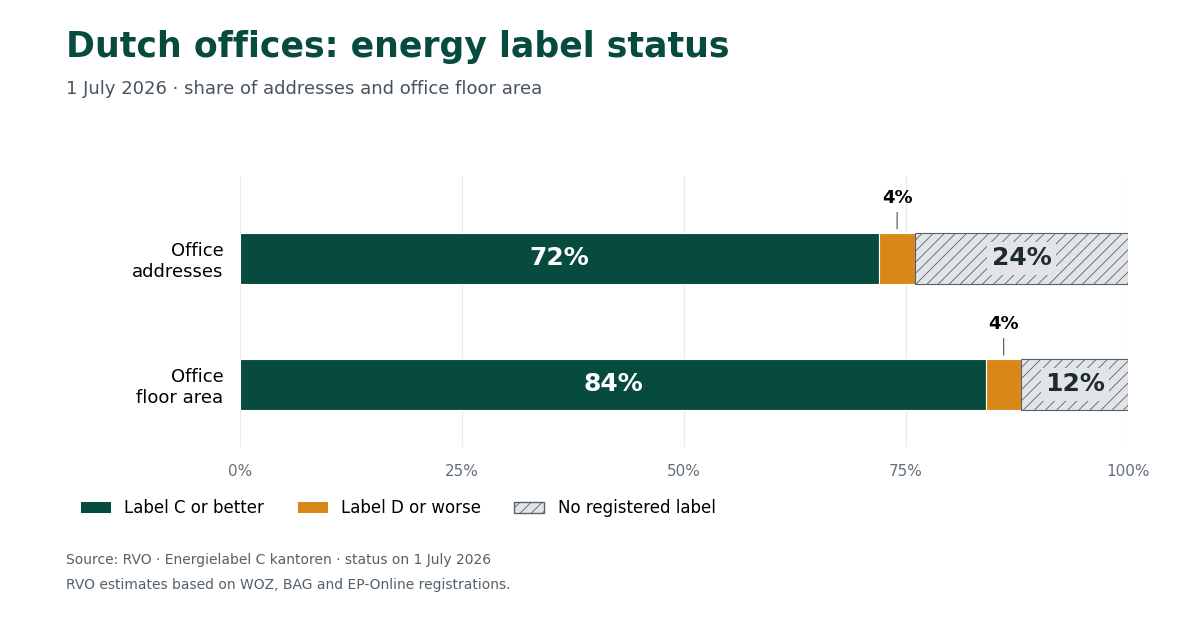
For offices there is one rule more: label C or better, or the building may not be used as an office. That rule, its exceptions and the related energy-saving obligation are in our guide to energy label C and the Dutch energy-saving obligation.
Which buildings are exempt, and the rule for warehouses
Not every building needs a label. RVO lists these exemptions:
- buildings with an industrial function, such as factory halls, workshops and storage halls
- buildings that are not heated or cooled for people
- religious buildings
- buildings used for less than two years
- free-standing buildings smaller than 50 m²
Warehouses fall under the first line. A storage hall counts as industrial, so it needs no label at sale or letting.
The office inside the warehouse is a different matter. If the offices and other label-bound spaces in or next to an industrial building add up to more than 50 m², those spaces do need a label. RVO gives the example itself: 40 m² of office in an industrial hall needs none, 55 m² does.
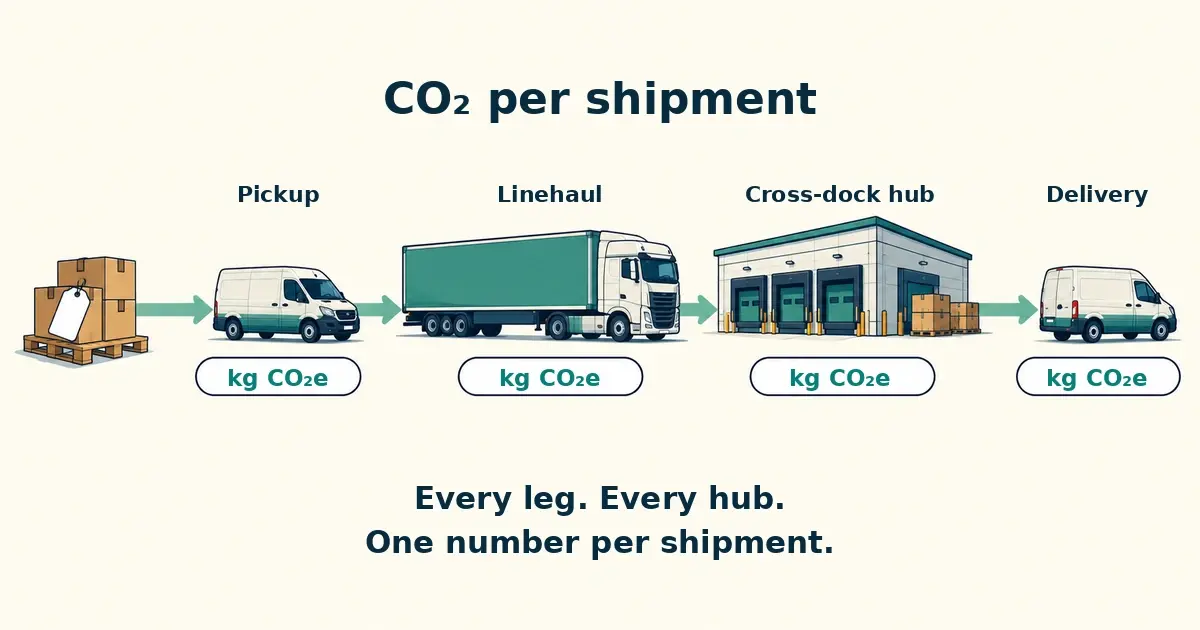
For a logistics company the result is often this. The 8,000 m² distribution centre is exempt. The 400 m² office block attached to it is not. If you run hubs for customers, our article on CO₂ per shipment shows what else they ask about those buildings.
How to check a label, and how to get one
Checking takes a minute. Go to EP-Online and search by postcode and house number. The search is free and needs no login. You see the label class and the registration date. A label older than ten years has expired.
Tenants can ask the landlord for the copy. Owners can download the certificate from EP-Online with eHerkenning, as long as the label was registered in 2021 or later.
To get a new label you hire a certified energy adviser. RVO points to the Centraal Register Techniek to find one. The adviser visits the building, calculates the performance and registers the label. The label counts only once it is in EP-Online. Have drawings, installation data and invoices for insulation or new equipment ready, so the adviser can count them.
The price is not regulated, and it depends on the size and complexity of the building. Ask two advisers for a quote.
What happens without a label
The inspectorate ILT checks sales and lettings. The two cases are handled differently.
If you sell or deliver a business building without a valid label, ILT can fine you. The policy rule ties the fine to the floor area and to the first fine category in Dutch criminal law, which is €550 since 1 January 2026.
Seller | Floor area | Fine | Amount at the 2026 level |
|---|---|---|---|
Private person | Any | 1 × first category | €550 |
Company | Under 1,000 m² | 2 × | €1,100 |
Company | 1,000 to 2,500 m² | 4 × | €2,200 |
Company | 2,500 to 5,000 m² | 8 × | €4,400 |
Company | Over 5,000 m² | 12 × | €6,600 |
The euro amounts are my calculation from the multipliers in the rule. The category amount is indexed every two years.
If you let a building without a label, ILT first sends a letter. You then have four weeks to register a label and hand it to the tenant. If you do not, ILT can impose an order with a penalty payment.
An office below label C is a third case. It may not be used as an office at all, and the municipality enforces that.
What changes between 2026 and 2033
The Netherlands is bringing in the revised EU buildings directive (EPBD IV) in steps. Some steps are law, others are still proposals.
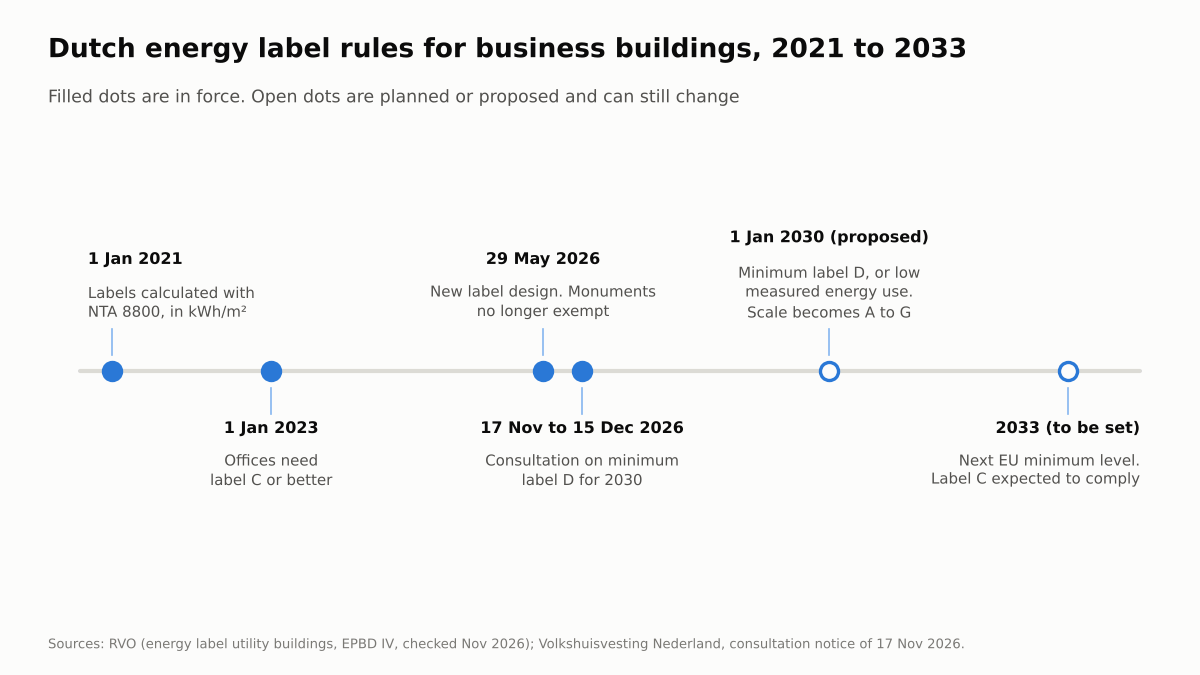
In force since 29 May 2026. The label has its new design, and monuments need a label at sale, letting and renovation like other buildings.
In consultation until 15 December 2026. On 17 November 2026 the government opened a consultation on minimum requirements for the least efficient business buildings. From 1 January 2030 a building would need at least label D, or measured energy use below a maximum set per building type. Monuments, religious buildings, certain defence buildings and buildings with an industrial function are left out. The rule is meant for the Besluit bouwwerken leefomgeving, the Dutch building decree.
Planned for 2030. RVO expects the label scale to change to A to G. The A+ classes disappear and the calculation method changes. Existing labels stay valid for their ten years.
2033. The directive asks for a second, stricter level. The Dutch level is not set yet. RVO's working assumption is that a building with label C, obtained before 1 January 2030 and still valid on 1 January 2033, will meet it.
What to do with this? If your building has label E, F or G, plan the improvements now, because 2030 leaves three budget years. If you have no label, get one. Without it you cannot tell which side of the line you are on.
Why banks and customers ask for the label, and what it does not tell them
Banks look at the energy performance of buildings they finance, and the label is the standard proof. If your bank also wants a reduction plan, see our guide to setting a climate target.
Customers ask for something else. Under the EU's Voluntary Standard, disclosure B3 wants the energy you really used, in MWh, and that comes from your bills. A label A office with long opening hours can use more energy than a label C office of the same size. So one does not replace the other.
Keep both in the same file: the label with its expiry date, and twelve months of bills. Our posts on where each datapoint sits in Dutch records and on Scope 1 and 2 show how to turn the bills into the figures customers want.
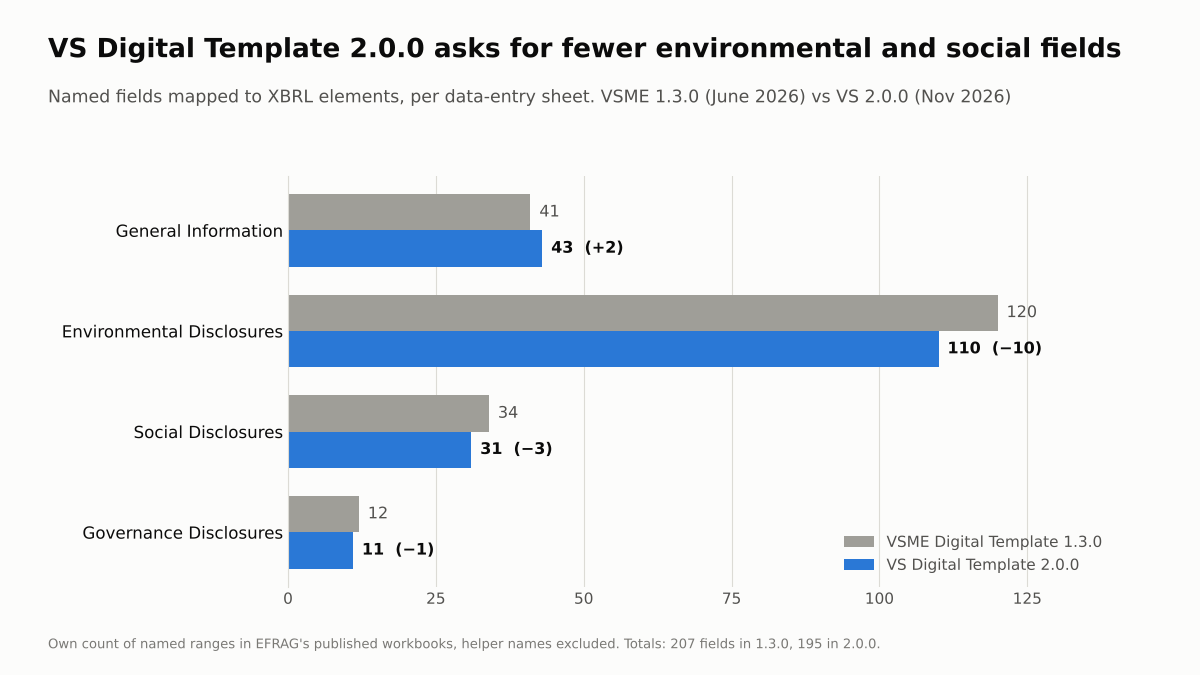
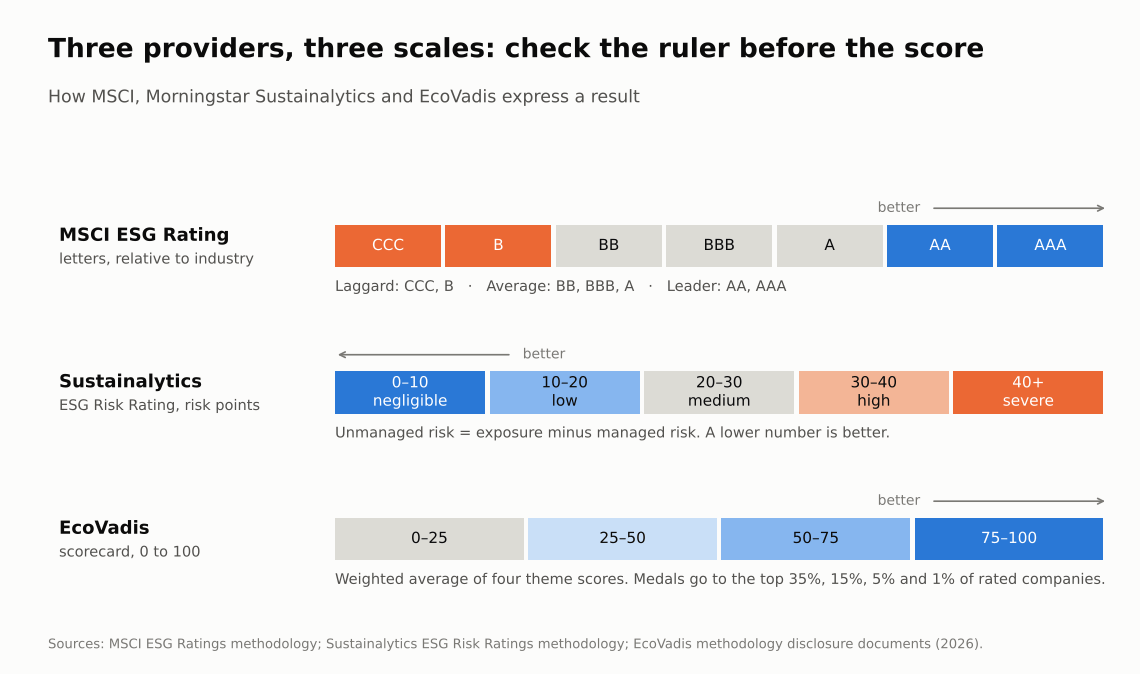
If you report with EFRAG's VS Digital Template, the label has no field of its own. Your measured use goes under B3. And when a tool or a rating agency turns energy into a number, read how ESG scores are calculated before you compare two results.
Start from your bills. ESG Lite's free check takes six facts about your building, including floor area and yearly energy spend, and returns an environmental readiness score plus a list of the VSME data points you are still missing. It needs no account. Start the free check
The check estimates energy use per m² from what you pay. It does not read or verify your energy label, and it is not an audit.
Sources
- RVO, Energielabel utiliteitsgebouwen and frequently asked questions (checked by RVO on 4 November 2026)
- RVO, EPBD IV and minimum energy performance levels for utility buildings
- RVO, EP-Online
- Informatiepunt Leefomgeving, Wetgeving energielabel C-verplichting
- ILT, Handhaving op energielabel bij verkoop of verhuur van gebouw
- Beleidsregel boeteoplegging verkoop en oplevering utiliteitsgebouwen zonder geldig energielabel 2024
- Volkshuisvesting Nederland, consultation notice of 17 November 2026
- Government of the Netherlands, EPCs for commercial and public buildings (English)
- Business.gov.nl, Energy labels (English)
Make Your Business Online By The Best No—Code & No—Plugin Solution In The Market.
30 Day Money-Back Guarantee
Say goodbye to your low online sales rate!
Is an energy label mandatory for commercial property in the Netherlands?
Yes, at four moments: sale, the start or renewal of a lease, delivery of a new building and after a major renovation. Industrial buildings, religious buildings and free-standing buildings under 50 m² are among the exemptions.
How long is a Dutch energy label valid?
Ten years at most. After that you need a new label before the next sale or lease.
Does a warehouse need an energy label?
Usually not, because storage halls count as industrial. Offices and similar spaces in or next to the warehouse do need a label when together they are larger than 50 m².
Why is the energy use on my label different from my bill?
The label is calculated for average use and average weather and covers the building only. Your bill shows what you really used, including equipment and long opening hours.
What is the fine for selling a business building without a label?
For a company it runs from 2 to 12 times the first fine category, depending on floor area. At the 2026 level that is €1,100 to €6,600. A private seller pays one time the category amount, €550.
Where can I look up the energy label of a building?
In EP-Online, the national register, by postcode and house number. It is free and open to everyone.
Will label D become mandatory for business buildings in 2030?
That is the proposal. A consultation runs from 17 November to 15 December 2026. Under the draft, the least efficient buildings need label D or a low measured energy use from 1 January 2030.